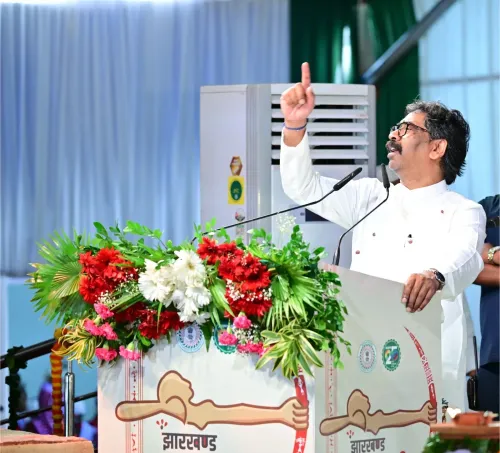
CM Hemant Soren launches student feedback drive on exam reforms

Synopsis
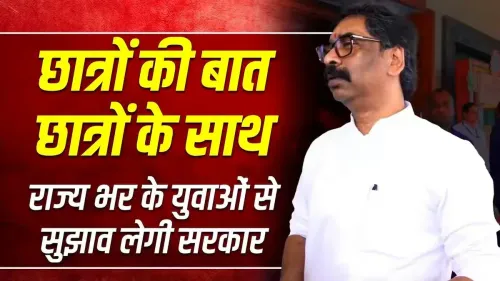
Jharkhand CM Hemant Soren has launched 'Chhatron Ki Baat — Chhatron Ke Saath', a public consultation campaign asking students statewide to submit exam-system suggestions via samvad.jharkhand.gov.in, promising expert review and time-bound implementation as the state marks 25 years of statehood.
Key Takeaways
Hemant Soren launched the 'Chhatron Ki Baat — Chhatron Ke Saath' campaign on 9 August 2026 , inviting Jharkhand students to share examination reform ideas.
Suggestions can be submitted at the official portal samvad.jharkhand.gov.in ; the government has committed to expert review and time-bound implementation.
The Soren government introduced new recruitment rules for the Jharkhand Public Service Commission (JPSC) — the first such overhaul since statehood in November 2000 — along with anti-paper-leak legislation.
The campaign is framed within the 'Jharkhandi First' policy, which prioritises employment opportunities for domicile residents of Jharkhand.
Soren positioned the initiative as a milestone in Jharkhand's 25th year as a state, calling youth the central actors in the next phase of the state's development.
Jharkhand Chief Minister Hemant Soren has thrown open the state's examination reform agenda to its students directly — launching a structured public consultation campaign called 'Chhatron Ki Baat — Chhatron Ke Saath' ('Students' Voice — With Students') on Sunday, 9 August 2026, and asking every aspirant in the state to log their grievances and suggestions on a dedicated government portal.
A portal, a promise, and a pinned post
The campaign is anchored to samvad.jharkhand.gov.in, where students across every district, block, college, university, and coaching centre in Jharkhand are invited to flag gaps in the examination system, share alternative models, document personal experiences, and propose fresh solutions. Soren pledged that every submission will be studied, tested by domain experts, and — where feasible — implemented within a fixed timeline consistent with existing rules and constitutional provisions.
The Chief Minister's message, pinned to his official X account, opens with the traditional Adivasi greeting 'Johar' and frames the exercise not as a government directive but as a shared journey: 'This is not merely the government's journey — it is the collective journey of all of us Jharkhandis.'
Paper leaks, JPSC overhaul, and the law that drew criticism
Soren acknowledged head-on that for years, critical sectors — education, health, social security, commissions, and employment — had not received the institutional strengthening they deserved. His administration, he said, chose to confront those failures rather than look away. The government introduced a revised regulatory framework for the Jharkhand Public Service Commission (JPSC) and other recruitment examinations — the first such overhaul since the state was carved out of Bihar in November 2000.
Alongside it came strict anti-leak legislation designed to protect examination integrity. That law attracted significant political criticism at the time. Soren was direct: 'Our belief was then, and remains today, that the interests of honest students are paramount.' The implicit reference is hard to miss — paper-leak scandals have convulsed competitive examinations across several Indian states in recent years, eroding the trust of millions of government-job aspirants and their families.
'Jharkhandi First' — local youth, local opportunity
The campaign sits within a wider policy frame the Soren government calls 'Jharkhandi First' — a commitment to expanding and protecting employment opportunities for domicile residents of the state. Soren reiterated that appointment processes have already been restructured with that goal in mind, and that the consultation exercise will feed directly into further reforms.
As Jharkhand marks 25 years of statehood, the Chief Minister cast the moment as a generational inflection point: the youth, he said, will be the most important actors in making this next chapter count. He invoked the state's collective resilience during the COVID-19 pandemic as proof that Jharkhandis can solve hard problems together — and argued that examination reform is the next test of exactly that spirit.
What students are being asked to do
The four specific asks are concrete: identify visible flaws in the examination system; share models of better practice; document problems faced personally; and propose new solutions. The government has committed to a review process with a defined deadline — not an open-ended inbox. That specificity matters. Vague consultation exercises are a familiar political ritual in India; Soren's framing of expert review plus time-bound implementation is a measurable commitment that students and opposition alike will be watching.
The portal address — samvad.jharkhand.gov.in — is live. Whether the suggestions that flow in reshape JPSC rules in any meaningful way will be the real test of whether 'Chhatron Ki Baat' becomes policy or just a pinned post.
Point of View
He is trying to convert a governance vulnerability (the credibility of competitive examinations) into a participatory reform narrative. The 'Jharkhandi First' framing also signals that domicile-preference in public employment will remain a live electoral theme ahead of future state contests. Whether the samvad portal generates actionable policy or serves primarily as a sentiment-management exercise will define how this initiative is remembered.
NationPress
9 Aug 2026
Frequently Asked Questions
What is the 'Chhatron Ki Baat — Chhatron Ke Saath' campaign in Jharkhand?
It is a government-led public consultation initiative launched by Chief Minister Hemant Soren on 9 August 2026, inviting students across Jharkhand to submit suggestions on improving the state's examination and recruitment systems via the portal samvad.jharkhand.gov.in.
How can Jharkhand students submit suggestions for exam reform?
Students can log their feedback, grievances, and proposed solutions directly on the official portal at samvad.jharkhand.gov.in. The government has said all submissions will be reviewed by experts and implemented within a defined timeline where feasible.
What changes has the Soren government already made to JPSC and exam rules?
The government introduced a revised regulatory framework for the Jharkhand Public Service Commission (JPSC) and other recruitment examinations — described as the first such overhaul since the state's formation in 2000 — along with strict anti-paper-leak legislation.
What is 'Jharkhandi First' and how does it relate to this campaign?
'Jharkhandi First' is a state government policy that prioritises employment and opportunities for domicile residents of Jharkhand. The student consultation campaign is framed as part of this broader commitment to expand local youth employment.
Why is Jharkhand focusing on examination reform in 2026?
Paper-leak scandals and delays in competitive examinations have become a nationwide problem in India, eroding trust among government-job aspirants. As Jharkhand marks 25 years of statehood, CM Soren has positioned the state as a potential model for transparent, technology-enabled exam governance.