CM Hemant Soren pays tribute to Birsa Munda on 151st birth anniversary
Synopsis
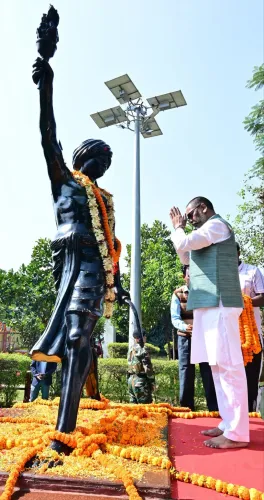
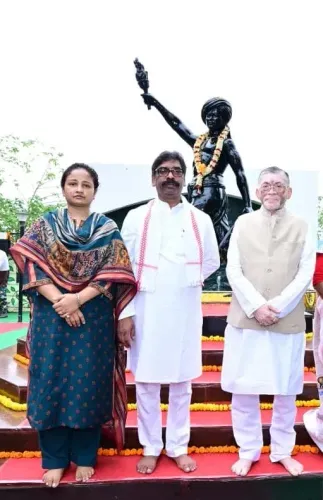
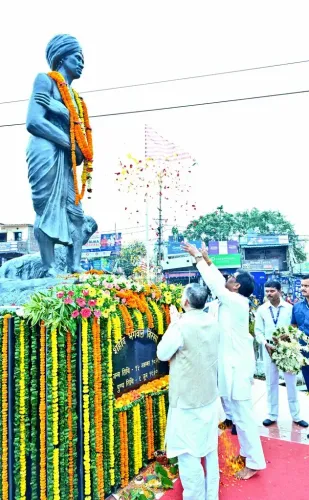
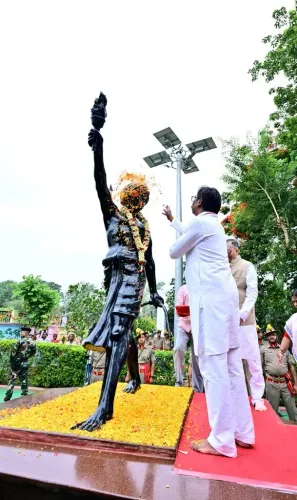
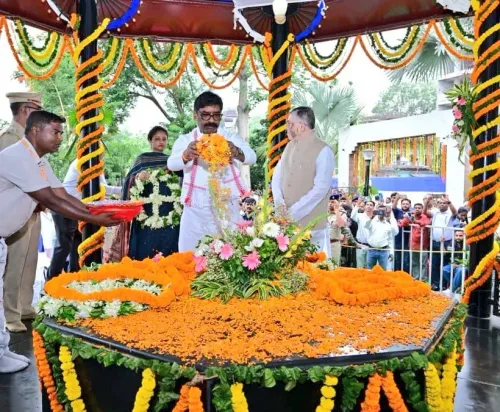
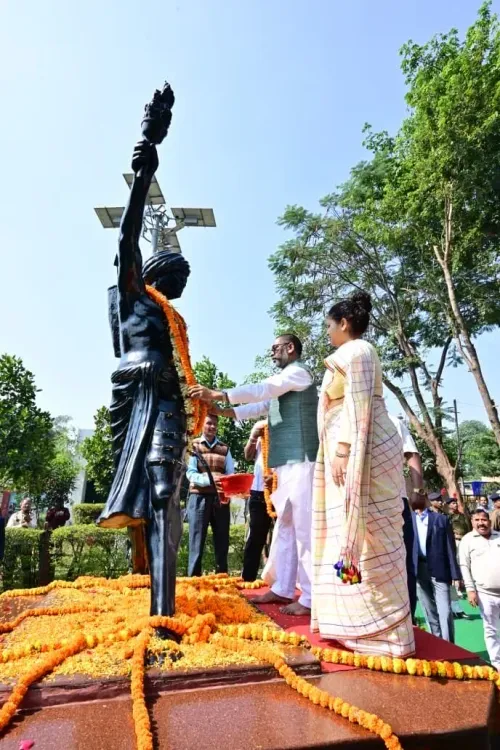
On Birsa Munda's 151st birth anniversary, Jharkhand CM Hemant Soren and wife Kalpana Soren offered a wreath at the Kokar samadhi sthal in Ranchi, renewing a pledge to protect jal, jungle and zameen in the tribal icon's name.
Key Takeaways
Hemant Soren and Kalpana Soren paid floral tribute at Birsa Munda's samadhi sthal in Kokar, Ranchi on 15 November 2026 .
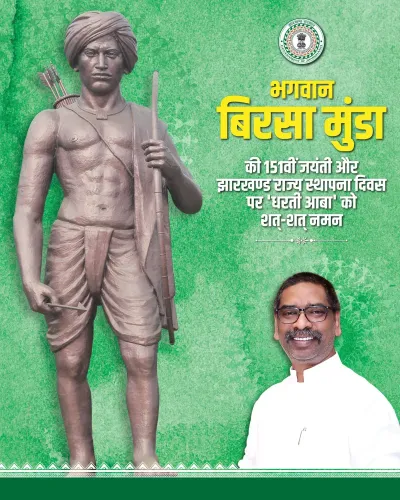
The occasion marks the 151st birth anniversary of Bhagwan Birsa Munda , the 19th-century tribal leader who led the ulgulan rebellion in the Chota Nagpur region.
Soren described Birsa Munda as 'the soul of Jharkhand, the symbol of our identity and self-respect,' not merely a historical figure.
The CM renewed his personal resolve to protect jal, jungle aur zameen — water, forests, and land — consistent with Birsa Munda's core demand.
Jharkhand was itself founded on November 15, 2000 — Birsa Munda's birth date — making the anniversary doubly significant for the state.
The tribute reflects the JMM 's sustained political identity built around tribal rights and the symbolism of Birsa Munda's legacy.
At the samadhi sthal in Kokar, Ranchi, Jharkhand Chief Minister Hemant Soren knelt before the memory of a man who defied an empire — laying a wreath on Sunday, November 15, 2026, to mark the 151st birth anniversary of Bhagwan Birsa Munda, accompanied by his wife and JMM leader Kalpana Soren.
Posting on X in Hindi, the Chief Minister called Birsa Munda not merely a 'great hero of our history' but 'Jharkhand ki aatma, hamari asmita aur swabhimaan ke prateek' — 'the soul of Jharkhand, the symbol of our identity and self-respect.' He pledged that the tribal icon's sacrifice would inspire generations, and renewed his personal resolve to protect jal, jungle aur zameen — the water, forests, and land — for which Birsa Munda gave everything.
Who was Birsa Munda — and why November 15 carries such weight
Birsa Munda, born on November 15, 1875, led the ulgulan — the great rebellion — of the Munda tribal community against British colonial land exploitation in the Chota Nagpur plateau. He rallied his people against the extraction of forests and dispossession of ancestral lands, articulating a vision of self-rule that resonated far beyond his short life. He died in British custody in 1900, aged just 25, and was accorded the honorific 'Dhartee Aaba' — Father of the Earth — by his community.
The date of his birth became foundational to Jharkhand itself: the state was carved out of Bihar on November 15, 2000, precisely to honour his legacy. Every anniversary since has been a moment of official commemoration, and the Kokar samadhi sthal in Ranchi is the symbolic heart of that observance.
Soren's vow: protecting land, forests, and water
In his post, Soren did not announce a new scheme or policy. Instead, he framed the anniversary as a moment of moral reckoning. 'Whenever I remember Dhartee Aaba,' he wrote, 'one resolve only grows stronger in my mind — to protect the jal, jungle and zameen for which he sacrificed everything, and to build the Jharkhand of his dreams, is our greatest responsibility.'
The Jharkhand Mukti Morcha, which Soren leads as executive president, has long drawn its political identity from this very language. For a state where Scheduled Tribe communities form a decisive electoral bloc, tributes to Birsa Munda are not merely ceremonial — they are a living assertion of the party's claim to represent the original spirit of Jharkhand's creation. Soren closed with the phrase 'shat-shat naman' — a hundredfold salutation.
That salutation, offered at a samadhi stone in Ranchi, carried a message that stretches from a 19th-century forest rebellion all the way to the contested resource politics of modern Jharkhand. The land question Birsa Munda died for has never really gone away.
Point of View
Which built its founding mandate on tribal rights. For Hemant Soren, personally renewing the pledge of jal-jungle-zameen on the 151st anniversary keeps that mandate visible in a state where land and forest rights remain live and contested issues. The choice of the Kokar samadhi sthal — not a rally stage — signals solemnity over spectacle. As tribal land questions grow increasingly complex in a resource-rich state, the symbolism of Birsa Munda is likely to intensify rather than fade in the years ahead.
NationPress
15 Nov 2026
Frequently Asked Questions
Who is Birsa Munda and why is he important to Jharkhand?
Birsa Munda was a 19th-century tribal leader from the Chota Nagpur region who led the Munda ulgulan rebellion against British colonial land exploitation. He is revered as 'Dhartee Aaba' — Father of the Earth — and Jharkhand was founded on his birth date, November 15, 2000, in direct tribute to his legacy.
Where did CM Hemant Soren pay tribute to Birsa Munda on November 15, 2026?
CM Hemant Soren and his wife Kalpana Soren offered a wreath at Birsa Munda's samadhi sthal located in Kokar, Ranchi, on the 151st birth anniversary of the tribal icon.
What is the significance of November 15 for Jharkhand?
November 15 is doubly significant for Jharkhand: it is both the birth anniversary of Bhagwan Birsa Munda and the founding day of the state of Jharkhand, which was carved out of Bihar on November 15, 2000, in his honour.
What did Hemant Soren say about Birsa Munda's legacy?
Soren called Birsa Munda 'the soul of Jharkhand, the symbol of our identity and self-respect,' and pledged that protecting jal, jungle and zameen — the water, forests, and land Birsa Munda fought for — remains the government's greatest responsibility.
What is jal jungle zameen and why is it associated with Birsa Munda?
Jal, jungle, zameen — meaning water, forests, and land — was the central demand of tribal resistance movements led by Birsa Munda against colonial-era dispossession. The phrase remains a rallying cry for tribal rights in Jharkhand and is closely linked to the JMM's political platform.