CM Himanta Accuses Opposition of Weakening Democratic Institutions
Synopsis
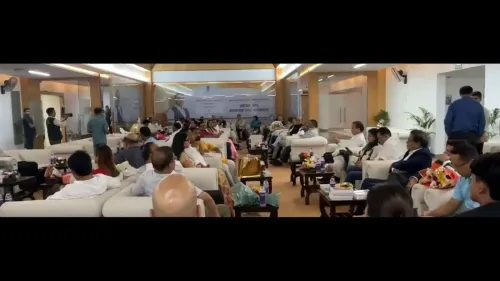
Assam Chief Minister and NEDA convenor Himanta Biswa Sarma accused the Opposition of deliberately undermining India's democratic institutions during a media address in Delhi on September 27, intensifying a recurring BJP charge ahead of an already polarised political season.
Key Takeaways
Assam Chief Minister Himanta Biswa Sarma addressed the media in Delhi on September 27, 2026 .
He accused the Opposition of being 'intent on eroding the very institutions that make India's democracy strong.' No specific party or incident was named in the statement.
As NEDA convenor , Sarma represents the BJP's strategic leadership across India's eight North-Eastern states .
BJP leaders have repeatedly used institutional-integrity arguments against opposition parties, especially around election and parliamentary cycles.
Opposition rebuttals and any follow-up specifics from BJP leaders are expected to shape the next phase of this debate.
A direct charge landed in the capital on Sunday, September 27: Assam Chief Minister Himanta Biswa Sarma told the media in Delhi that the Opposition is 'intent on eroding the very institutions that make India's democracy strong' — a pointed accusation that frames the ruling alliance's sharpest political argument ahead of an already charged national political climate.
The Charge and What It Signals
Speaking directly to reporters, Sarma did not name a specific party or incident, but the language was deliberate. Accusing the Opposition of 'eroding institutions' places the debate squarely in the arena of constitutional bodies — bodies such as the judiciary, the Election Commission, and Parliament itself — whose independence sits at the heart of India's democratic framework. The framing is not accidental: it positions the BJP as a defender of the republic's architecture, and the Opposition as a force working against it.
This is familiar terrain. BJP leaders have, over successive political cycles, returned to this line of attack, particularly when tensions around parliamentary sessions or election cycles run high. What gives Sarma's intervention its particular weight is his platform: as Chief Minister of Assam and convenor of the North-East Democratic Alliance (NEDA), he speaks not just for a single state but as the BJP's strategic anchor across an entire region of eight states.
Why Sarma's Voice Carries Regional Weight
Sarma has carved a distinct national profile within the BJP — one that goes beyond Assam's borders. As NEDA convenor, he has been instrumental in expanding the BJP's footprint across India's North-East, a region that once leaned heavily toward the Congress. His media appearances in Delhi routinely carry dual significance: they address the national conversation while reinforcing his standing as a key BJP voice on governance and political strategy.
The Opposition, for its part, has consistently countered such charges by arguing that it is the ruling establishment — not the opposition benches — that has pressured constitutional institutions. That counter-narrative is certain to sharpen in response to Sarma's latest salvo.
What Comes Next
The political community will now watch for two things: a formal rebuttal from major opposition parties, and whether Sarma or other BJP leaders follow this statement with specifics — naming institutions, incidents, or legislation they claim is being targeted. A broad accusation without particulars invites scrutiny; a detailed charge invites a prolonged battle. Either way, the terms of the debate have been set.
India's democratic institutions have never been a neutral subject in partisan politics — but when a leader of Sarma's regional stature puts them at the centre of a national press interaction, the argument is clearly going somewhere.
Point of View
Sarma underscores his national ambitions and his role as a trusted BJP communicator beyond the North-East. The absence of specifics, however, is a double-edged choice: it keeps the charge broad enough to land emotionally, but also leaves it open to dismissal as a routine partisan attack without new substance. The political temperature will be set by whether the Opposition's response generates a counter-narrative forceful enough to shift the framing.
NationPress
27 Sept 2026
Frequently Asked Questions
What did Himanta Biswa Sarma say about the Opposition?
Assam Chief Minister Himanta Biswa Sarma said the Opposition 'appears intent on eroding the very institutions that make India's democracy strong,' during a media address in Delhi on September 27, 2026.
Where did Himanta Biswa Sarma make this statement?
He made the statement while speaking to the media in Delhi.
Which institutions is the BJP saying the Opposition is targeting?
Sarma did not specify particular institutions in the post, but BJP leaders have historically referred to bodies such as the judiciary and the Election Commission when making such charges.
What is NEDA and what is Himanta Sarma's role in it?
NEDA stands for the North-East Democratic Alliance. Himanta Biswa Sarma is its convenor and has used the platform to expand the BJP's political presence across India's eight North-Eastern states.
Has the BJP made similar accusations against the Opposition before?
Yes. BJP leaders have recurrently accused opposition parties of undermining constitutional bodies, with such statements typically intensifying around parliamentary sessions and election periods.