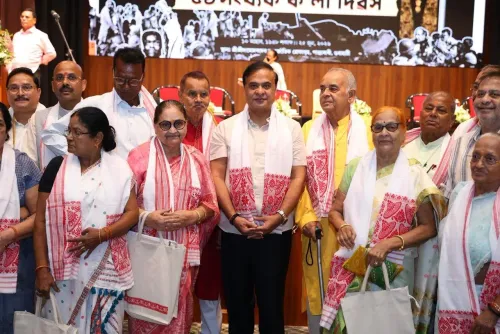
CM Himanta addresses media after Nalbari Sanskrit University convocation
Synopsis
Chief Minister Himanta Biswa Sarma addressed the media after the 3rd Convocation of Kumar Bhaskar Varma Sanskrit and Ancient Studies University in Nalbari on November 15, 2026, spotlighting Assam's continuing investment in classical learning and Sanskrit scholarship.
Key Takeaways
Himanta Biswa Sarma addressed the media following the 3rd Convocation of Kumar Bhaskar Varma Sanskrit and Ancient Studies University.
The university is located in Nalbari, Assam , and is dedicated exclusively to Sanskrit language and ancient Indian studies.
The institution is named after the celebrated early-medieval Kamarupa king Kumar Bhaskar Varma , reflecting Assam's deep Sanskritic heritage.
Reaching a third convocation signals the university has now graduated multiple cohorts of classical scholars.
CM Himanta has been Assam's Chief Minister since May 2021 and regularly engages with state universities as part of his governance approach.
At Nalbari on Sunday, November 15, 2026, Chief Minister Dr. Himanta Biswa Sarma stepped before the press after presiding over the 3rd Convocation of Kumar Bhaskar Varma Sanskrit and Ancient Studies University — a state institution that sits at the intersection of Assam's higher-education ambitions and India's broader revival of classical learning.
A university built around classical scholarship in Assam
Kumar Bhaskar Varma Sanskrit and Ancient Studies University, named after the celebrated early-medieval king of the Varman dynasty of Kamarupa, is Nalbari's most distinctive academic institution. Established by the Assam government, it focuses exclusively on Sanskrit language, literature, and the broader universe of ancient Indian knowledge systems — a mandate that sets it apart from the state's mainstream university network.
Reaching its third convocation marks a moment of institutional consolidation. It signals that the university has now graduated at least three cohorts of scholars trained in a discipline India has historically struggled to mainstream within modern higher education.
Himanta's presence and what it signals for state policy
CM Himanta Biswa Sarma, who has been Assam's Chief Minister since May 2021, has made regular engagement with state universities a visible part of his governance style. His appearance at this convocation — and the subsequent media address — underlines the state government's intent to treat Sanskrit and ancient studies as a legitimate pillar of Assam's higher education architecture, not a ceremonial footnote.
The post-convocation media interaction is itself significant. It transforms a graduation ceremony into a policy moment, giving the Chief Minister's Office a platform to articulate — on record — the government's vision for traditional learning in a northeastern state that is also navigating rapid modernisation.
Sanskrit education and the northeast's cultural stakes
Assam's investment in a dedicated Sanskrit university carries particular resonance in the northeast, a region whose ancient links to Sanskritic civilisation — through kingdoms like Kamarupa — are well-documented but often underrepresented in national academic discourse. Nalbari district, which hosts the university, benefits from both the institutional presence and the academic footfall it draws.
For students and Sanskrit scholars graduating from this university, today's convocation is a credential in a niche but growing field — one that intersects with archaeology, linguistics, manuscript studies, and classical philosophy. The road for these graduates runs through a labour market that is slowly, unevenly, beginning to recognise their training.
Point of View
A state with deep but underacknowledged Sanskritic roots through the Kamarupa kingdom, this university represents both a cultural assertion and a higher-education diversification play. The post-convocation media address elevates a graduation ceremony into a governance statement, allowing the Chief Minister to frame traditional scholarship as modern state policy. Watchers of northeast India's education landscape will track whether budget allocations and faculty recruitment follow the optics.
NationPress
15 Nov 2026
Frequently Asked Questions
What is Kumar Bhaskar Varma Sanskrit and Ancient Studies University?
Kumar Bhaskar Varma Sanskrit and Ancient Studies University is a state university in Nalbari, Assam, established by the Assam government and dedicated exclusively to Sanskrit language, literature, and ancient Indian knowledge systems.
Where is Kumar Bhaskar Varma Sanskrit University located?
The university is located in Nalbari district, Assam, in northeast India.
Who is CM Himanta Biswa Sarma?
Dr. Himanta Biswa Sarma is the Chief Minister of Assam, serving in that role since May 2021. He is a prominent BJP leader and regularly participates in state university events.
What was the significance of the 3rd Convocation of the Sanskrit University?
The 3rd Convocation marks the graduation of at least three successive cohorts of scholars trained in Sanskrit and ancient studies, signalling the university's growing institutional maturity.
Why does Assam have a university dedicated to Sanskrit?
Assam has historical ties to Sanskritic civilisation through the ancient Kamarupa kingdom, and the state government established the university to preserve and develop classical learning alongside mainstream higher education.