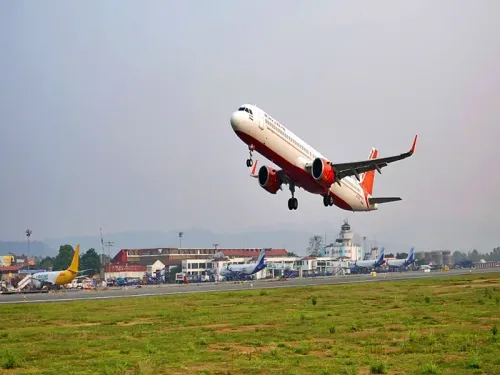
CM Himanta Announces Guwahati–Dubai, Abu Dhabi Flights from Aug 4

Synopsis
Assam Chief Minister Himanta Biswa Sarma announced on 22 June 2026 that Air India will operate direct flights from Guwahati to Dubai and Abu Dhabi starting 4 August, days after EU member states lifted their travel advisory for the state — a dual milestone for Northeast India's global integration.
Key Takeaways
Air India will commence direct flights from Guwahati to Dubai and Abu Dhabi starting 4 August 2026 .
The announcement was made by Assam Chief Minister Himanta Biswa Sarma on 22 June 2026 .
EU member states lifted their travel advisory for Assam just days before the aviation announcement.
The new routes eliminate the need for Northeast travellers to transit through Delhi , Mumbai , or Kolkata to reach the Gulf.
The development aligns with India's Act East Policy and the UDAN scheme's goal of integrating the Northeast into global networks.
Guwahati serves as the primary aviation hub for all eight Northeastern states, amplifying the regional impact.
Assam Chief Minister Himanta Biswa Sarma announced on Monday, 22 June 2026 that Air India will launch direct flights connecting Guwahati to Dubai and Abu Dhabi starting 4 August 2026, marking a significant step in the state's push for international connectivity. The announcement came just days after European Union member states lifted their travel advisory for Assam, signalling a broader shift in the state's global standing.
Context
In his post, CM Sarma described the development as 'opening new avenues to connect Assam to the global community,' linking the new Gulf routes to the recent lifting of the EU travel advisory. The back-to-back developments — a diplomatic signal from Europe followed by a commercial aviation announcement — frame Guwahati as an emerging international gateway for Northeast India. The non-stop flights will be operated by Air India, India's national flag carrier, which has been steadily expanding its footprint in the Northeast.
Policy Backdrop
The new routes sit within a long arc of policy effort to end the Northeast's geographic and economic isolation. India's Act East Policy, upgraded in 2014, explicitly prioritised infrastructure and connectivity links between the Northeast and destinations across Southeast Asia and the Middle East. The UDAN regional connectivity scheme, launched in 2017, expanded air access within the Northeast on domestic routes, and state-level aviation and tourism summits held between 2021 and 2024 focused on attracting direct international services and persuading foreign governments to lift security-related travel advisories.
The Gulf corridor is particularly significant because Dubai and Abu Dhabi serve as major hubs for the Indian diaspora, tourism, and commerce. Direct connectivity removes the need for travellers from Assam and the broader Northeast to transit through Delhi, Mumbai, or Kolkata, reducing both travel time and cost.
Stakeholders and Impact
The primary beneficiaries are Assam's tourism sector, business travellers, and the large number of residents who maintain ties with the Indian diaspora in the UAE. For the tourism industry, the combination of a lifted EU advisory and new Gulf routes could translate into a meaningful uptick in inbound visitors and investment inquiries. Air India stands to capture a previously underserved market segment: travellers from the Northeast who have historically faced multi-leg journeys to reach the Gulf.
Broader regional implications are also significant. Guwahati, as the primary aviation hub for all eight Northeastern states, means that residents of Meghalaya, Nagaland, Manipur, and neighbouring states will also benefit from the new international access point. This aligns with CM Sarma's role as convenor of the North-East Democratic Alliance (NEDA), which coordinates development priorities across the region.
What's Next
Attention will now turn to passenger load factors on the new routes once services begin in August, which will determine whether further frequency increases or additional Middle Eastern destinations follow. Analysts and tourism stakeholders will also watch for state budget allocations directed at tourism infrastructure, given that lifted advisories and new air routes must be matched by on-ground capacity to convert interest into sustained growth. Any follow-on announcements regarding Southeast Asian destinations from Guwahati would further cement the city's ambition to become a genuine international aviation node for the Northeast.
Point of View
The timing allows him to present Assam not merely as a recipient of central government connectivity schemes but as an active player in attracting global aviation interest. The Gulf corridor is strategically chosen: diaspora ties and trade flows with the UAE are among the most economically dense for any Indian state, and direct access from Guwahati converts latent demand into a viable commercial proposition. Whether this momentum translates into sustained tourism and investment growth will depend on how quickly the state's ground infrastructure catches up with its new air links.
NationPress
22 Jun 2026
Frequently Asked Questions
When will Air India start flights from Guwahati to Dubai and Abu Dhabi?
Air India is scheduled to commence direct flights from Guwahati to Dubai and Abu Dhabi from 4 August 2026 , as announced by Assam Chief Minister Himanta Biswa Sarma.
Why did the EU lift its travel advisory for Assam?
The specific reasons cited by EU member states for lifting the Assam travel advisory have not been detailed in the announcement; the lifting was referenced by CM Sarma as a positive development preceding the Air India flight announcement.
What is the significance of direct Guwahati–Dubai flights for Northeast India?
Direct flights from Guwahati eliminate the need for travellers from the Northeast to transit through major metros like Delhi or Mumbai , reducing travel time and costs while opening the region to Gulf tourism, trade, and diaspora connectivity.
How does this relate to India's Act East Policy?
India's Act East Policy , upgraded in 2014 , prioritised connectivity between the Northeast and international destinations including the Middle East; the new Gulf routes from Guwahati directly advance that goal.
Which other Northeastern states benefit from the Guwahati–Gulf flights?
Since Guwahati is the primary international aviation hub for all eight Northeastern states, residents of states including Meghalaya , Nagaland , and Manipur will also gain easier access to Dubai and Abu Dhabi .