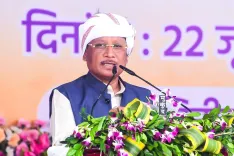
CM Himanta Hails Assam's Shift from Insurgency to Semiconductor Hub

Synopsis
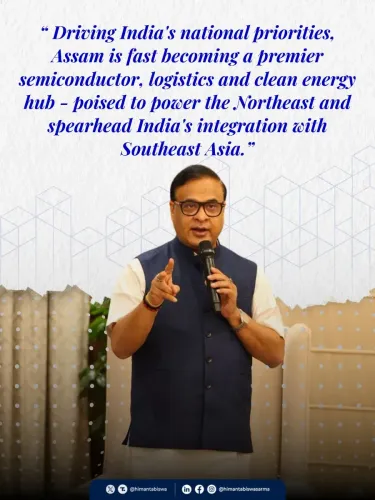
At the Republic Summit 2026, Assam Chief Minister Himanta Biswa Sarma declared that the state has transformed from an insurgency-affected region into an emerging semiconductor hub, calling it India's fastest-growing state now attracting global investment interest.
Key Takeaways
CM Himanta Biswa Sarma addressed the Republic Summit 2026 on 22 June 2026 , highlighting Assam's decade-long economic transformation.
He described Assam's journey 'from insurgency to an upcoming semiconductor hub,' framing it as a model of governance-driven change.
The semiconductor push aligns with the Central government's India Semiconductor Mission , launched in 2021 .
Assam's improved security environment — linked to the winding down of ULFA insurgency — is cited as a key enabler of investor confidence.
The Act East Policy provides strategic backing for positioning the Northeast as an industrial and trade corridor.
Specific investors, facility locations, and timelines for the semiconductor hub have not yet been officially confirmed.
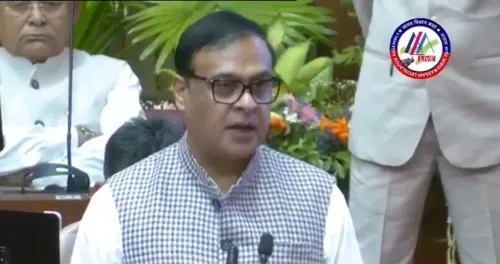
Assam Chief Minister Himanta Biswa Sarma on Monday, 22 June 2026, declared that the state has undergone a decade-long transformation — from a region defined by armed insurgency to an emerging destination for high-technology investment, including a forthcoming semiconductor hub. He made the remarks at the Republic Summit 2026, positioning Assam as India's fastest-growing state attracting global attention.
Context
Speaking at the summit, CM Sarma stated: 'From insurgency to an upcoming semiconductor hub, this is the transformation of Assam over the last decade. Today, we are the fastest-growing state in India and attracting global attention.' The remarks encapsulate a narrative the Assam government has been building since 2021, when Sarma assumed office, around converting improved security conditions into industrial momentum.
For decades, Assam was associated with the activities of the United Liberation Front of Asom (ULFA), whose prolonged insurgency suppressed investor confidence and limited economic activity in the state. A sustained peace process and improved law-and-order conditions have since altered that perception significantly.
Policy Backdrop
The semiconductor ambition referenced by CM Sarma aligns with the Central government's India Semiconductor Mission, approved in 2021, which aims to build domestic fabrication units and an electronics manufacturing ecosystem. The Mission is part of a broader push for supply-chain self-reliance and reducing dependence on single-country imports for critical components.
Assam's industrial pivot also draws from the Act East Policy, which frames the Northeast as a gateway to Southeast Asian markets. The Assam Accord of 1985 had earlier provided a political framework for addressing core grievances, and the relative stability that followed has been cited as a precondition for the current wave of investment interest.
Multiple northeastern states have reported higher capital investment inflows in recent years, a pattern consistent with the region's integration into national industrial corridors after decades of limited activity.
Stakeholders and Impact
Assam's youth stand to be the most direct beneficiaries if semiconductor assembly or fabrication proposals materialise, given the sector's demand for skilled technical labour. Electronics investors — both domestic and global — are watching the state's infrastructure readiness and policy incentives closely.
For the broader Northeast, a successful semiconductor project in Assam would mark a symbolic and economic milestone, signalling that the region can compete for high-value manufacturing mandates alongside established industrial states. CM Sarma's role as convenor of the North-East Democratic Alliance (NEDA) also gives such announcements a regional political dimension, reinforcing the BJP's governance narrative across allied northeastern governments.
What's Next
Concrete progress — including the identity of investors, the proposed location of any semiconductor facility, and the timeline for commissioning — remains to be officially announced. The Republic Summit 2026 is expected to serve as a platform for further disclosures on investment commitments to Assam.
If semiconductor proposals advance to ground-breaking stage, Assam would become one of the few non-coastal, non-metro states to anchor a significant slice of India's chip-manufacturing ambitions — a development that could redefine the state's economic identity for the coming generation.
Point of View
Even as ground-level project details remain unannounced. For the BJP, showcasing Assam's transformation serves a dual purpose: validating its governance record in the Northeast and reinforcing NEDA's cohesion ahead of future electoral cycles. The broader pattern of northeastern states competing for industrial mandates suggests this is as much about regional positioning as it is about any single investment announcement.
NationPress
22 Jun 2026
Frequently Asked Questions
What did Assam CM Himanta Biswa Sarma say at Republic Summit 2026?
CM Himanta Biswa Sarma said Assam has transformed 'from insurgency to an upcoming semiconductor hub' over the last decade and called it India's fastest-growing state attracting global attention.
Is Assam getting a semiconductor factory?
CM Sarma has referred to an 'upcoming semiconductor hub' in Assam, but specific details about investors, location, and timelines for a fabrication or assembly facility have not yet been officially confirmed.
What is the India Semiconductor Mission and how does it relate to Assam?
The India Semiconductor Mission, approved in 2021, is a Central government scheme to build domestic chip manufacturing capacity. Assam's semiconductor ambitions are being positioned within this national framework.
How has Assam changed from its insurgency days?
A sustained peace process involving the United Liberation Front of Asom (ULFA) and improved law-and-order conditions have significantly boosted investor confidence in Assam, enabling a shift toward industrial and technology investment.
What is the Act East Policy and its role in Assam's growth?
India's Act East Policy frames the Northeast as a strategic gateway to Southeast Asian markets, providing policy backing for infrastructure and industrial investment in states like Assam.