CM Nitish Reaffirms Bihar-Centre Push to Boost Farmer Income

Synopsis
Bihar Chief Minister Nitish Kumar on 22 June 2026 reaffirmed that the central and state governments are jointly working to raise farmer incomes, make agriculture sustainable, and guarantee disaster compensation — reflecting Bihar's long-standing vulnerability to floods and the state's reliance on flagship central schemes like PM-KISAN and PMFBY.
Key Takeaways
The Chief Minister's Office of Bihar shared CM Nitish Kumar's remarks on 22 June 2026 emphasising joint central-state action on farmer welfare.
The statement covers three priorities: raising farmer income, making agriculture sustainable, and compensating for natural-disaster losses.
Key central schemes underpinning these goals include PM-KISAN (launched 2019 ) and Pradhan Mantri Fasal Bima Yojana (launched 2016 ).
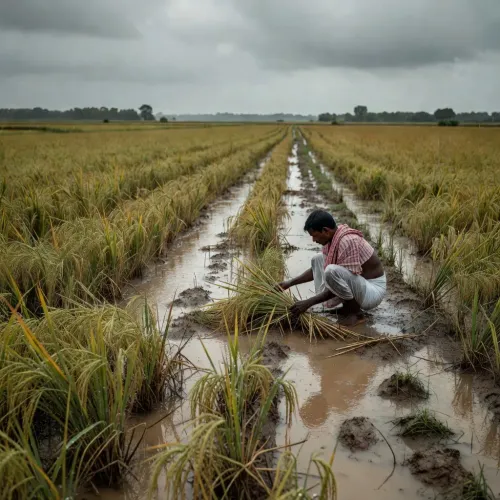
Bihar is among India's most flood-prone states, making disaster compensation a recurring and critical policy focus.
The remarks align with the central government's 2016 target to double farmers' income through coordinated central-state interventions.
The statement sets a political benchmark ahead of the kharif sowing season when disaster-relief mechanisms face their most immediate test.
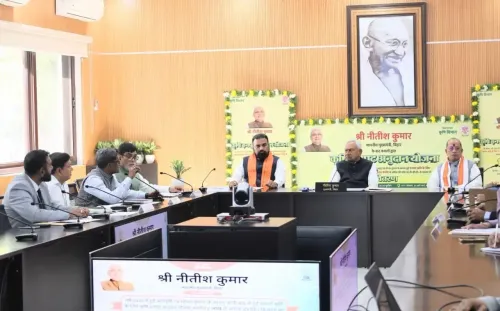
The Chief Minister's Office of Bihar on Monday, 22 June 2026 shared remarks by Chief Minister Nitish Kumar reaffirming that the central and state governments are working together to raise farmers' incomes, make agriculture more secure and sustainable, and ensure compensation for losses caused by natural disasters.
The post, shared from the official @officecmbihar handle, quoted the Chief Minister as saying: 'Kendra evam rajya sarkarein milkar kisanon ki aay badhane, krishi ko adhik surakshit, samriddh evam tikau banane tatha prakritik aapdaon se hone wale nuksan ki bharpayi sunishchit karne ke liye nirantar karya kar rahi hain' — 'The central and state governments are continuously working together to increase farmers' income, make agriculture more secure, prosperous and sustainable, and ensure compensation for losses caused by natural disasters.'
Context
Bihar is one of India's most agriculturally vulnerable states, regularly exposed to both flooding from the Kosi, Gandak and other rivers and to drought in its southern districts. The statement reflects a long-standing political and administrative priority for the state government, which has consistently framed agricultural welfare as a joint responsibility shared between Patna and New Delhi. Chief Minister Nitish Kumar, who has led the state since 2005, has repeatedly positioned farmer income and disaster relief at the centre of his governance agenda.
Policy Backdrop
The remarks align with two flagship central schemes that form the backbone of India's agricultural welfare architecture. The Pradhan Mantri Kisan Samman Nidhi (PM-KISAN), launched in 2019, provides direct income support through annual cash transfers to eligible farmer families across the country. The Pradhan Mantri Fasal Bima Yojana (PMFBY), rolled out in 2016, offers crop insurance cover against losses from natural calamities including floods, drought, and unseasonal rainfall.
These schemes were introduced in the broader context of a central government target — announced in 2016 — to double farmers' income. Bihar has participated in both programmes, with state co-contribution to the insurance premium and supplementary state-level relief mechanisms running alongside the central architecture. Policy emphasis in recent years has also shifted toward climate-resilient and sustainable farming practices to address long-term vulnerabilities.
Stakeholders and Impact
The primary beneficiaries of the joint government effort are Bihar's farmers, particularly small and marginal cultivators who are most exposed to income volatility and disaster-related crop loss. Bihar has a large agrarian population, and disruptions caused by annual flooding or erratic monsoons can wipe out livelihoods across entire districts in a single season. Coordinated central-state action on insurance claim processing and income transfers is therefore of direct consequence to millions of households.
The statement also carries significance for state officials and district administrations responsible for implementing disaster compensation mechanisms, as it signals continued political backing at the highest level for timely and adequate relief disbursal.
What's Next
Observers will watch for concrete follow-through in Bihar's upcoming budget allocations and in any new joint guidelines issued by the state and central governments on crop insurance claim settlement timelines. With the kharif sowing season underway, the effectiveness of the disaster compensation framework will face a near-term test as farmers plant crops ahead of the monsoon. The Chief Minister's public reaffirmation of this commitment sets a political benchmark against which delivery will be measured in the months ahead.
Point of View
Where agricultural distress and annual flooding make agrarian promises electorally indispensable. The statement fits a broader national pattern in which state governments use high-visibility social media posts to associate themselves with central welfare schemes, sharing credit while also flagging shared responsibility for delivery. For Bihar specifically, the emphasis on natural-disaster compensation is not rhetorical — the state's structural flood vulnerability means that insurance and relief mechanisms are tested every monsoon season. The real measure of this commitment will come in claim settlement speeds under PMFBY and the continuity of PM-KISAN transfers in the months ahead.
NationPress
22 Jun 2026
Frequently Asked Questions
What did Bihar CM Nitish Kumar say about farmers on 22 June 2026?
CM Nitish Kumar stated that the central and state governments are continuously working together to increase farmers' income, make agriculture more secure and sustainable, and ensure compensation for losses caused by natural disasters.
Which central schemes support farmer income and disaster relief in Bihar?
The two main central schemes are PM-KISAN, which provides annual direct income transfers to farmer families since 2019, and Pradhan Mantri Fasal Bima Yojana (PMFBY), a crop insurance programme launched in 2016 that covers losses from floods, drought, and other natural calamities.
Why is natural disaster compensation especially important for Bihar farmers?
Bihar is one of India's most flood-prone states, with rivers like the Kosi and Gandak regularly inundating agricultural land. Annual flooding can destroy entire harvests, making timely disaster compensation critical for millions of small and marginal farming households.
What is the central government's target for doubling farmers' income?
The central government announced a target to double farmers' income in 2016, which triggered the rollout of multiple central and state-level schemes combining direct income support, crop insurance, and sustainable farming initiatives.
How does Bihar's state government work with the centre on farmer welfare?
Bihar co-contributes to crop insurance premiums under PMFBY alongside the central government and runs supplementary state-level relief mechanisms. The state administration also coordinates with the centre on PM-KISAN beneficiary lists and disaster compensation disbursals.