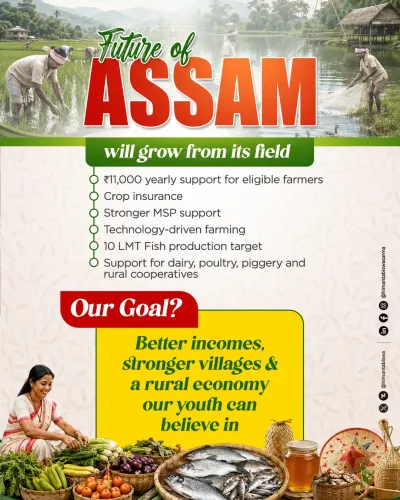
CM Himanta Highlights 1,000 Families' Fisheries Success in Darrang
Synopsis
Assam CM Himanta Biswa Sarma on 14 July 2026 spotlighted around 1,000 families across five villages in Darrang district who have achieved economic and social progress through fish farming, calling it an inspiring example of community resolve and reaffirming state support for such grassroots initiatives.
Key Takeaways
Assam CM Himanta Biswa Sarma posted on 14 July 2026 about a fisheries success story in Darrang district .
Around 1,000 families across five villages in Darrang have reportedly achieved economic and social progress through fish farming.
The CM reaffirmed the state government's commitment to encouraging such community-driven economic initiatives.
The development aligns with the Pradhan Mantri Matsya Sampada Yojana (PMMSY) , the central scheme launched in 2020 to modernise fisheries and support inland fish farmers.
The BJP-led Assam government has promoted fisheries cluster models in rural districts since 2016 as part of its rural income diversification strategy.
Expansion of the Darrang model to other districts may be reflected in upcoming state budget allocations for fisheries infrastructure.
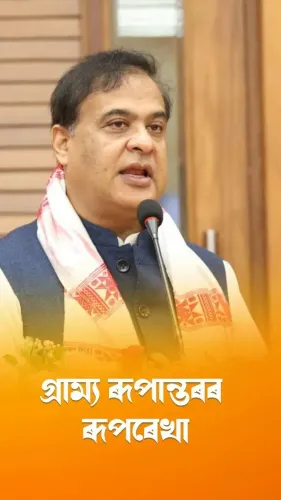
Assam Chief Minister Himanta Biswa Sarma on Tuesday, 14 July 2026, highlighted a grassroots fisheries success story from Darrang district, where around 1,000 families across five villages have reportedly achieved economic and social progress through fish farming. The Chief Minister shared the development on X, calling it an inspiring example of community-driven prosperity and reaffirming the state government's commitment to supporting such initiatives.
In his post, CM Sarma wrote: 'असम के दरंग ज़िले में 5 गांवों के लगभग 1,000 परिवारों ने मत्स्य पालन के माध्यम से आर्थिक समृद्धि और सामाजिक प्रगति का नया उदाहरण प्रस्तुत किया है' — translating to: 'Around 1,000 families in five villages of Assam's Darrang district have set a new example of economic prosperity and social progress through fisheries.' He added that when citizens make such resolve, the nation grows stronger.
Context
Darrang is a central Assam district with a predominantly rural economy, historically reliant on agriculture and small-scale allied activities. The district, like much of rural Assam, has long faced challenges of underemployment and limited income diversification. Fisheries has emerged in recent years as a viable supplementary livelihood for farming households in the Brahmaputra belt.
The Chief Minister's post, accompanied by a video, frames the Darrang cluster as a model of bottom-up economic transformation — one where community resolve, rather than top-down intervention alone, has driven measurable change.
Policy Backdrop
The Pradhan Mantri Matsya Sampada Yojana (PMMSY), launched by the Government of India in 2020, provides the central policy scaffold for this kind of rural fisheries expansion. The scheme is designed to modernise the fisheries sector, increase fish production, and generate rural employment — with inland fish farming in states like Assam being a key focus area.
The BJP-led Assam government, in office since 2016, has consistently promoted fisheries as an allied sector to reduce rural dependence on traditional agriculture. Cluster and self-help group models in districts such as Darrang have been repeatedly cited by the administration as examples of grassroots economic activity aligned with national rural development goals.
Stakeholders and Impact
The primary beneficiaries are the fish-farming households across the five villages in Darrang, whose livelihoods and social standing have reportedly improved through collective fisheries activity. Rural communities in neighbouring districts may also look to this cluster as a replicable model.
For the state government, such stories serve as evidence of the effectiveness of its allied-sector promotion strategy, particularly in constituencies where agricultural distress has historically been a political pressure point. Policymakers and development practitioners working on rural income diversification across the North East are also watching such cluster outcomes closely.
What's Next
Attention will now turn to whether the Assam government scales this model to other districts in the upcoming state budget or legislative session. Allocations for fisheries infrastructure — cold chains, hatcheries, and market linkages — will be a key indicator of how seriously the administration intends to replicate the Darrang experience across the state.
If the cluster model proves replicable, it could inform both state-level policy and the broader implementation of PMMSY in the North East, offering a template for community-led rural economic development beyond Assam's borders.
Point of View
Linking local outcomes to national scheme architecture. Politically, such stories are particularly useful in central Assam constituencies where agricultural distress and unemployment remain live issues ahead of future electoral cycles.
NationPress
13 Oct 2026
Frequently Asked Questions
Which district in Assam has become a fisheries success story?
Darrang district in central Assam has been highlighted by CM Himanta Biswa Sarma, where around 1,000 families across five villages have reportedly achieved economic and social progress through fish farming.
What did Assam CM Himanta Biswa Sarma say about Darrang fisheries?
CM Sarma said the 1,000 families in five Darrang villages have set a new example of economic prosperity and social progress through fisheries, and that the state government will continue to encourage such inspiring efforts.
What is the Pradhan Mantri Matsya Sampada Yojana?
PMMSY is a central government scheme launched in 2020 to modernise the fisheries sector, increase fish production, and generate rural employment, with inland fish farming in states like Assam being a key focus.
How has the Assam government supported fisheries development?
The BJP-led Assam government has since 2016 promoted fisheries as an allied sector to raise rural incomes, supporting cluster and self-help group models in districts such as Darrang aligned with national rural development goals.
Will the Darrang fisheries model be expanded to other Assam districts?
That remains to be seen; observers will watch state budget allocations for fisheries infrastructure in the next assembly session as an indicator of whether the government plans to scale the Darrang model statewide.