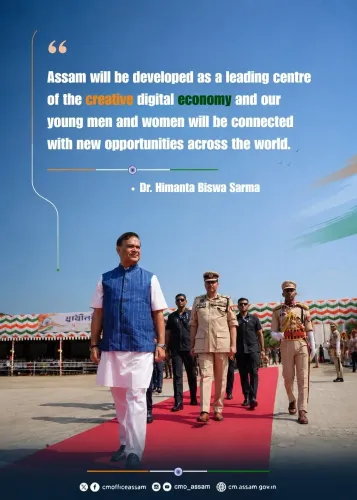
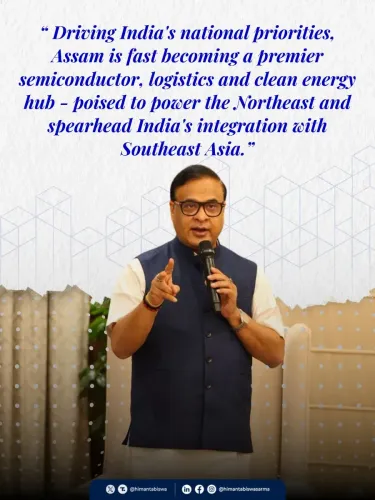
CM Himanta backs India's data centre ambitions
Synopsis
Assam Chief Minister Himanta Biswa Sarma amplified a piece on India's data centre ambitions via the NaMo App on 14 July 2026, backing the national push to move from digital consumer to trusted technology power — a signal with implications for northeastern investment strategy.
Key Takeaways
Assam CM Himanta Biswa Sarma shared an article on India's data centre ambitions via the NaMo App on 14 July 2026 .
The article, published by Organiser , frames India's current moment as a shift from digital consumer to 'trusted technology power.' MeitY released a Draft National Data Centre Policy in 2020 to structure investment and data localisation frameworks.
The push aligns with the Atmanirbhar Bharat agenda, which prioritises domestic capacity in critical digital infrastructure.
As NEDA convenor, Sarma is positioned to direct national technology momentum toward northeastern India , including Assam .
Investors and state IT departments will watch for concrete incentives such as land allocation and power tariff concessions.
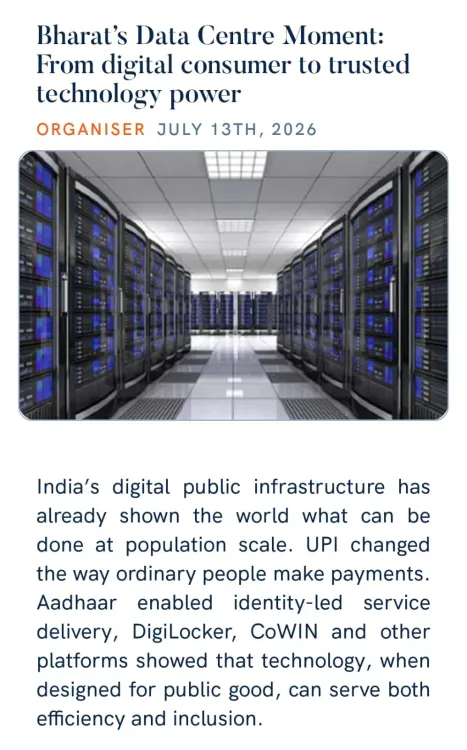
Assam Chief Minister Himanta Biswa Sarma on Tuesday, 14 July 2026, shared an article titled 'Bharat's Data Centre Moment: From digital consumer to trusted technology power,' amplifying the case for India's push to become a global hub for digital infrastructure. The post, shared via the NaMo App, signals the BJP leader's alignment with the national narrative of technology self-reliance.
Context
The article shared by Sarma was published by Organiser, an RSS-affiliated weekly, and frames India's current moment in data infrastructure as a strategic inflection point — a shift from being a passive consumer of global digital services to an active, trusted technology power. By amplifying it through the NaMo App, the platform associated with Prime Minister Narendra Modi, Sarma places the message squarely within the ruling establishment's broader technology agenda.
The phrase 'trusted technology power' carries deliberate weight in the current geopolitical climate, where data sovereignty and supply-chain security have become central to how nations assess digital partnerships. India has repeatedly positioned itself as a reliable alternative to infrastructure concentrated in China or dependent on a narrow set of Western providers.
Policy Backdrop
The push for domestic data centre capacity has deep roots in Indian policy. The Digital India programme, launched in 2015, laid the groundwork for expanding digital infrastructure and reducing dependence on foreign technology platforms. MeitY — the Ministry of Electronics and Information Technology — followed with a Draft National Data Centre Policy in 2020, aimed at creating a structured framework for investment and data localisation.
These efforts sit within the wider Atmanirbhar Bharat framework, which seeks domestic capacity in critical technologies ranging from semiconductors to cloud infrastructure. Data centres are a foundational layer: they determine where data is stored, processed, and governed, making them a matter of both economic and national security interest.
Northeastern states, historically underserved in technology investment, are being integrated into this national strategy. As convenor of the North-East Democratic Alliance (NEDA), Sarma is well-positioned to channel this momentum toward the region's development agenda.
Stakeholders and Impact
The primary stakeholders in India's data centre expansion include state IT departments, domestic and foreign technology investors, cloud service providers, and the communities that stand to gain from infrastructure-linked employment. For Assam specifically, attracting data centre investment would diversify an economy historically anchored in agriculture, tea, and oil.
Technology investors are watching for state-level incentives — land allocation, power tariff concessions, and single-window clearances — that make a location viable for large-scale data centre operations. A political signal from a sitting Chief Minister, particularly one with regional convening authority, can meaningfully influence investor confidence.
What's Next
The immediate question is whether Sarma's endorsement translates into concrete state-level action — announcements of dedicated data centre zones, investment summits, or policy incentives for Assam and other NEDA states. At the national level, any further refinements to MeitY's data centre policy or new production-linked incentive schemes for digital infrastructure would give this political signalling a firmer legislative backbone.
India's ambition to be a 'trusted technology power' will ultimately be measured not by the articles amplified by its leaders, but by the gigawatts of data centre capacity commissioned, the investment commitments secured, and the data governance frameworks enacted.
Point of View
Not merely a regional administrator. For a northeastern state like Assam, which has historically struggled to attract high-value technology investment, this kind of top-level political visibility can be a precursor to policy action. The framing of India as a 'trusted technology power' also feeds into a broader geopolitical pitch that the BJP has been making to Western and Gulf investors wary of China-linked infrastructure. Whether this translates into tangible state-level data centre incentives will be the real test of Sarma's technology ambitions for the region.
NationPress
12 Oct 2026
Frequently Asked Questions
What did Assam CM Himanta Biswa Sarma post about data centres?
On 14 July 2026, Sarma shared an article titled 'Bharat's Data Centre Moment: From digital consumer to trusted technology power' via the NaMo App, backing India's push to become a global digital infrastructure hub.
What is India's national data centre policy?
MeitY released a Draft National Data Centre Policy in 2020 to create a framework for data centre investment and data localisation, building on the Digital India programme launched in 2015.
What is the NaMo App?
The NaMo App is the official digital platform associated with Prime Minister Narendra Modi, used to share news, policy updates, and articles aligned with the ruling establishment's agenda.
How does Assam fit into India's data centre plans?
As a northeastern state and the base of NEDA convenor Himanta Biswa Sarma, Assam is being integrated into national digital infrastructure strategies, with potential for state-level investment incentives in data centres.
What is Atmanirbhar Bharat's role in India's technology push?
Atmanirbhar Bharat is the Indian government's self-reliance framework that emphasises domestic capacity in critical sectors, including digital infrastructure such as data centres, semiconductors, and cloud services.