CM Himanta calls for Geographic Equity in India's growth
Synopsis
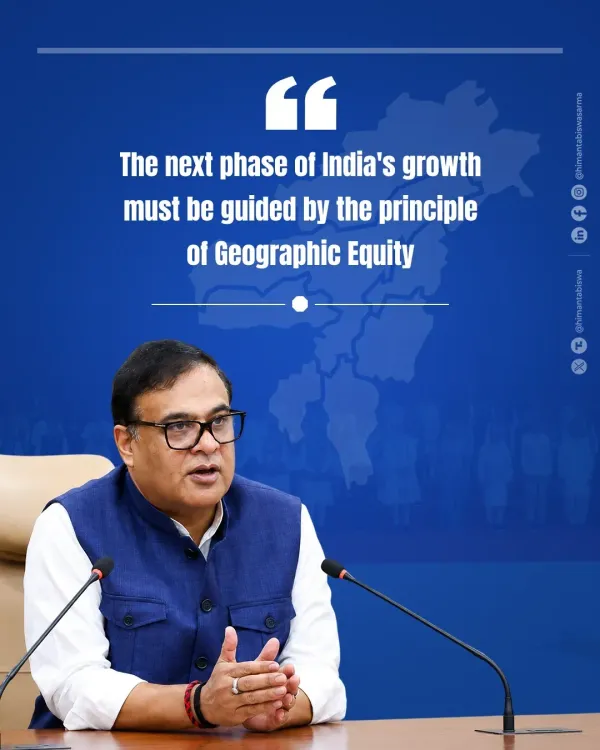
Assam Chief Minister Himanta Biswa Sarma has called for 'Geographic Equity' to guide India's next growth phase, urging balanced and regionally inclusive development as a pillar of the Viksit Bharat vision for 2047. The statement draws on a long policy lineage of Finance Commission transfers and Northeast connectivity drives.
Key Takeaways
Himanta Biswa Sarma on 13 June 2026 called 'Geographic Equity' the guiding principle for India's next growth phase.
He argued growth must be 'balanced, inclusive and regionally equitable' for every part of India to contribute to #ViksitBharat .
The 15th Finance Commission (2020) raised states' share in central taxes to 41 percent , citing the need to reduce regional imbalances.
The Act East Policy (2014) and NITI Aayog's SDG India Index (2018) are among the existing frameworks targeting inter-regional equity.
As NEDA convenor , Sarma speaks for NDA partners across all eight northeastern states , amplifying the political weight of the call.
The phrase will be watched for adoption in future Union Budgets , NITI Aayog reports, and Northeast infrastructure policy.
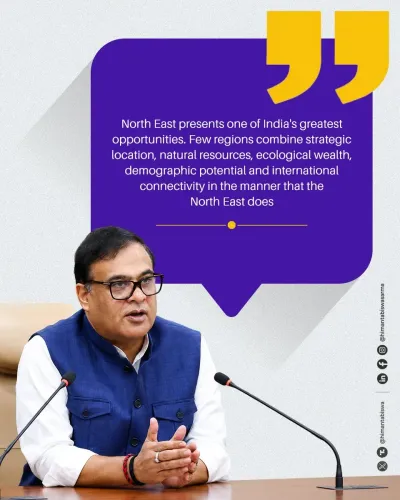
Assam Chief Minister Himanta Biswa Sarma on Saturday, 13 June 2026, called for 'Geographic Equity' to guide the next phase of India's economic growth, arguing that development must be balanced, inclusive, and regionally equitable so that every part of the country contributes meaningfully to a #ViksitBharat.
Context
Sarma's post frames 'Geographic Equity' as a foundational principle for India's development trajectory, not merely a regional aspiration. He argued that growth must remain 'balanced, inclusive and regionally equitable' — language that directly challenges a model of development concentrated in a handful of urban and coastal centres. The statement carries particular weight coming from the chief minister of a state that has historically lagged on per-capita income and infrastructure metrics.
As convenor of the North-East Democratic Alliance (NEDA), Sarma speaks for a coalition of NDA partners across eight northeastern states, giving his articulation of regional equity a political as well as administrative dimension.
Policy Backdrop
The call echoes a long arc of Indian policy concern. The 15th Finance Commission (2020) raised the states' share in central taxes to 41 percent, explicitly citing the need to address regional imbalances. NITI Aayog, formed in 2015 to replace the Planning Commission, has promoted cooperative federalism and released annual SDG India Index reports since 2018 to track and incentivise balanced progress across states.
The Act East Policy, unveiled in 2014, accelerated infrastructure and economic integration of the Northeast with the rest of India and ASEAN neighbours through roads, railways, and waterways. The NDA government's Viksit Bharat vision — targeting a fully developed economy by 2047 — has increasingly incorporated connectivity corridors and industrial nodes in the Northeast and eastern states as core components of that roadmap.
Sarma's framing of 'Geographic Equity' as a named principle updates these earlier planning-era concerns within the language of competitive federalism and outcome-linked funding that now defines Centre-state relations.
Stakeholders and Impact
The most immediate stakeholders are the eight northeastern states — Assam, Arunachal Pradesh, Manipur, Meghalaya, Mizoram, Nagaland, Sikkim, and Tripura — which have historically received special category transfers but continue to face infrastructure deficits and lower industrial investment relative to peninsular India. A formal policy commitment to geographic equity could influence the allocation logic of future Union Budgets and Finance Commission awards.
Broader beneficiaries would include other lagging regions — parts of eastern India, central India, and the hilly states — whose growth rates have trailed the national average even as aggregate GDP figures have improved. State governments in these regions are likely to find in Sarma's formulation a useful political vocabulary for pressing their fiscal claims at the Centre.
What's Next
The phrase 'Geographic Equity' will be worth tracking in upcoming NITI Aayog documents, state budget speeches, and the next Union Budget to see whether it is adopted as an official planning concept. Progress on ongoing Northeast infrastructure corridors and industrial clusters will serve as a practical test of whether the principle moves from political articulation to budgetary commitment. Sarma's standing as NEDA convenor means the formulation is likely to surface in NDA's inter-state coordination forums in the months ahead.
Point of View
It functions simultaneously as a governance argument and a political signal to Northeast electorates ahead of state electoral cycles. The framing aligns with, but goes further than, existing NDA rhetoric by demanding that regional balance become a first-order criterion — not a residual outcome — of national economic planning. Whether it gains traction will depend on whether it is adopted in formal fiscal and planning documents or remains a rhetorical marker.
NationPress
14 Sept 2026
Frequently Asked Questions
What is 'Geographic Equity' and why is Himanta Biswa Sarma talking about it?
'Geographic Equity' refers to the principle that economic growth should be distributed across all regions of India, not concentrated in a few states or cities. Assam CM Himanta Biswa Sarma used the term on 13 June 2026 to argue that every part of India must participate meaningfully in the country's rise toward the Viksit Bharat goal of 2047.
What is Viksit Bharat and how does geographic equity relate to it?
Viksit Bharat is the NDA government's national vision to make India a fully developed economy by 2047. Sarma argues that achieving this goal requires balanced, inclusive, and regionally equitable growth — meaning lagging states and regions must not be left behind as the national economy expands.
What has the Indian government done so far to address regional imbalances?
Key measures include the Act East Policy (2014) for Northeast integration, NITI Aayog's SDG India Index (from 2018) to track state-level progress, and the 15th Finance Commission's decision to raise states' share in central taxes to 41 percent, partly to address regional disparities.
Why does Himanta Biswa Sarma's statement on regional equity carry political weight?
As Chief Minister of Assam and convenor of the North-East Democratic Alliance (NEDA), Sarma coordinates NDA partners across all eight northeastern states. His articulation of geographic equity thus represents a collective voice from a region that has historically received fewer industrial investments despite being a strategic priority.
What should we watch for after Himanta Sarma's geographic equity call?
Key signals to track include whether 'Geographic Equity' appears in NITI Aayog reports or the next Union Budget, progress on Northeast infrastructure corridors and industrial clusters, and whether other state governments adopt the term in their fiscal negotiations with the Centre.