CM Himanta calls for unified Eastern & NE India growth push

Synopsis
Assam CM and NEDA convenor Himanta Biswa Sarma urged Eastern and Northeast India to act as a unified region on 24 June 2026, saying the NDA's focus on the area has begun converting shared potential into real progress.
Key Takeaways
Himanta Biswa Sarma called on Eastern and Northeast India to 'think and act as one region' in a post on 24 June 2026 .
He credited the NDA's 'unwavering focus' on the region for turning the vision of collective progress into reality.
NEDA , which Sarma convenes, was constituted in 2016 to consolidate NDA-aligned parties across the eight northeastern states.
The Act East Policy launched in 2014 provides the foundational framework for connectivity between Northeast India and Southeast Asia.
The statement positions the Northeast and Eastern states as a single contiguous development corridor bordering China, Myanmar, Bangladesh , and Bhutan .
The next NEDA or North Eastern Council meeting is expected to be a key platform for translating this vision into concrete policy announcements.
Assam Chief Minister Himanta Biswa Sarma on Wednesday, 24 June 2026, called for Eastern and Northeast India to act as a single region, asserting that the National Democratic Alliance (NDA)'s sustained focus on the area has begun translating a long-held vision of collective progress into tangible reality.
Context
In his post, Sarma wrote: 'Across Eastern and NE India, our destinies are connected and our collective potential is immense. The moment we begin to think and act as one region, there will be no limit to what we can achieve.' The statement positions the two sub-regions — long treated as separate administrative and political zones — as a single economic and strategic unit.
As convenor of the North-East Democratic Alliance (NEDA), Sarma occupies a unique vantage point. NEDA, constituted in 2016, was designed to consolidate non-Congress parties across the eight northeastern states under the NDA umbrella, giving the ruling coalition both political depth and a coordination mechanism for regional governance.
Policy Backdrop
The NDA's engagement with the Northeast gained formal shape through the Act East Policy, unveiled in 2014, which sought to improve physical and economic connectivity between Northeast India and Southeast Asia. Since then, the approach has broadened to include adjacent eastern states, creating what planners describe as a contiguous development corridor stretching from West Bengal and Odisha through the eight northeastern states to the international borders with China, Myanmar, Bangladesh, and Bhutan.
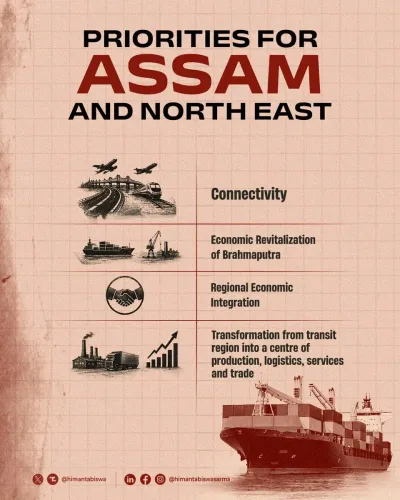
Investment in roads, railways, waterways, and power infrastructure has accompanied political consolidation in the region over the past decade. Sarma's remarks reflect this established pattern of treating Eastern and Northeastern India not merely as a political bloc but as an integrated economic zone with shared developmental imperatives.
Stakeholders and Impact
The framing carries significance for all eight northeastern states — Assam, Arunachal Pradesh, Manipur, Meghalaya, Mizoram, Nagaland, Sikkim, and Tripura — as well as the eastern states that share geographic and economic links with the sub-region. Businesses, border communities, and state governments stand to benefit if the vision of a unified regional market is backed by policy coordination and infrastructure spending.
For the NDA at the Centre, the statement reinforces a narrative of governance continuity and regional ambition ahead of what is expected to be an active legislative calendar. Sarma, as the most prominent BJP face in the Northeast, lends political weight to the message beyond Assam's borders.
What's Next
Observers will watch for the next NEDA coordination meeting or North Eastern Council session, either of which could serve as a platform to announce fresh connectivity or investment packages that give institutional form to the unity Sarma is advocating. His remarks may also signal a coming push to align state budgets and central schemes across the corridor.
If Eastern and Northeastern states move toward deeper economic integration — coordinating on trade corridors, power grids, and digital infrastructure — the region could emerge as one of India's fastest-growing economic blocs, with Assam positioned at its administrative and political centre.
Point of View
He is doing more than offering rhetoric — he is signalling that the next phase of the Act East Policy may seek to formally integrate eastern states into what has so far been a predominantly northeastern agenda. As NEDA convenor, Sarma is well-placed to drive this expansion, and the statement likely previews a coordinated push at the next round of regional governance meetings. The broader arc points toward the NDA positioning the combined eastern corridor as a showcase of development-led federalism ahead of future electoral cycles.
NationPress
24 Jun 2026
Frequently Asked Questions
What did Assam CM Himanta Biswa Sarma say about Northeast India on 24 June 2026?
He called for Eastern and Northeast India to 'think and act as one region,' saying the NDA's focus on the area has helped turn the vision of collective progress into reality.
What is NEDA and what is Himanta Biswa Sarma's role in it?
NEDA, the North-East Democratic Alliance, is a political platform constituted in 2016 to unite NDA-aligned parties across the eight northeastern states. Himanta Biswa Sarma serves as its convenor.
What is India's Act East Policy and how does it relate to this statement?
The Act East Policy, launched in 2014, aims to improve physical and economic connectivity between Northeast India and Southeast Asia. Sarma's call for regional unity builds on this policy framework.
Which states are part of Northeast India?
Northeast India comprises eight states: Assam, Arunachal Pradesh, Manipur, Meghalaya, Mizoram, Nagaland, Sikkim, and Tripura.
What could follow Sarma's call for Eastern and NE India integration?
Observers expect the next NEDA coordination meeting or North Eastern Council session to announce fresh connectivity or investment packages that give institutional form to the regional unity Sarma is advocating.