CM Himanta Clears Auto Land Conversion for Solar, Khadi Units

Synopsis
The Assam Cabinet, chaired by CM Himanta Biswa Sarma, has approved automatic online conversion of agricultural land for Micro, Khadi enterprises and Solar Plants, scrapping mandatory District Collector approval. Amendments to the governing Act will be introduced in the upcoming Budget Session.
Key Takeaways
The Assam Cabinet approved automatic conversion of agricultural land for Micro and Khadi enterprises and Solar Plants via an online process.
Prior approval from the District Collector (DC) will no longer be required for these specific land-use conversions.
CM Himanta Biswa Sarma announced that amendments to the Assam Agricultural Land Regulation (Reclassification and Transfer for Non-Agricultural Purpose) Act will be introduced in the upcoming Budget Session .
The decision builds on Assam's single-window clearance system introduced in 2022 and the updated Industrial Policy of 2021 .
Key beneficiaries include MSME entrepreneurs , Khadi unit operators , solar power developers , and agricultural landowners in Assam.
The move aligns with national renewable energy targets set by the Ministry of New and Renewable Energy .
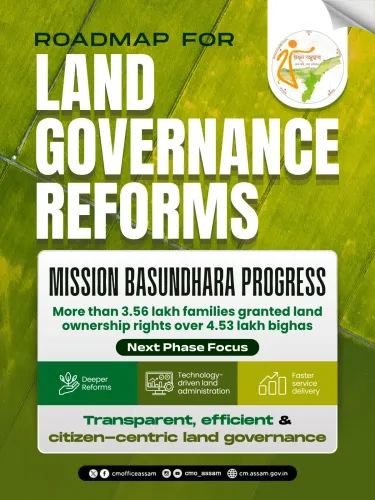
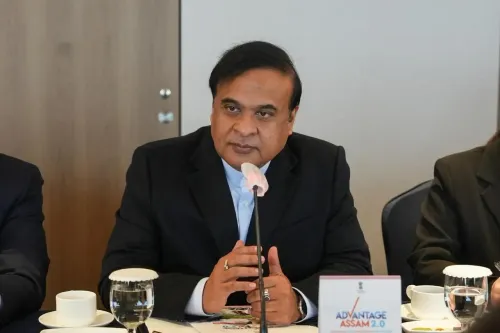
The Chief Minister's Office of Assam announced on Tuesday, 23 June 2026 that the Assam Cabinet has approved automatic conversion of agricultural land for Micro and Khadi enterprises and Solar Plants through an online process, eliminating the need for prior District Collector approval. Chief Minister Dr. Himanta Biswa Sarma made the announcement while addressing the media after the Cabinet meeting, adding that formal amendments to the Assam Agricultural Land Regulation (Reclassification and Transfer for Non-Agricultural Purpose) Act will be introduced in the upcoming Budget Session.
Context
Speaking after the Cabinet sitting, CM Himanta Biswa Sarma said the government would move amendments to the land regulation Act in the Budget Session to give the new policy a statutory footing. Until now, entrepreneurs and solar developers seeking to convert agricultural land for eligible projects had to obtain prior clearance from the District Collector (DC), a step the Cabinet has now decided to remove for the specified categories. The shift to an online, automatic conversion process is designed to cut processing time and reduce discretionary bureaucratic intervention.
Policy Backdrop
Assam has pursued regulatory simplification across industrial approvals since 2021, when the state introduced an updated Industrial Policy offering incentives for MSMEs and renewable energy projects. A single-window clearance system was rolled out in 2022 to reduce delays for investors navigating multiple departments. The latest Cabinet decision deepens that trajectory by removing a specific approval layer — DC sign-off — for two priority sectors: village and micro industries under the Khadi and MSME umbrella, and clean-energy installations.
The move also aligns with national priorities. The Ministry of New and Renewable Energy has set ambitious solar capacity targets, and states across India have been under pressure to streamline land-use approvals to meet those goals. Assam, which faces land scarcity constraints typical of the Northeast, has historically had a more cautious approach to agricultural land reclassification, making this automatic-conversion mechanism a notable departure.
Stakeholders and Impact
MSME entrepreneurs and Khadi unit operators stand to benefit most immediately, as the online process removes a step that could previously delay project launches by weeks or months. Solar power developers — both large independent power producers and smaller distributed-energy operators — will find it easier to site installations on agricultural land without navigating individual DC offices across Assam's districts. Agricultural landowners who wish to lease or sell land for these purposes will also face fewer procedural hurdles.
The broader MSME sector in Assam has been a focus of the state government's employment and investment push since 2021, with the sector seen as critical to absorbing the state's young workforce. Faster land conversion is expected to reduce the time between project approval and ground-breaking for eligible units.
What's Next
The formal legislative step — introducing amendments to the Assam Agricultural Land Regulation Act — is slated for the upcoming Budget Session of the Assam Legislative Assembly. The precise date of the session has not been confirmed officially. Separately, the government is expected to launch the online land conversion portal for eligible Micro, Khadi, and Solar projects, which will operationalise the Cabinet's decision ahead of or alongside the legislative amendment. Observers will watch whether the portal's eligibility criteria and safeguards against misuse of the automatic-conversion route are clearly defined in the draft amendment bill.
Point of View
Khadi, and Solar projects is a concrete administrative reform, not merely a policy signal — it removes a discretionary chokepoint that has historically slowed small-industry and clean-energy investment in the Northeast. By anchoring the change in a forthcoming legislative amendment, the Himanta government is also attempting to give the reform durability beyond executive orders, which can be quietly reversed. The move fits a recognisable pattern in Indian state governance: using ease-of-doing-business metrics as a competitive lever to attract investment away from better-connected western and southern states. The real test will be whether the online portal is designed with adequate safeguards to prevent misuse of the automatic-conversion route for purposes beyond the stated eligible categories.
NationPress
23 Jun 2026
Frequently Asked Questions
What did the Assam Cabinet decide about agricultural land conversion?
The Assam Cabinet approved automatic conversion of agricultural land through an online process for setting up Micro and Khadi enterprises and Solar Plants, removing the earlier requirement of prior District Collector approval.
Will DC approval still be needed for land conversion in Assam?
No, for the specific categories of Micro and Khadi enterprises and Solar Plants, the Cabinet has decided to eliminate the mandatory District Collector approval step, replacing it with an automatic online process.
When will the Assam land regulation amendment be introduced?
CM Himanta Biswa Sarma announced the amendment to the Assam Agricultural Land Regulation Act will be introduced in the upcoming Budget Session of the Assam Legislative Assembly. The exact date of the session has not been officially confirmed.
Who benefits from Assam's new agricultural land conversion policy?
MSME entrepreneurs, Khadi unit operators, solar power developers, and agricultural landowners in Assam are the primary beneficiaries, as they can now pursue land reclassification faster without navigating individual DC offices.
How does this fit into Assam's broader investment policy?
The decision builds on Assam's updated Industrial Policy of 2021 and a single-window clearance system introduced in 2022, continuing the state government's push to simplify regulatory approvals and attract manufacturing and clean-energy investment.