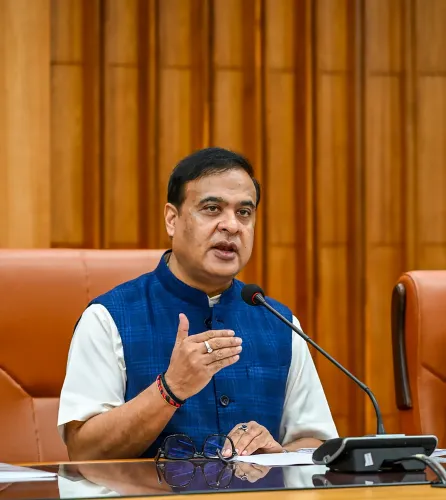
CM Himanta Flags Assam's 3-Tier Cancer Grid on Awareness Day
Synopsis
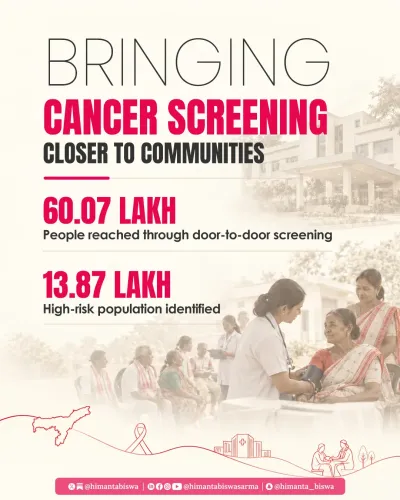
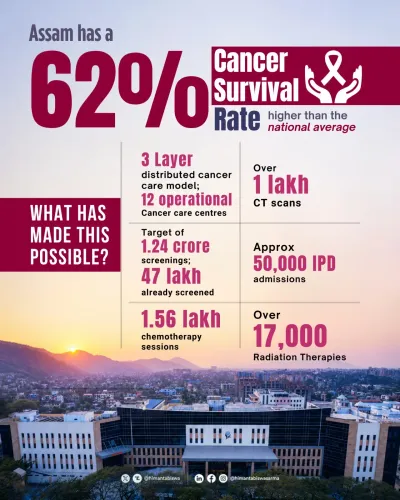
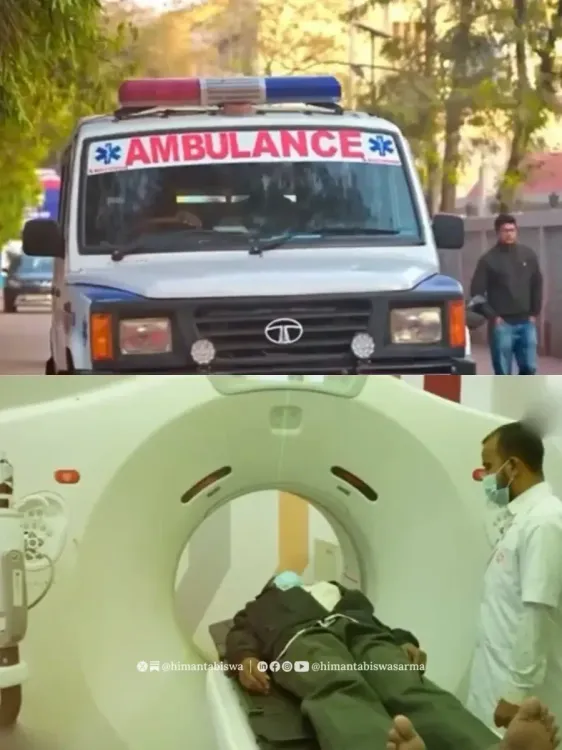
On National Cancer Awareness Day, Assam CM Himanta Biswa Sarma highlighted the state's 3-tier Cancer care grid — covering detection, diagnosis and treatment — with 12 facilities already operational, urging residents to get screened early.
Key Takeaways
National Cancer Awareness Day is observed on 7 November every year in India to promote early detection and treatment access.
Assam CM Himanta Biswa Sarma announced the state's 3-tier Cancer care grid spanning detection, diagnosis, and treatment.
12 facilities under the grid are already functional, according to the Chief Minister.
The tiered model is designed to reduce late-stage cancer presentations — a documented challenge in India's Northeast.
The approach aligns with the national NPCDCS framework (launched 2010) and mirrors networks built in Tamil Nadu and Kerala .
Sarma urged Assam residents to use these facilities proactively and seek testing at the first sign of symptoms.
On National Cancer Awareness Day, 7 November 2026, Assam Chief Minister Himanta Biswa Sarma turned a solemn calendar moment into a pointed public health call — spotlighting the state's structured effort to close one of India's most persistent medical gaps: catching cancer early enough to matter.
A three-tier grid built for the Northeast's reality
Sarma announced that Assam has built a 3-tier Cancer care grid — designed to detect at the primary level, diagnose at the secondary level, and treat at tertiary centres. Of the planned facilities, 12 are already functional, according to the Chief Minister. The tiered model is a direct answer to a problem well-documented across India's Northeast: patients arriving at hospitals only after the disease has advanced, when treatment options narrow sharply.
The architecture mirrors approaches adopted by states such as Tamil Nadu and Kerala, which built decentralised referral-and-treatment networks under central non-communicable disease programmes launched in the early 2010s. The idea is straightforward — the closer screening is to a patient's home, the earlier the catch.
National Cancer Awareness Day and India's NCD burden
National Cancer Awareness Day is observed every 7 November across India to promote prevention, early detection, and treatment access. It sits within a broader national architecture — the National Programme for Prevention and Control of Cancer, Diabetes, Cardiovascular Diseases and Stroke (NPCDCS), launched in 2010, which has pushed states to strengthen screening and referral infrastructure for non-communicable diseases.
Assam carries a particular burden. Certain districts in the state have historically reported high cancer incidence rates, making the case for localised infrastructure not an aspiration but a necessity. Sarma's grid, in that context, is less a policy announcement and more an operational response to documented demand.
The Chief Minister's direct ask to residents
Sarma's post did not stop at infrastructure — he urged residents to 'make best use of these world class facilities' and to 'test themselves in case of any symptoms.' The message is a classic early-detection pitch: infrastructure only saves lives if people walk through the door. Getting that behavioural shift — especially in rural and semi-urban Assam — is the harder half of the equation.
Watching whether future state budgets deepen investment in these centres, and whether they get fully empanelled under Ayushman Bharat PMJAY, will tell the real story of Assam's cancer-care ambition.
Twelve facilities functional, one state, one disease — the grid is live. Whether it bends Assam's cancer curve is the number that will matter most.
Point of View
They become a durable governance credential for the BJP in the region.
NationPress
7 Nov 2026
Frequently Asked Questions
What is National Cancer Awareness Day in India?
National Cancer Awareness Day is observed every year on 7 November in India to spread awareness about cancer prevention, early detection, and available treatment facilities.
What is Assam's 3-tier Cancer care grid?
It is an Assam state initiative with three levels: primary-level detection, secondary-level diagnosis, and tertiary-level treatment — designed to catch cancer earlier and closer to patients' homes.
How many cancer care facilities are functional in Assam under this grid?
According to Chief Minister Himanta Biswa Sarma, 12 facilities under the 3-tier Cancer care grid are already operational as of November 2026.
Why does Assam need a specialised cancer care network?
Certain districts in Assam have historically reported high cancer incidence rates, and patients in the Northeast have often presented at advanced stages due to limited local screening and diagnosis facilities.
What is the NPCDCS and how does it relate to Assam's cancer grid?
The National Programme for Prevention and Control of Cancer, Diabetes, Cardiovascular Diseases and Stroke (NPCDCS) , launched in 2010 , encourages states to build decentralised NCD screening and referral networks — the framework Assam's 3-tier grid aligns with.