CM Himanta Flags Assam School Infra Push Nearing Saturation
Synopsis
Assam Chief Minister Himanta Biswa Sarma on 7 July 2026 said the state's school infrastructure transformation is visible on the ground, with nearly all schools equipped with essential facilities and the government now targeting full saturation by closing remaining gaps.
Key Takeaways
CM Himanta Biswa Sarma declared on 7 July 2026 that almost every school in Assam now has essential infrastructure in place.
The government says it is 'zeroing in on remaining gaps' to achieve 100% saturation of school facilities.
The push aligns with the national Samagra Shiksha framework, which prioritises physical access before quality metrics.
State initiatives since May 2021 , including the Gunotsav assessment programme, have driven the infrastructure expansion.
The state education department's next gap-closure report and the 2026-27 budget session will be key milestones to verify the claim.
A validated saturation claim could position Assam as a regional benchmark under the NEDA framework.
Assam Chief Minister Himanta Biswa Sarma on Tuesday, 7 July 2026, declared that the transformation of the state's schools is now visibly underway, with nearly every institution equipped with essential infrastructure and the government zeroing in on remaining gaps to achieve full saturation.
Context
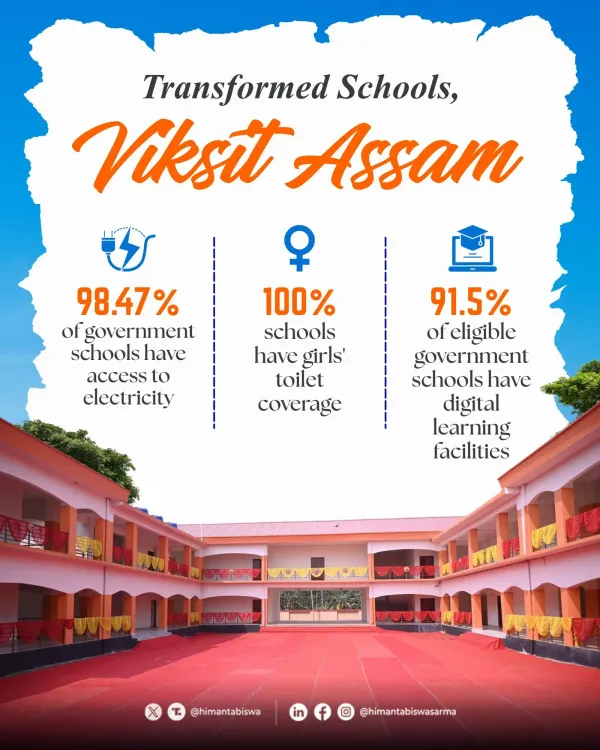
Posting on X, CM Sarma stated: 'Facts matter. The transformation of Assam's schools is already visible across the State. With almost every school now equipped with essential infra, we are zeroing in on the remaining gaps to reach 100% saturation.' The post was accompanied by an image, underscoring the government's intent to present ground-level evidence of progress rather than rely on policy announcements alone.
The remark signals a shift in the state's communication strategy — from announcing targets to asserting near-completion, a posture that puts the onus on verifiable outcomes ahead of any upcoming legislative or budget review.
Policy Backdrop
Since CM Sarma took office in May 2021, the Assam government has pursued multiple state-level initiatives to upgrade physical school facilities. These have run alongside assessments such as Gunotsav, an annual learning-outcome evaluation that also doubles as an infrastructure audit across government schools.
The state's approach mirrors the phased model embedded in the national Samagra Shiksha framework, which prioritises universal access to basic physical facilities — classrooms, toilets, drinking water, and electricity — before advancing to quality and learning-outcome metrics. Assam's drive aligns with similar infrastructure-saturation pushes seen across other North-East states in recent years.
Stakeholders and Impact
The primary beneficiaries of the infrastructure push are Assam's school-going students and teaching staff, particularly in rural and remote areas where facility gaps have historically been most acute. For teachers, functional classrooms, sanitation, and utilities translate directly into improved working conditions and attendance rates.
The government's framing of 'zeroing in on remaining gaps' suggests that the current phase is targeted and residual rather than systemic — a distinction that will matter when the state education department publishes its next round of facility-mapping data. Civil society groups and parent bodies in underserved districts will be watching whether the claim of near-saturation holds up against independent assessments.
What's Next
The immediate marker to watch is the Assam state education department's progress report on gap closure, expected to feed into deliberations during the 2026-27 budget session. A mid-term review of school infrastructure targets would either validate or complicate the Chief Minister's assertion of near-universal coverage.
If the saturation claim is substantiated, Assam could position itself as a benchmark for infrastructure delivery among North-East states under the North-East Democratic Alliance (NEDA) framework that CM Sarma convenes — lending the initiative a regional political dimension beyond state-level governance.
Point of View
' he is pre-empting opposition criticism and setting a verifiability standard for his own government. The timing, ahead of a likely budget-session review, suggests the administration is building a public record to defend education expenditure and claim credit for Samagra Shiksha outcomes at the state level. The 'zeroing in on remaining gaps' framing is politically astute: it concedes imperfection while asserting momentum, making it harder to attack without appearing to dismiss genuine progress. For Sarma, consolidating Assam's education story also reinforces his standing as the most prominent BJP administrator in the North-East.
NationPress
7 Jul 2026
Frequently Asked Questions
What did Assam CM Himanta Biswa Sarma say about schools on 7 July 2026?
CM Sarma posted on X that the transformation of Assam's schools is already visible, with nearly every school now equipped with essential infrastructure, and that the government is working to close remaining gaps to reach 100% saturation.
What is the Gunotsav programme in Assam?
Gunotsav is an annual school assessment initiative launched by the Assam government that evaluates learning outcomes and also serves as a facility audit across government schools in the state.
How does Assam's school infrastructure drive connect to the national Samagra Shiksha scheme?
Samagra Shiksha is a centrally sponsored scheme that funds universal access to basic school facilities. Assam's state-level infrastructure push aligns with this framework, following the phased model of securing physical infrastructure before targeting quality improvements.
What are the remaining gaps in Assam's school infrastructure?
CM Sarma's post does not specify which facilities remain incomplete. Independent verification will depend on the state education department's next progress report, expected ahead of the 2026-27 budget session.
What is NEDA and what is CM Himanta's role in it?
The North-East Democratic Alliance (NEDA) is a BJP-led political coalition of parties from North-East India. CM Himanta Biswa Sarma serves as its convenor, giving Assam's governance record regional political significance.