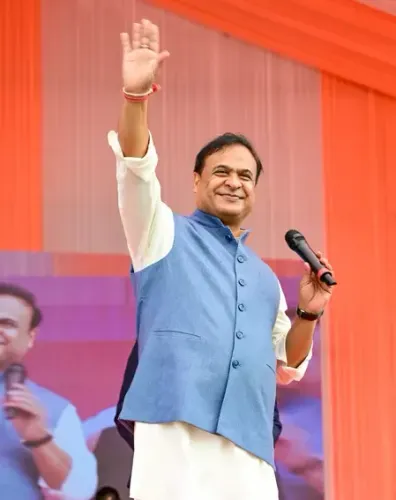
CM Himanta Hails India-UK Trade Deal, Sees Tea Boom

Synopsis
Assam Chief Minister Himanta Biswa Sarma has welcomed the India-UK Comprehensive Economic and Trade Agreement entering into force, saying duty-free access for GI-tagged Assam Tea is a defining moment for the state's tea workers, growers, and MSME exporters.
Key Takeaways
The India-UK Comprehensive Economic and Trade Agreement (CETA) entered into force on 15 July 2026 , granting duty-free access to 99% of India's exports to the UK.
Assam Tea , which carries a GI tag , will enter the UK market completely tariff-free for the first time under the agreement.
CM Himanta Biswa Sarma said the deal is a 'major boost' for the lakhs of tea garden workers and growers in Assam.
India-UK bilateral trade is projected to nearly double to $120 billion by 2030 , according to the post.
Assam's agro-processing and MSME sectors are also expected to benefit alongside the tea industry.
The CETA follows earlier agreements with Australia (December 2022) and the UAE (May 2022) as part of India's bilateral trade push.
Assam Chief Minister Himanta Biswa Sarma on Thursday, 16 July 2026, welcomed the entry into force of the India-UK Comprehensive Economic and Trade Agreement (CETA), calling it a defining moment for Assam and crediting the accord to the leadership of Prime Minister Narendra Modi. The agreement grants duty-free access to 99% of India's exports to the United Kingdom, with Assam Tea set to enter the UK market completely tariff-free for the first time.
Context
In his post, CM Sarma stated that the deal marks a milestone for the state's most iconic export: 'Our tea, the pride of Assam and among the finest in the world, will now enter the UK market completely duty-free for the very first time.' He described it as a 'major boost' for the lakhs of tea garden workers and growers across Assam. The Chief Minister also highlighted that India-UK bilateral trade is projected to nearly double to $120 billion by 2030.
The India-UK free trade negotiations were formally launched in January 2022 following the United Kingdom's departure from the European Union. The current administration has pursued a series of bilateral trade pacts in parallel, including deals with Australia and the United Arab Emirates, to widen market access for Indian producers beyond traditional blocs.
Policy Backdrop
Assam Tea carries a Geographical Indication (GI) tag, conferring it protected status as a product uniquely tied to the region. Previously, Indian tea faced UK import tariffs that placed it at a competitive disadvantage against producers from other origins that had preferential access. Duty-free entry under the CETA is expected to improve price realisation for growers and strengthen demand for the GI-tagged product in one of the world's most established tea-consuming markets.
India's broader trade liberalisation push under PM Modi has prioritised deals with major economies to secure preferential access for agricultural and manufactured exports. The India-Australia Economic Cooperation and Trade Agreement entered into force in December 2022, and the India-UAE Comprehensive Economic Partnership Agreement took effect in May 2022, establishing a pattern of high-value bilateral accords.
Stakeholders and Impact
Tea garden workers represent one of the largest organised labour groups in Assam, and the sector underpins livelihoods across the Brahmaputra Valley and Barak Valley districts. CM Sarma noted that beyond tea, the state's expanding agro-processing and MSME sectors are also positioned to benefit from the agreement's broader tariff concessions.
For small and medium exporters, preferential access to the UK market reduces the cost burden of entry and opens competitive space against third-country rivals. The CETA's coverage of 99% of Indian exports means that a wide range of goods — from processed foods to textiles — stand to gain, with regionally concentrated products like Assam Tea among the most immediate beneficiaries.
What's Next
Attention will now turn to the operational details of the agreement: rules-of-origin requirements and customs procedures that will determine how smoothly Assam Tea and other exports move through UK ports under the new tariff regime. State and central government agencies are expected to issue guidance for exporters on compliance and certification processes.
Longer term, the projected doubling of India-UK bilateral trade to $120 billion by 2030 will depend on take-up by exporters, sustained demand conditions in the UK, and the pace of implementation on both sides. Parliamentary and state-level reviews of the agreement's employment and price impact are anticipated within the coming years, providing early indicators of whether the deal's promise translates into measurable gains for Assam's tea economy.
Point of View
Framing a central-government accord in terms of direct benefit to Assam's most politically and economically significant sector. By anchoring the India-UK CETA to tea garden workers — a large, organised constituency — Sarma connects macro trade policy to ground-level livelihoods in a way that resonates beyond Guwahati. The move also reinforces the BJP's north-east narrative: that the region is no longer a peripheral beneficiary of national policy but an active participant in India's global economic integration. The forward-looking $120 billion trade projection, while unverified, signals ambition and sets a benchmark against which future performance will be measured.
NationPress
15 Oct 2026
Frequently Asked Questions
What is the India-UK Comprehensive Economic and Trade Agreement?
The India-UK Comprehensive Economic and Trade Agreement (CETA) is a bilateral accord that liberalises trade between India and the United Kingdom, granting duty-free access to 99% of India's exports to the UK. Negotiations were formally launched in January 2022 after the UK's departure from the EU.
How does the India-UK trade deal benefit Assam Tea?
Under the CETA, GI-tagged Assam Tea will enter the UK market completely duty-free for the first time, removing tariff barriers that previously placed it at a competitive disadvantage. CM Himanta Biswa Sarma said this will strengthen demand and enhance price realisation for growers and workers.
What did Assam CM Himanta Biswa Sarma say about the India-UK deal?
CM Sarma described the agreement as a 'defining moment' for Assam, highlighting duty-free access for Assam Tea and projected benefits for tea garden workers, agro-processors, and MSME exporters. He credited the accord to the leadership of Prime Minister Narendra Modi.
What is the India-UK bilateral trade target by 2030?
According to CM Sarma's post, India-UK bilateral trade is projected to nearly double to $120 billion by 2030 as a result of the CETA and deepening economic ties.
Which other trade agreements has India signed recently?
India concluded a Comprehensive Economic Partnership Agreement with the UAE that took effect in May 2022, and the India-Australia Economic Cooperation and Trade Agreement entered into force in December 2022. The India-UK CETA is the latest in this series of bilateral accords.