CM Himanta hails 'Om Namah Shivaya' chant at Indonesia's Prambanan
Synopsis
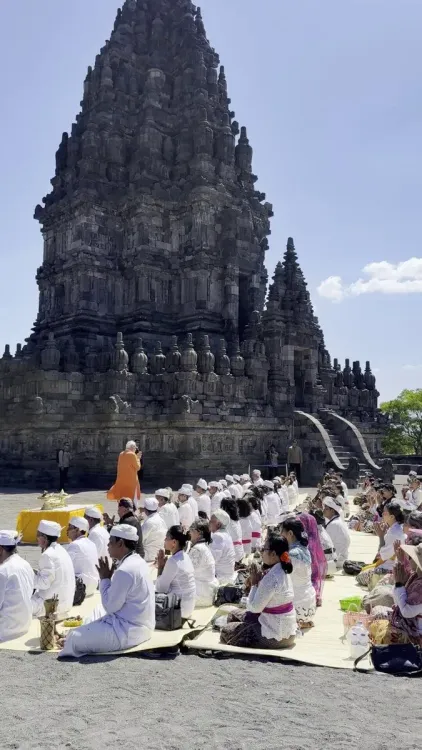
Assam CM Himanta Biswa Sarma hailed the chanting of 'Om Namah Shivaya' at Indonesia's 9th-century Prambanan temple as a proud moment for Indians, pledging bilateral cooperation to conserve and revive the shared Hindu civilisational heritage between the two nations.
Key Takeaways
CM Himanta Biswa Sarma described hearing Om Namah Shivaya at Prambanan as a moment of pride for every Indian.
He pledged that India and Indonesia will jointly work on conservation and revival of their shared cultural heritage.
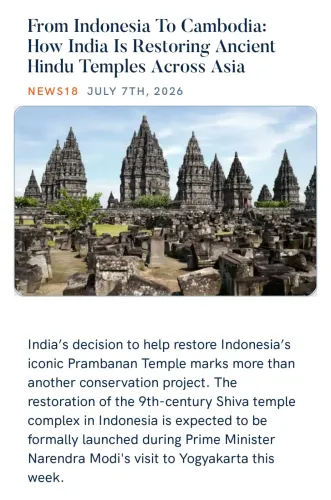
Prambanan is a 9th-century Hindu temple complex in Central Java and a UNESCO World Heritage Site since 1991 .
India and Indonesia have maintained a bilateral Cultural Agreement since 1955 , with Indian technical assistance for Prambanan restoration ongoing since the 1950s .
The statement aligns with India's Act East Policy , which uses cultural diplomacy to deepen ties with ASEAN nations sharing Hindu-Buddhist legacies.
Formal follow-up may come at the next ASEAN-India Summit in the form of a joint heritage working group.
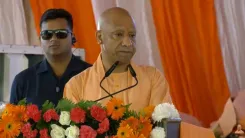
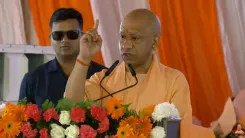
Assam Chief Minister Himanta Biswa Sarma on Wednesday, 8 July 2026, invoked the chanting of 'Om Namah Shivaya' at the ancient Prambanan temple complex in Indonesia as a proud moment for every Indian, pledging that the two nations will work together to preserve and revive their shared civilisational heritage.
Context
In his post, CM Sarma wrote: 'Hearing the resonance of Om Namah Shivaya at the historic Prambanan temple in Indonesia is a moment of pride for every Indian. India and Indonesia will work together for the conservation and revival of this shared cultural heritage. This is a powerful symbol of our centuries-old civilisational friendship.'
The Prambanan temple complex, located in Central Java, is a 9th-century Hindu temple compound primarily dedicated to Lord Shiva. It was designated a UNESCO World Heritage Site in 1991 and stands as one of the most significant surviving monuments of Hindu civilisation outside the Indian subcontinent.
Policy Backdrop
India and Indonesia share a bilateral Cultural Agreement dating back to 1955, covering cooperation in archaeology, performing arts, and museology. During Prime Minister Narendra Modi's 2018 visit to Indonesia, both sides agreed to intensify joint conservation efforts at Hindu-Buddhist heritage sites, including Prambanan.
India has periodically extended technical assistance for the restoration of Prambanan since the 1950s, reflecting a long-standing commitment to preserving the region's pre-Islamic Hindu-Buddhist legacy. These efforts sit squarely within India's Act East Policy, which uses cultural diplomacy as a bridge to deepen people-to-people ties with ASEAN nations.
Indonesia's own history is deeply intertwined with Indian civilisational influence. Powerful Hindu-Buddhist kingdoms such as the Sailendra and Mataram dynasties drew extensively on Indian religious, architectural, and literary traditions, leaving behind monuments like Prambanan that endure as shared heritage.
Stakeholders and Impact
Heritage conservationists and the Hindu diaspora across Southeast Asia are the most immediate stakeholders in any deepened India-Indonesia cultural cooperation. For India, such engagement reinforces a broader diplomatic narrative: that shared civilisational roots can serve as a durable foundation for contemporary strategic and economic partnerships.
CM Sarma, as a senior BJP leader and convenor of the North-East Democratic Alliance (NEDA), is well-placed to amplify this message, given that India's northeastern states sit at the geographic and cultural crossroads of the Act East Policy. His remarks signal alignment between state-level political voices and the Union government's foreign-policy priorities.
What's Next
Observers will watch for any formal announcement of a joint India-Indonesia heritage working group or a dedicated conservation project at Prambanan, potentially at the next ASEAN-India Summit. Such a move would translate the rhetorical commitment expressed in posts like Sarma's into a structured bilateral mechanism.
The broader pattern suggests that cultural diplomacy centred on sites like Prambanan will continue to grow as a pillar of India's engagement with Southeast Asia, reinforcing ties that go well beyond trade and security into the realm of shared identity and memory.
Point of View
Extending the government's diplomatic messaging beyond the Ministry of External Affairs into state politics. By invoking the Shiva mantra at a UNESCO site in Indonesia, he frames civilisational continuity as a live, emotionally resonant reality rather than an academic footnote. This kind of cultural statecraft has intensified since 2014, with Hindu-Buddhist heritage sites in Southeast Asia becoming recurring reference points in India's soft-power playbook. Whether the pledge of joint conservation translates into a concrete bilateral mechanism will determine whether this remains symbolic positioning or becomes actionable diplomacy.
NationPress
7 Oct 2026
Frequently Asked Questions
What is the Prambanan temple and why is it significant for India?
Prambanan is a 9th-century Hindu temple complex in Central Java, Indonesia , dedicated primarily to Lord Shiva and listed as a UNESCO World Heritage Site since 1991 . It is significant for India because it represents the spread of Hindu civilisation to Southeast Asia and has been a site of Indian technical conservation assistance since the 1950s .
What did Himanta Biswa Sarma say about Prambanan?
CM Himanta Biswa Sarma said that hearing Om Namah Shivaya at Prambanan is a moment of pride for every Indian, and that India and Indonesia will work together to conserve and revive their shared cultural heritage, calling it a symbol of centuries-old civilisational friendship.
What is India's Act East Policy and how does Prambanan fit in?
India's Act East Policy seeks to deepen strategic, economic, and people-to-people ties with ASEAN nations. Prambanan fits in as a tangible symbol of shared Hindu-Buddhist heritage, making cultural diplomacy around the site a natural extension of the policy's goals.
Has India previously worked with Indonesia on heritage conservation?
Yes. India and Indonesia signed a bilateral Cultural Agreement in 1955 , and Indian technical teams have assisted in Prambanan's restoration since the 1950s . During PM Modi's 2018 visit to Indonesia , both nations agreed to intensify joint conservation of Hindu-Buddhist heritage sites.
What could follow CM Sarma's statement on India-Indonesia cultural cooperation?
Analysts expect a possible announcement of a formal joint heritage working group or a dedicated conservation project at Prambanan, most likely at the next ASEAN-India Summit , which would give institutional form to the bilateral cultural commitment.