CM Himanta Shares How India Restores Hindu Temples Across Asia
Synopsis
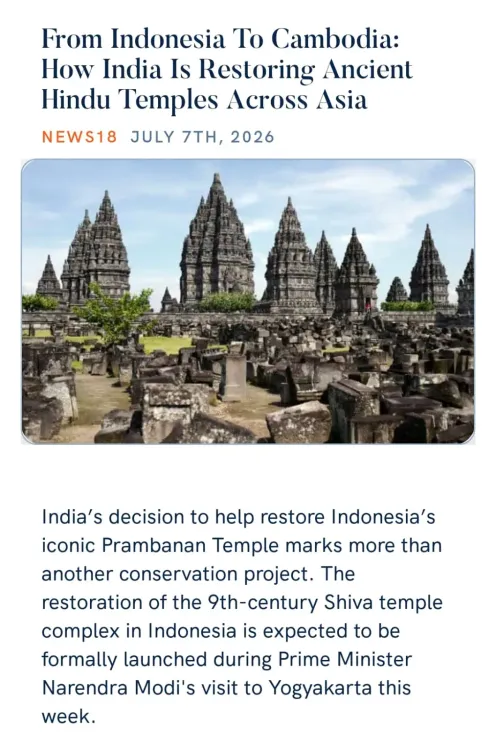
Assam Chief Minister Himanta Biswa Sarma highlighted India's restoration of ancient Hindu temples across Southeast Asia, from Indonesia's Prambanan to Cambodia's Angkor, through ASI-led projects under the Act East Policy and Project Mausam framework.
Key Takeaways
Assam CM Himanta Biswa Sarma shared an explainer on 8 July 2026 on India's temple restoration work across Southeast Asia.
The Archaeological Survey of India (ASI) has deployed teams to countries including Indonesia and Cambodia under bilateral cultural agreements.
India's Act East Policy (2014) elevated heritage conservation as a core instrument of outreach to ASEAN nations.
Project Mausam , launched in 2014 by the Ministry of Culture , maps and conserves maritime cultural linkages including temple sites across the Indian Ocean region.
Temple restoration serves dual purposes: preserving shared Hindu-Buddhist heritage and reinforcing India's soft-power standing in Southeast Asia.
New ASI project announcements are expected at forthcoming India-ASEAN summits and during high-level visits to Phnom Penh and Jakarta .
Assam Chief Minister Himanta Biswa Sarma on Wednesday, 8 July 2026, shared a detailed explainer on India's ongoing efforts to restore ancient Hindu temples across Southeast Asia, highlighting projects spanning countries from Indonesia to Cambodia. The post, shared via the NaMo App, drew attention to a facet of Indian foreign policy that blends archaeological expertise with cultural diplomacy.
Context
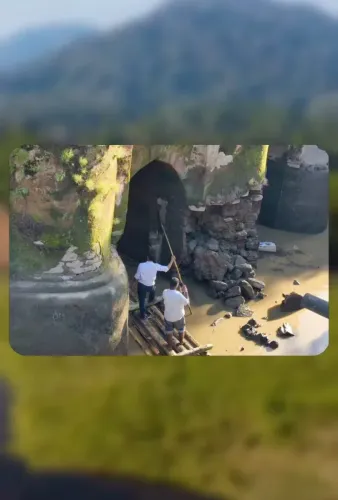
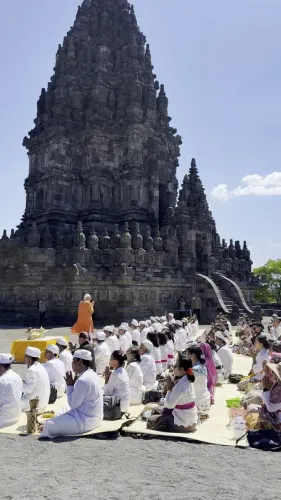
The article CM Sarma amplified traces India's involvement in conserving Hindu and Hindu-Buddhist heritage sites across the Indian Ocean region and Southeast Asia. Countries such as Indonesia — home to the Prambanan temple complex — and Cambodia — site of the iconic Angkor heritage zone — have been among the recipients of Indian technical and conservation expertise. The Archaeological Survey of India (ASI), India's primary monument conservation agency, has deployed specialised teams under bilateral cultural agreements to assist in structural and stone conservation at these sites.
India's engagement with overseas heritage is not new, but it has gained fresh momentum under successive governments. The Look East Policy, launched in 1991, first formalised cultural cooperation with Southeast Asian nations as a diplomatic instrument. Its successor, the Act East Policy, announced in 2014, elevated heritage projects to a core pillar of outreach to ASEAN member states, placing them alongside economic connectivity and security dialogue.
Policy Backdrop
A key institutional vehicle for this work is Project Mausam, a Ministry of Culture initiative launched in 2014 to map and conserve maritime cultural linkages — including temple sites — across the Indian Ocean world. The project draws on the historical reality that Indian civilizational influence, carried by trade and migration, shaped the religious and architectural landscape of much of Southeast Asia over more than a millennium.
These restoration efforts are also calibrated to serve India's broader strategic interests. By positioning itself as the custodian of shared Asian civilizational heritage, New Delhi reinforces people-to-people ties with ASEAN governments and populations that share Hindu-Buddhist cultural roots. The approach complements hard-power and economic instruments with a form of soft power that is difficult for rival actors to replicate.
Stakeholders and Impact
The direct beneficiaries of these restoration programmes include heritage agencies in host countries, local tourism sectors, and scholarly communities engaged in the study of ancient Asian civilisations. For Indonesia and Cambodia in particular, well-preserved temple complexes are significant drivers of inbound tourism revenue, meaning Indian technical assistance carries tangible economic value alongside its cultural symbolism.
Within India, such initiatives resonate with a domestic audience attuned to narratives of civilizational continuity and global cultural leadership. Senior political figures sharing content on these projects — as CM Sarma has done — amplify their visibility and signal cross-party support for cultural diplomacy as a foreign-policy tool.
What's Next
Analysts tracking India-ASEAN relations expect new ASI project announcements or memoranda of understanding to emerge at forthcoming India-ASEAN summits or during high-level bilateral visits to Phnom Penh and Jakarta. As India's diplomatic calendar with Southeast Asia remains active, heritage cooperation is likely to feature prominently alongside trade and connectivity discussions. The renewed attention to these programmes — driven in part by social media amplification from leaders like CM Sarma — suggests that cultural diplomacy will remain a visible and politically valued strand of India's foreign engagement.
Point of View
The ruling establishment signals that soft power — rooted in shared Hindu-Buddhist heritage — is as strategic as trade corridors. This framing also serves a domestic audience receptive to narratives of India as an ancient civilizational power reclaiming its role as a cultural anchor for Asia.
NationPress
6 Oct 2026
Frequently Asked Questions
Which Hindu temples is India restoring in Southeast Asia?
India has been involved in conservation work at major Hindu and Hindu-Buddhist sites including the Prambanan complex in Indonesia and heritage zones around Angkor in Cambodia , with the Archaeological Survey of India providing technical expertise under bilateral agreements.
What is Project Mausam and how does it relate to temple restoration?
Project Mausam is a Ministry of Culture initiative launched in 2014 to map and conserve maritime cultural linkages across the Indian Ocean region, including ancient temple sites that reflect centuries of Indian civilizational influence in Southeast Asia.
What is India's Act East Policy and why does it include heritage projects?
The Act East Policy , announced in 2014 , expanded on the earlier Look East Policy by elevating cultural diplomacy — including heritage conservation — as a core instrument of India's engagement with ASEAN nations, alongside economic and security cooperation.
Why is Assam CM Himanta Biswa Sarma sharing content about temple restoration abroad?
As a senior BJP leader and convenor of the North-East Democratic Alliance , CM Himanta Biswa Sarma frequently amplifies content that highlights India's civilizational and cultural diplomacy, reflecting the party's broader emphasis on India's Hindu heritage as a foreign-policy asset.
What is the Archaeological Survey of India's role in overseas temple conservation?
The Archaeological Survey of India (ASI) is India's primary monument conservation agency and has deployed specialised teams to Southeast Asian countries under bilateral cultural agreements to assist in structural conservation and stone restoration at ancient temple sites.