CM Himanta Launches Livestock Insurance with 85% Premium Cover
Synopsis
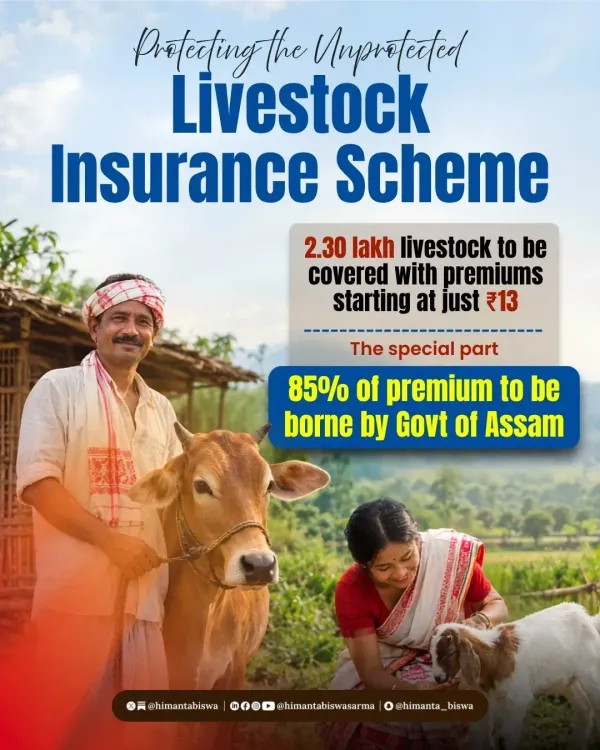
Assam CM Himanta Biswa Sarma announces livestock insurance covering cattle, buffaloes, goats, sheep and pigs, with the state government paying 85% of the premium — a major risk-protection push for rural households dependent on animal husbandry.
Key Takeaways
Assam will bring cattle, buffaloes, goats, sheep and pigs under a livestock insurance scheme.
The state government will cover 85% of the insurance premium, minimising out-of-pocket cost for farmers.
The scheme extends the framework of the central government's National Livestock Mission (launched 2014) with additional state-level subsidy.
The announcement targets rural households in Assam for whom livestock is a primary — not supplementary — source of income.
Rollout details including district coverage, enrolment process, and total budget are yet to be officially published.
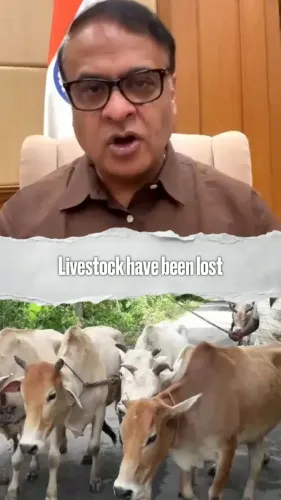
A single disease outbreak, a flood, a drought — and a family's entire income can vanish with the animal it depends on. Assam Chief Minister Himanta Biswa Sarma announced on Thursday, 24 September 2026 that the state will now extend livestock insurance to cattle, buffaloes, goats, sheep, and pigs, with the government shouldering 85 percent of the premium cost — leaving farmers to pay only a marginal share.
What the scheme covers and why the 85% figure matters
The announcement covers five categories of livestock, making it one of the broadest state-level insurance net in the Northeast. By absorbing 85% of the premium, the Assam government removes the single biggest barrier that keeps small and marginal farmers from enrolling in risk-protection schemes: upfront cost. For a family whose only capital asset is a buffalo or a small goat herd, even a modest annual premium has historically felt unaffordable.
The move builds on the architecture of the National Livestock Mission, a 2014 central government programme that introduced subsidised insurance components for animal husbandry. States have the flexibility to layer additional subsidy on top of the central contribution, and Assam's announcement follows exactly that model — using state funds to push coverage deep into rural households that the baseline scheme may not fully reach.
The Northeast's livestock economy and why Assam is acting now
Assam has a large rural population whose livelihoods are closely tied to agriculture and allied sectors, including animal husbandry. Livestock is not supplementary income here — for many households, it is the primary income. Floods, which hit the Brahmaputra plain almost every year, and disease outbreaks regularly wipe out herds, sending families into debt with no recovery mechanism in place.
The state's move is part of a visible pattern: state governments across India are expanding risk-mitigation coverage in the animal husbandry sector, recognising that crop insurance alone leaves a significant chunk of rural vulnerability unaddressed. Covering pigs alongside cattle and goats is notable — it signals the scheme is designed to reach communities across Assam's diverse demographic and dietary landscape.
What livestock farmers should watch for next
The rollout details — district-wise coverage, enrolment process, budget allocation, and integration with the existing National Livestock Mission framework — are yet to be officially detailed. Those specifics will determine how quickly the scheme translates from announcement to actual claim settlements in the field. The test, as always with welfare programmes, is last-mile delivery.
For rural Assam, the stakes are concrete and immediate. A policy that actually pays out when a cow dies or a pig pen is swept away is the difference between a family that recovers and one that doesn't.
Point of View
The announcement reinforces a welfare-oriented governance brand ahead of what remains a competitive political landscape in the state. The five-species coverage — notably including pigs — is a quiet but deliberate signal of inclusivity across Assam's ethnically and culturally diverse rural communities. The real policy test will come at implementation: whether the enrolment machinery and claim-settlement infrastructure can match the ambition of the headline figure.
NationPress
25 Sept 2026
Frequently Asked Questions
What is the Assam livestock insurance scheme announced by CM Himanta?
Assam CM Himanta Biswa Sarma announced that the state government will provide insurance for cattle, buffaloes, goats, sheep and pigs, covering 85% of the insurance premium so that farmers bear only a minimal cost.
Which animals are covered under Assam's new livestock insurance?
The scheme covers five categories: cattle, buffaloes, goats, sheep and pigs — making it one of the broadest livestock insurance nets in Northeast India.
How much of the livestock insurance premium does the Assam government pay?
The Assam government will pay 85% of the premium, leaving farmers responsible for only the remaining 15%.
Is this scheme linked to the National Livestock Mission?
Yes, the National Livestock Mission is a central government scheme launched in 2014 that includes subsidised livestock insurance. Assam's announcement adds a state-level top-up subsidy on that existing framework.
Who benefits from the Assam livestock insurance scheme?
Livestock farmers and rural households across Assam — particularly small and marginal farmers for whom animals like cattle, goats and pigs are a primary source of household income.