CM Himanta marks BTC Govt's 1 year, flags ₹1,000cr road package
Synopsis
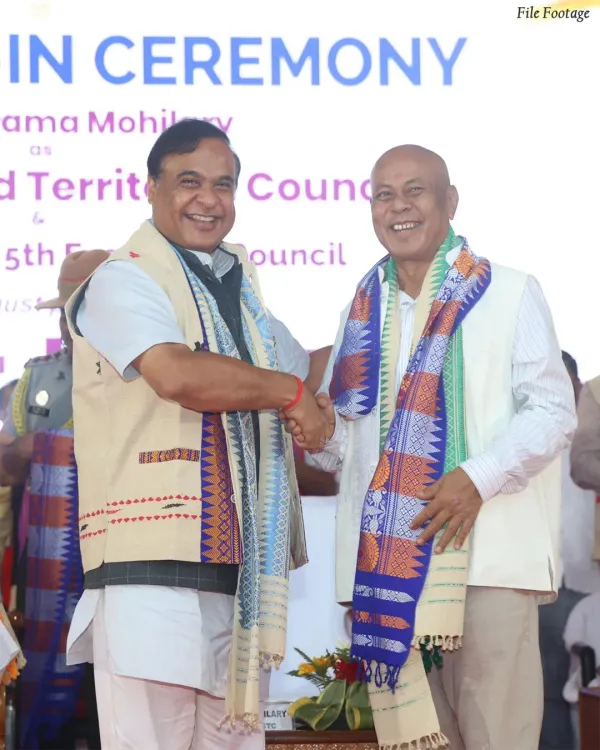
Assam CM Himanta Biswa Sarma marked the BTC government's first anniversary by highlighting full implementation of Assam's welfare schemes in BTR, a ₹1,000 crore road infrastructure package, and the state's ambition to develop Bodoland as a manufacturing and logistics hub.
Key Takeaways
The BTC government led by Hagrama Mohilary completed one year in office on October 5, 2026 .
CM Sarma invoked a 'Triple Engine' NDA alignment — Centre (Delhi), state (Dispur), and BTC (Kokrajhar) — as the driver of regional development.
The Assam government has approved a ₹1,000 crore special package exclusively for road infrastructure development in the Bodoland Territorial Region .
State welfare schemes including Orunodoi, CMAAA, MMUA , and free ration are being implemented in BTR at full scale.
Implementation of every clause of the Bodo Peace Accord , signed in January 2020, was cited as a key governance commitment.
The government aims to position BTR as a manufacturing and logistics hub , leveraging its proximity to Bhutan and the India-Bangladesh corridor.
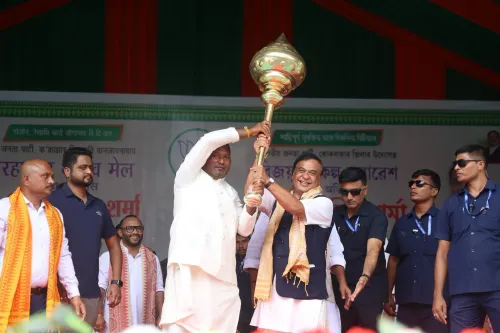
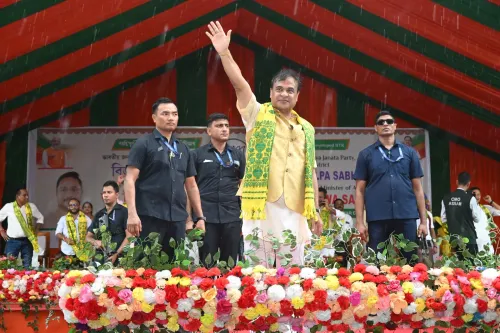
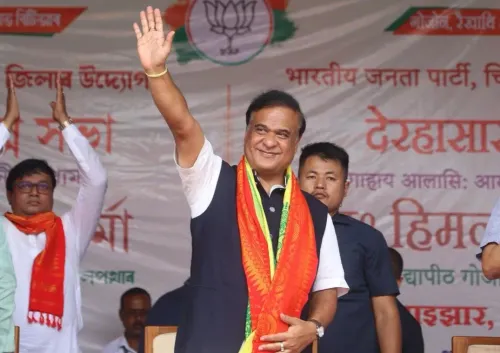
One year into its tenure, the Bodoland Territorial Council (BTC) government led by Chief Hagrama Mohilary is receiving a public vote of confidence from Assam Chief Minister Himanta Biswa Sarma, who on Monday, October 5, 2026, used the anniversary to lay out a sweeping developmental scorecard — anchored by a ₹1,000 crore special road infrastructure package — for the Bodoland Territorial Region (BTR).
A 'Triple Engine' alignment at Delhi, Dispur, and Kokrajhar
Sarma's congratulatory post frames the moment squarely in BJP's coalition logic: an NDA government at the Centre, a BJP-led dispensation in Dispur (Assam's state capital), and the BTC government in Kokrajhar all pulling in the same direction. The 'Triple Engine' framing is deliberate — it signals that policy clearances, state-level resource allocation, and local governance are no longer working at cross-purposes in a region that spent decades in conflict.
Central to that alignment is the Bodo Peace Accord, signed in January 2020 under Prime Minister Narendra Modi, which ended a prolonged insurgency by the National Democratic Front of Bodoland factions and created the conditions for the current elected BTC. Sarma's post explicitly states that 'every clause of the Bodo Peace Accord' is being implemented — a claim that, if borne out, would mark one of Northeast India's more consequential peace dividends in recent memory.
Welfare schemes land in BTR: Orunodoi to free ration
The Chief Minister listed four Assam state welfare programmes now running in BTR at full scale: Orunodoi (a direct benefit transfer scheme for women), CMAAA (Chief Minister's Atmanirbhar Asom Abhijan, supporting self-employment), MMUA (Mukhyamantri Mahila Udyamita Abhijan, a women's entrepreneurship drive), and free ration distribution. The enumeration matters: for much of BTR's post-accord transition, residents questioned whether state-government schemes would reach the region with the same intensity as the rest of Assam. The list is an answer — or at least a public commitment — to that concern.
₹1,000 crore roads bet and the manufacturing-logistics ambition
The sharpest policy signal in Sarma's post is the ₹1,000 crore special package approved for road infrastructure in BTR. Road connectivity has historically been the region's largest constraint — poor links to Assam's highway network kept supply chains fragile and investment at bay. Pairing the infrastructure announcement with the stated goal of positioning BTR as a 'manufacturing and logistics hub' suggests the state government is attempting to turn a peace dividend into an economic dividend, using connectivity as the trigger.
BTR borders Bhutan and sits close to the India-Bangladesh corridor, giving it latent strategic value as a trans-boundary logistics node — a potential that has rarely been capitalised on during the years of unrest.
What the first anniversary means for BTR's longer arc
The BTC government's first anniversary is not just a bureaucratic milestone. It is the first full year of civilian-led administration in a region where elected governance had been repeatedly disrupted by violence and mid-term political crises. A calm, functional year — marked by scheme delivery and a large infrastructure commitment — represents the baseline that future accountability must be measured against. Whether the ₹1,000 crore road package translates into tenders, contracts, and tarmac before the next election cycle will be the real test of the Triple Engine's torque.
Point of View
A pitch that will feature prominently in future state and council elections. The explicit invocation of the Bodo Peace Accord signals that the party sees peace-to-prosperity messaging as its strongest card in the Northeast. The ₹1,000 crore roads commitment, however, will need visible execution to sustain credibility: in conflict-affected regions, infrastructure announcements have a long history of stalling between sanction and ground-break. The manufacturing-and-logistics ambition is aspirational but structurally plausible given BTR's cross-border geography — if connectivity improves, private capital could follow.
NationPress
5 Oct 2026
Frequently Asked Questions
What is the BTC government and who leads it?
The Bodoland Territorial Council (BTC) is the autonomous self-governing body for the Bodoland Territorial Region (BTR) in Assam. It is currently led by Chief Hagrama Mohilary and completed one year in office on October 5, 2026.
What is the Bodo Peace Accord?
The Bodo Peace Accord was signed in January 2020 between the Government of India, the Assam state government, and factions of the National Democratic Front of Bodoland. It ended decades of armed insurgency and provided for political representation and development of the Bodo community.
What is the ₹1,000 crore package announced for BTR?
The Assam government has approved a ₹1,000 crore special package specifically for developing road infrastructure in the Bodoland Territorial Region, aimed at improving connectivity and supporting the region's growth as a manufacturing and logistics hub.
What is the Orunodoi scheme mentioned by CM Himanta?
Orunodoi is an Assam state government direct benefit transfer scheme that provides financial assistance to women in low-income households. CM Himanta confirmed it is being implemented in the Bodoland Territorial Region along with other welfare programmes.
What does 'Triple Engine' government mean in Assam's context?
'Triple Engine' refers to the BJP-NDA alignment at three tiers simultaneously — the Central government in Delhi, the Assam state government in Dispur, and the BTC government in Kokrajhar — which CM Himanta argues ensures faster and more coordinated development for the region.