CM Himanta Marks World Gibbon Day, Flags Canopy Bridge Win
Synopsis
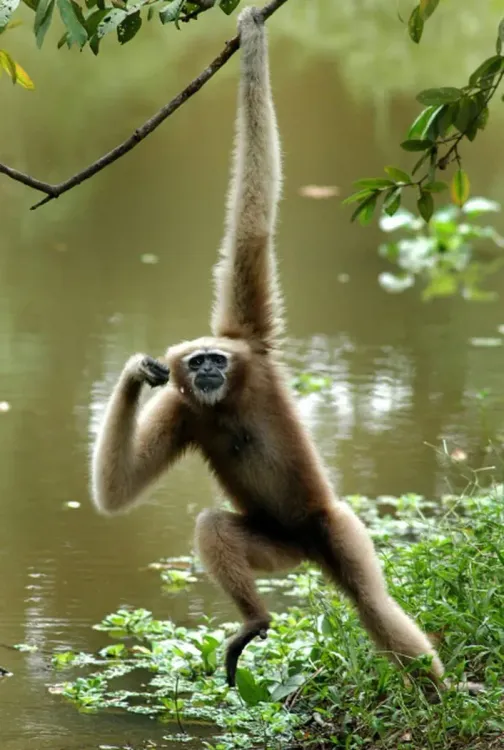
On World Gibbon Day, Assam CM Himanta Biswa Sarma highlighted the canopy bridge at Hollongapar Gibbon Sanctuary that lets India's only native ape — the Hoolock Gibbon — safely cross a railway line, calling it a heartening moment of science-led conservation.
Key Takeaways
Assam CM Himanta Biswa Sarma posted on World Gibbon Day, 24 October 2026 , spotlighting the Hoolock Gibbon as India's only native ape species.
He described witnessing a gibbon use a canopy bridge at Hollongapar Gibbon Sanctuary to cross a railway track safely — calling it 'a heartening moment.' The Hollongapar Gibbon Sanctuary in Jorhat district was notified in 1997 specifically to conserve the Hoolock Gibbon population.
The Hoolock Gibbon is listed under Schedule I of India's Wildlife (Protection) Act, 1972 , granting it the highest level of legal protection.
The canopy bridge represents cross-agency coordination between Assam's forest authorities and Indian Railways to reduce habitat fragmentation.
Updated Hoolock Gibbon population surveys and possible expansion of canopy bridges to other railway segments remain key items to watch.
India's only native ape — the Hoolock Gibbon — got a rare moment in the spotlight on Saturday, 24 October 2026, when Assam Chief Minister Himanta Biswa Sarma used World Gibbon Day to reflect on the state's quiet but consequential conservation work, including a firsthand account of watching a gibbon safely cross a railway track via a specially built canopy bridge at Hollongapar.
Hollongapar's canopy bridge and what it means
Hollongapar Gibbon Sanctuary, tucked inside Jorhat district in eastern Assam, is the country's only protected area dedicated to the Hoolock Gibbon. Its central challenge has always been geography: a functioning Indian Railways line bisects the forest, cutting off gibbon movement between canopy patches. The canopy bridge — an engineered rope-and-net corridor strung above the tracks — is a direct answer to that problem, allowing arboreal primates to move without descending to ground level.
Sarma described witnessing a gibbon use the structure as 'a heartening moment,' and the image lands with force. These are animals that almost never descend from the trees; a working canopy bridge is not infrastructure in the usual sense. It is ecological suturing.
Schedule I protection and the 1997 sanctuary
The legal scaffolding around the Hoolock Gibbon is among the strongest in Indian wildlife law. India's Wildlife (Protection) Act, 1972 places the species under Schedule I, its highest tier of protection. The Gibbon Wildlife Sanctuary was formally notified in 1997, creating a dedicated reserve for the population in this fragmented forest patch. Despite three decades of protected status, habitat fragmentation driven by rail and road corridors has remained the single biggest structural threat.
Sarma's post signals that the state sees science-led engineering — not just legal designation — as the active layer of conservation going forward.
Northeast India's infrastructure-biodiversity tightrope
Assam's canopy-bridge model fits into a wider pattern playing out across Northeast India, where economic connectivity projects — railways, highways, transmission lines — run directly through some of the subcontinent's most biodiverse terrain. The challenge is not unique to gibbons: elephants, slow lorises, and clouded leopards face similar corridor fragmentation across the region.
What makes the Hollongapar intervention notable is its species-specific design and the institutional coordination it required between state forest authorities and a national railway network. That kind of cross-agency cooperation is rarely easy — and rarely publicised. The Chief Minister choosing to highlight it on a global observance day is itself a signal about where Assam wants to position its conservation narrative.
With updated Hoolock Gibbon population surveys expected and questions open about whether canopy bridges will be extended to additional railway segments, the quiet work at Hollongapar may soon face a louder reckoning. One bridge, one gibbon crossing — but the principle it proves could scale.
Point of View
But as one actively engineering coexistence between infrastructure and wildlife. By spotlighting a specific, verifiable intervention (the canopy bridge) over general pledges, it sidesteps the hollow 'green' rhetoric common to political communications. The post also implicitly builds the case for replicating the model on other fragmented corridors across the Northeast, where railway and highway expansion continues to pressure Schedule I species. For a Chief Minister who doubles as NEDA convenor, projecting a science-informed conservation identity adds a distinct dimension to his regional political brand.
NationPress
24 Oct 2026
Frequently Asked Questions
What is the Hoolock Gibbon and why is it significant for India?
The Hoolock Gibbon is India's only native ape species, found primarily in the forests of Northeast India, particularly Assam. It is listed under Schedule I of the Wildlife (Protection) Act, 1972, giving it the country's highest level of legal protection.
What is the canopy bridge at Hollongapar Gibbon Sanctuary?
The canopy bridge is an engineered rope-and-net corridor built above a railway line that bisects the Hollongapar Gibbon Sanctuary in Jorhat, Assam. It allows gibbons to move between forest patches without descending to the ground, reducing the risk of rail-related fatalities.
When was Hollongapar Gibbon Sanctuary established?
The Gibbon Wildlife Sanctuary at Hollongapar in Jorhat district, Assam, was formally notified in 1997 to conserve the Hoolock Gibbon population in that fragmented forest area.
What is World Gibbon Day and when is it observed?
World Gibbon Day is observed annually on 24 October to raise global awareness about the conservation challenges facing gibbon species, which are threatened primarily by habitat loss and fragmentation.
What is Assam doing to protect wildlife from railway encroachment?
Assam has implemented species-specific infrastructure like canopy bridges over railway lines to allow arboreal primates such as the Hoolock Gibbon to cross safely, combining engineering solutions with legal protections under the Wildlife (Protection) Act.