CM Himanta Pitches Delhi-Dispur Bullet Train Corridor
Synopsis
Assam Chief Minister Himanta Biswa Sarma has publicly championed a 'Northern Bullet Train corridor' stretching from Delhi to Dispur, positioning high-speed rail as a transformative boost for Northeast India's travel and business connectivity.
Key Takeaways
Assam CM Himanta Biswa Sarma on 10 November 2026 publicly advocated for a Delhi–Dispur Northern Bullet Train corridor .
Dispur , Assam's capital, is located within Guwahati ; the existing fastest rail journey from Delhi covers roughly 1,900 km in over 16 hours .
India's only approved high-speed rail project, the Mumbai–Ahmedabad corridor , has been under construction since 2015 with Japanese support.
No verified Detailed Project Report (DPR) or budget allocation for a Delhi-Guwahati high-speed line has been publicly announced.
Sarma serves as convenor of the North-East Democratic Alliance (NEDA) , giving him political leverage to push this demand toward the Centre.
Key triggers to watch: a Railway Budget allocation, a NITI Aayog feasibility mandate, or multilateral funding discussions.
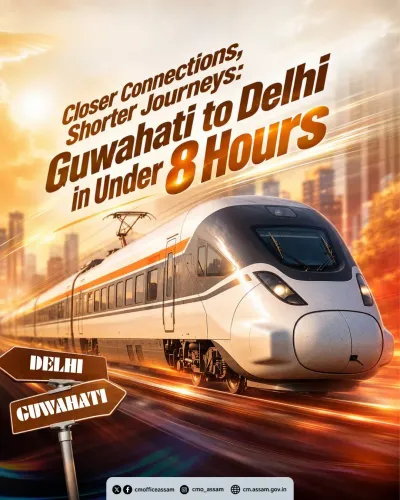
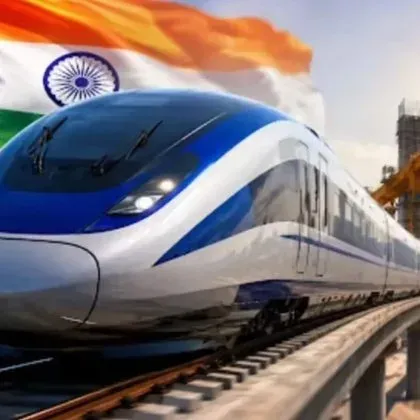
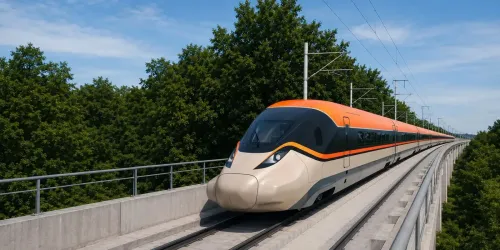
A bullet train linking Delhi to Dispur — the capital of Assam — is the bold vision Assam Chief Minister Himanta Biswa Sarma put on the national conversation on Tuesday, 10 November 2026, calling on Indians to 'gear up for the future of mobility' with a Northern Bullet Train corridor that promises to stitch together India's major cities in a matter of hours.
What Sarma is proposing — and why it matters for the Northeast
Sarma framed the corridor explicitly as a tool for both travel and business, arguing that high-speed rail connectivity would take the region's economic potential 'to new heights.' For Dispur — the seat of Assam's government, embedded within the sprawling urban fabric of Guwahati — a direct bullet-train link to the national capital would represent a generational leap. Currently, the fastest train between Delhi and Guwahati covers roughly 1,900 kilometres in well over 16 hours. High-speed rail could, in principle, compress that journey to under four.
The pitch lands against a backdrop of genuine infrastructure ambition. India's first high-speed rail project — the Mumbai–Ahmedabad corridor — received cabinet approval in 2015 with Japanese technical and financial backing, and has been under construction since. That western corridor proved how complex, expensive, and time-intensive bullet-train execution can be. The Northeast, with its mountainous terrain, seismic sensitivity, and cross-state land-acquisition challenges, would pose an even steeper engineering ask.
The Northeast's long wait for high-speed connectivity
Successive governments have prioritised high-speed rail along India's western and northern plains — corridors where flat geography and high passenger density make the economics work more readily. The Northeast has historically lagged, with broad-gauge railway expansion itself only completed to key towns in the region in the last decade. Any bullet-train project linking Delhi to Dispur would require a detailed feasibility study, a Detailed Project Report (DPR), and significant budget allocation — none of which have been publicly announced as of November 2026.
That gap between aspiration and approved project is worth noting. Sarma, as convenor of the North-East Democratic Alliance (NEDA) — the BJP's coalition vehicle across eight northeastern states — carries political weight in pushing such demands toward the Centre. His post is as much a public mandate-building exercise as it is a policy announcement.
What moves this from a post to a project
Watchers of India's railway expansion will look for concrete follow-through: an entry in an upcoming Union Railway Budget, a NITI Aayog feasibility mandate, or a bilateral funding conversation with a multilateral partner — the kind of Japanese financing that underpins the Mumbai–Ahmedabad corridor. Without those steps, the Northern Bullet Train corridor remains a compelling vision rather than a sanctioned project.
Still, corridors like this rarely move from zero to DPR without political champions making noise first. Sarma just made his noise — loudly and publicly.
Point of View
He has a structural reason to amplify Northeast connectivity as a BJP governance deliverable ahead of state election cycles. The proposal also benchmarks the Northeast against western India's bullet-train momentum, a framing that is hard for Delhi to ignore. The real test is whether this translates into a DPR commission or remains a high-profile aspiration in India's long infrastructure wish-list.
NationPress
10 Nov 2026
Frequently Asked Questions
What is the Delhi to Dispur Northern Bullet Train corridor?
It is a proposed high-speed rail link between Delhi and Dispur, the capital of Assam, advocated by Assam Chief Minister Himanta Biswa Sarma to dramatically cut travel time and boost business connectivity in the Northeast. No official project sanction or DPR has been publicly announced yet.
How long does it currently take to travel from Delhi to Guwahati by train?
The fastest existing trains cover the roughly 1,900-kilometre Delhi–Guwahati route in over 16 hours. A high-speed rail corridor could potentially reduce that to under four hours.
Does India have any other bullet train projects under way?
Yes. India's first approved high-speed rail corridor runs between Mumbai and Ahmedabad. It received cabinet approval in 2015 with Japanese technical and financial support and has been under construction since, though it has faced delays.
Who is Himanta Biswa Sarma and why is he pushing for this?
Himanta Biswa Sarma is the Chief Minister of Assam and a senior BJP leader. He also serves as convenor of the North-East Democratic Alliance (NEDA), which coordinates BJP-aligned governance across eight northeastern states, giving him both political standing and a regional mandate to push large-scale connectivity projects.
What needs to happen before the Delhi–Dispur bullet train becomes a real project?
Concrete steps would include commissioning a feasibility study and Detailed Project Report (DPR), a formal allocation in a Union Railway Budget, and potentially securing multilateral funding — similar to the Japanese financing that backs the Mumbai–Ahmedabad corridor.