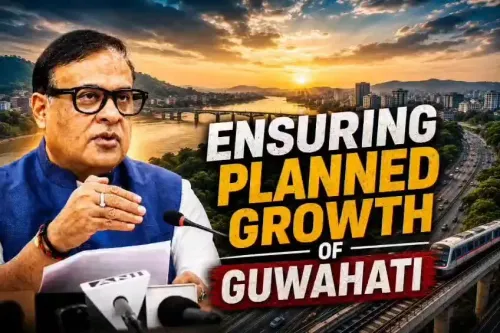
CM Himanta Plans ₹2,500cr Underground Cabling for Guwahati
Synopsis
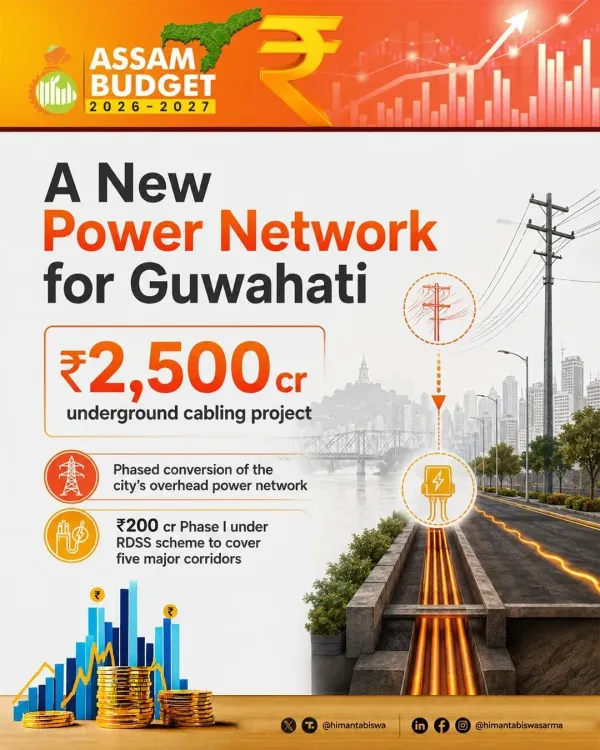
Assam Chief Minister Himanta Biswa Sarma has announced a ₹2,500 crore project to take all overhead power lines in Guwahati underground, clearing the proposal at the Assam Cabinet 2026 meeting. The move aims to eliminate storm-related outages and modernise the city's utility network.
Key Takeaways
Assam Chief Minister Himanta Biswa Sarma announced the project on 10 July 2026 via a post on X.
The project carries an outlay of ₹2,500 crore and was approved at the Assam Cabinet 2026 meeting.
All overhead power lines in Guwahati will be relocated underground, eliminating the visible cable network across the city.
Guwahati is the largest city in Assam and was previously included in the national Smart Cities Mission launched in 2015.
The initiative is expected to reduce storm-related power outages and improve urban aesthetics in Northeast India 's commercial capital.
Tendering, funding mix with central schemes, and phased rollout timelines are the key next steps to watch.
Assam Chief Minister Himanta Biswa Sarma announced on Friday, 10 July 2026 that Guwahati will undertake a ₹2,500 crore project to shift all overhead power lines underground, promising to make the city 'wireless' in a move cleared at the Assam Cabinet 2026 meeting.
Context
Guwahati, the largest city in Assam and the principal commercial gateway to Northeast India, has long grappled with a dense web of overhead power and telecom cables that pose safety hazards and are routinely damaged by the region's severe monsoon storms and floods. The Chief Minister's announcement signals a decisive push to modernise the city's utility infrastructure at scale.
Sarma posted on X: 'Guwahati will soon be wireless! A ₹2,500cr project will be undertaken to take all overhead power lines underground.' The hashtag #AssamCabinet2026 confirms the proposal has received cabinet-level approval.
Policy Backdrop
Guwahati was selected under the Smart Cities Mission, launched in 2015, which prioritised utility modernisation and urban aesthetics across Indian cities. The underground cabling initiative is consistent with that framework, extending it into a far larger capital outlay than most earlier Smart Cities projects in the state.
Since Himanta Biswa Sarma assumed office in May 2021, the Assam government has placed capital-city beautification and climate resilience at the centre of its urban agenda. Underground cabling projects have precedents in several Indian metros, where they have reduced outage frequency, improved streetscape aesthetics, and created conduit capacity for future digital infrastructure.
Stakeholders and Impact
The primary beneficiaries are Guwahati's residents and businesses, who currently face repeated power disruptions during monsoon season when overhead lines snap under storm loads. Power distribution utilities operating in the city will need to coordinate closely on asset transfer and network reconfiguration throughout the project's execution.
The scale of the investment — ₹2,500 crore — also makes this one of the largest single urban infrastructure commitments in Assam's recent history, with potential to attract allied civil and digital infrastructure work along the same trenched corridors.
What's Next
Key milestones to watch include the tendering process, the funding mix between state resources and central scheme allocations, and the phased rollout timeline. Construction phases will inevitably involve road excavation across multiple city zones, requiring careful traffic management to minimise disruption to Guwahati's already congested arterial roads.
If executed on schedule, the project could set a benchmark for other Northeast India cities looking to harden their power networks against climate-driven disruptions while simultaneously upgrading urban aesthetics ahead of the region's growing role as a trade and tourism hub.
Point of View
500 crore underground cabling announcement is the most financially significant urban infrastructure commitment Himanta Biswa Sarma has made for Guwahati since taking office in 2021, and it signals that the state is willing to back its beautification and resilience rhetoric with large capital outlays. Coming under the #AssamCabinet2026 banner, the timing also serves a political purpose — demonstrating governance momentum ahead of any electoral cycle. The project's success, however, will hinge entirely on execution: underground cabling in a flood-prone, rapidly expanding city like Guwahati is technically complex and historically prone to cost and schedule overruns in comparable Indian urban settings. Analysts will watch whether the funding architecture leans on central scheme money or state resources, as that will determine both fiscal sustainability and the speed of disbursement.
NationPress
10 Jul 2026
Frequently Asked Questions
What is the Guwahati underground power line project?
The Guwahati underground power line project is a ₹2,500 crore initiative approved by the Assam Cabinet in 2026 to shift all overhead electricity cables in Guwahati below ground, reducing outages and improving the city's streetscape.
Who announced the Guwahati cable underground project?
Assam Chief Minister Himanta Biswa Sarma announced the project on 10 July 2026 through a post on X, confirming it was cleared at the Assam Cabinet 2026 meeting.
Why is Guwahati putting power lines underground?
Overhead power lines in Guwahati are frequently damaged by monsoon storms and floods, causing repeated outages. Moving them underground will improve supply reliability, enhance urban aesthetics, and create conduit space for future digital infrastructure.
How much will the Guwahati underground cabling project cost?
The project is estimated to cost ₹2,500 crore , making it one of the largest single urban infrastructure investments in Assam 's recent history.
What is the Smart Cities Mission connection to Guwahati?
Guwahati was selected under India's Smart Cities Mission launched in 2015 , which targeted utility modernisation and urban upgrades — the underground cabling project aligns with and significantly expands on that earlier framework.