CM Himanta Links Polygamy to Govt Job Disqualification

Synopsis
Assam CM Himanta Biswa Sarma declared on 18 July 2026 that polygamy and government employment are incompatible, invoking the #UCCAssam framework and vowing to protect women from injustice regardless of the offender's identity.
Key Takeaways
CM Himanta Biswa Sarma stated on 18 July 2026 that polygamy and government jobs cannot coexist in Assam .
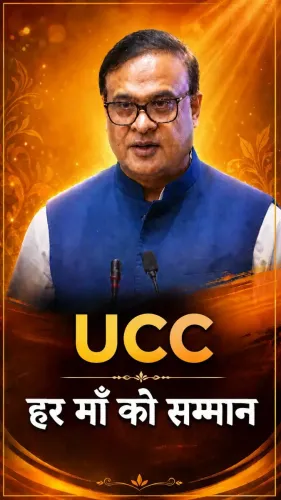
The post was tagged #UCCAssam , placing it within the state's Uniform Civil Code push.
Uttarakhand enacted India's first state-level UCC in 2024 , banning polygamy and inspiring similar moves in other BJP-ruled states.
The policy is framed as a gender-justice measure to protect sisters and daughters from injustice, regardless of the offender's community.
Possible next steps include a UCC bill or service-rule amendments in the Assam Legislative Assembly .
Article 44 of the Constitution, which calls for a Uniform Civil Code, underpins the legal rationale cited by BJP-led governments.
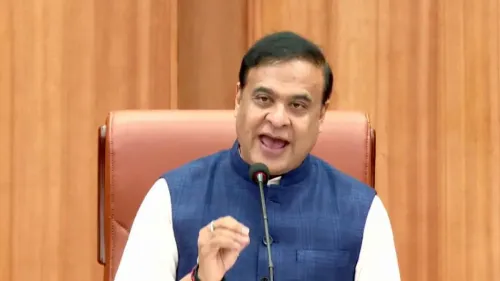
Assam Chief Minister Himanta Biswa Sarma on Saturday, 18 July 2026 declared that polygamy and government employment cannot coexist, signalling a firm policy push under the #UCCAssam framework. The statement, posted on X, asserts that no injustice will be tolerated against women — regardless of who the offender is.
In his post, CM Sarma wrote in Hindi: 'बहुविवाह जैसा अपराध और सरकारी नौकरी साथ-साथ नहीं चल सकते। हमारी बहन-बेटियों पर कोई अन्याय नहीं होने देंगे, चाहे वह कोई भी हो।' — translated: 'A crime like polygamy and a government job cannot go hand in hand. We will not allow any injustice to our sisters and daughters, whoever may be responsible.'
Context
Assam under the BJP government has been progressively tightening personal-law reforms, with polygamy emerging as a central target. The hashtag #UCCAssam indicates that this statement is framed within the broader push for a Uniform Civil Code (UCC) at the state level. CM Sarma has repeatedly positioned such measures as essential for gender justice and constitutional equality.
The post does not specify a particular community but uses universal language — 'whoever may be responsible' — a phrasing that signals the policy is intended to apply across religious lines.
Policy Backdrop
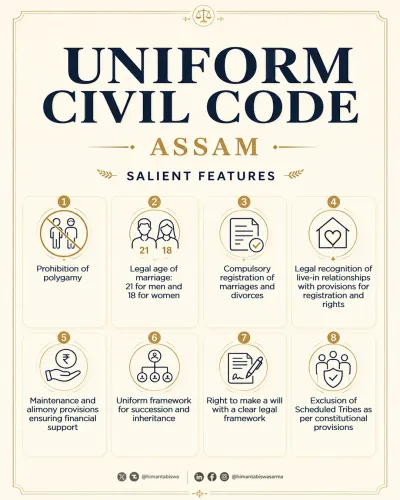
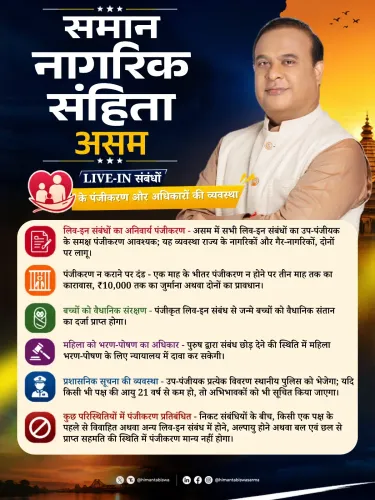
Uttarakhand became the first Indian state to enact a state-level UCC in 2024, which included a prohibition on polygamy. That move triggered similar legislative discussions in other BJP-ruled states, with Assam among the most vocal in signalling intent to follow suit.
Article 44 of the Indian Constitution directs the state to endeavour to secure a Uniform Civil Code for citizens — a Directive Principle that BJP-led governments have increasingly invoked to justify personal-law reforms. Linking polygamy to disqualification from government service would represent a significant extension of that principle into employment rules.
Stakeholders and Impact
The most direct stakeholders are women in Assam — particularly those in households where polygamous marriages have left them without legal protection or financial security. Government employees in the state now face the prospect of service-rule amendments that could cost them their jobs if found to have contracted multiple marriages.
Civil society groups advocating for women's rights have broadly welcomed such measures, while critics from minority communities have raised concerns about selective enforcement. CM Sarma's post uses inclusive language to preempt such objections, stressing that the rule will apply regardless of the offender's identity.
What's Next
Observers will watch for the possible tabling of a UCC bill or related amendments to Assam government service rules in the Assam Legislative Assembly. An executive order specifying disqualification criteria for polygamy among state employees could follow as an interim step.
If Assam enacts enforceable service-rule changes, it would become one of the first states after Uttarakhand to translate UCC principles into binding employment consequences — potentially setting a template for other BJP-governed states in the north-east and beyond.
Point of View
He is building public consensus ahead of likely legislative or executive action on service rules. The framing of polygamy as a 'crime' incompatible with public employment is a sharper escalation than earlier rhetorical positions, suggesting the Assam government may be preparing enforceable disqualification norms. The universal 'whoever may be responsible' clause is politically deliberate: it deflects accusations of targeting any single community while keeping the measure's practical impact in focus. This fits a broader BJP pattern of using employment consequences — rather than criminal prosecution alone — as the primary deterrent in personal-law reform.
NationPress
17 Oct 2026
Frequently Asked Questions
What did Assam CM Himanta Biswa Sarma say about polygamy and government jobs?
CM Sarma declared on 18 July 2026 that polygamy and government employment cannot go together in Assam, and that no injustice against women will be tolerated regardless of who is responsible.
Which state first enacted a UCC banning polygamy in India?
Uttarakhand became the first Indian state to enact a state-level Uniform Civil Code in 2024, which included a prohibition on polygamy.
Can a government employee in Assam be sacked for polygamy?
CM Sarma's statement signals that the Assam government intends to make polygamy a disqualifying offence for government employment, but specific service-rule amendments or a UCC bill are yet to be formally tabled as of 18 July 2026.
Does the polygamy ban in Assam apply to all communities?
CM Sarma's post used the phrase 'whoever may be responsible,' indicating the intended policy would apply across all communities and not be limited to any single religious group.