CM Himanta: Assam Third State to Adopt UCC

Synopsis
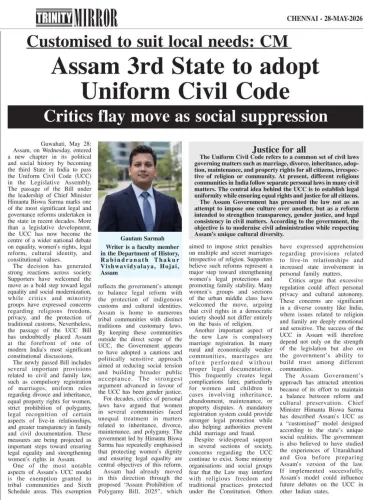
Chief Minister Himanta Biswa Sarma declared Assam the third Indian state to adopt the Uniform Civil Code on May 26, 2026, citing Dr. B.R. Ambedkar's constitutional vision and protections for minority women, following Uttarakhand and Gujarat.
Key Takeaways
Assam has been declared the third Indian state to adopt the Uniform Civil Code, after Uttarakhand and Gujarat .
CM Himanta Biswa Sarma framed the UCC as fulfilling Dr.
Ambedkar 's vision enshrined in Article 44 of the Constitution.
The code is intended to end child marriage and polygamy and guarantee property rights for minority women in Assam.
Uttarakhand enacted its UCC law in February 2024 , establishing the first state-level model for uniform civil provisions.
The move aligns with BJP election manifesto commitments from 2014 and 2019 to enact a national Uniform Civil Code.
Legal challenges and implementation details remain areas to watch as the legislation progresses through the Assam Assembly.
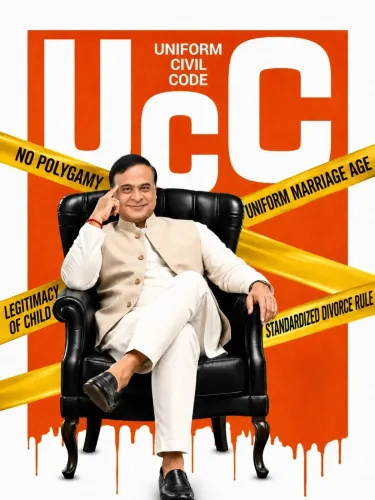
The Chief Minister's Office of Assam announced on Tuesday, May 26, 2026, that Chief Minister Dr. Himanta Biswa Sarma has declared Assam the third Indian state to adopt the Uniform Civil Code (UCC), describing the move as a landmark step in social reform that fulfills Dr. B.R. Ambedkar's constitutional vision of equal rights for all citizens.
Context
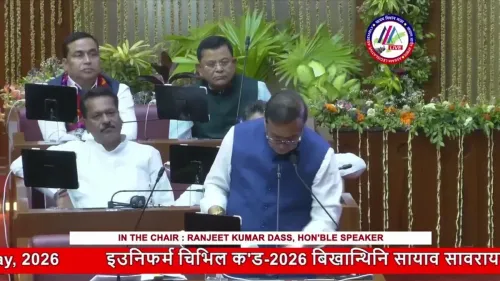
Speaking at what is understood to be a session of the Assam Legislative Assembly, CM Sarma framed the UCC as a direct realisation of Ambedkar's intent when he championed Article 44 of the Indian Constitution, which directs the state to secure a uniform civil code for all citizens. The Chief Minister specifically cited equal rights, property ownership protections, and safeguards for minority women as central outcomes of the legislation. He also underscored the code's provisions ending child marriage and polygamy as transformative for affected communities.
The official statement quoted CM Sarma as emphasising that the UCC 'fulfills Dr. B.R. Ambedkar's vision by ensuring equal rights, protection and property ownership for minority women while ending child marriage and polygamy.' The framing positions the legislation as a social-justice measure rather than solely a political one.
Policy Backdrop
Article 44 of the Indian Constitution, adopted in 1950, has long stood as a directive principle urging the state to enact a common civil law superseding religion-based personal laws on matters such as marriage, divorce, inheritance, and adoption. The provision remained largely dormant at the national level for decades, surfacing periodically in judicial observations and party manifestos.
Uttarakhand became the first Indian state to enact a UCC law in February 2024, establishing a state-level model for uniform provisions on marriage and inheritance. Gujarat has been cited in official statements as the second state to advance UCC adoption. Assam now joins this group as the third state, continuing a legislative pattern among BJP-governed states that have moved to translate a long-standing party commitment into law.
The BJP's election manifestos of 2014 and 2019 both carried explicit commitments to enact a Uniform Civil Code, citing goals of gender equality and national integration. State-level enactments are seen as building political and legal precedent ahead of any potential national-level legislation.
Stakeholders and Impact
The primary beneficiaries identified by the government are minority women in Assam, who would gain equal property and inheritance rights and protection against practices such as unilateral divorce, polygamy, and child marriage under existing personal laws. Proponents argue the code levels a legal playing field that has historically disadvantaged women in communities governed by customary or religious personal law.
Critics of UCC legislation, including opposition voices and civil society groups in other states, have raised concerns about the erosion of minority cultural autonomy and the federal complexity of applying uniform rules across India's diverse religious communities. Legal challenges to state-level UCC laws remain a possibility, with courts likely to scrutinise provisions touching on constitutionally protected religious practices.
What's Next
Attention will now turn to the specific provisions of Assam's UCC bill as it moves through the legislative process, including the scope of its application across religious communities and the timeline for implementation. Legal observers will watch for challenges in the Gauhati High Court or the Supreme Court of India, as seen in debates following Uttarakhand's enactment.
With three BJP-governed states now having adopted or advanced UCC frameworks, pressure may build on the central government to accelerate national-level deliberations. Whether other state legislatures — in Madhya Pradesh, Himachal Pradesh, or elsewhere — follow suit in the near term will be a key indicator of the legislation's political momentum ahead of the next general election cycle.
Point of View
And signals that BJP-governed states are building a cumulative legislative record on an issue the party has championed for over a decade. By invoking Ambedkar's name and centering minority women's rights, CM Sarma is deliberately shifting the rhetorical frame from religious uniformity to constitutional equality — a move designed to pre-empt the standard critique that UCC targets minority communities. The three-state pattern now creates political pressure on the central government, which must decide whether to consolidate these state experiments into a national framework before the next electoral cycle. How the courts respond to Assam's law will be as consequential as the legislation itself.
NationPress
10 Oct 2026
Frequently Asked Questions
Which states have adopted the Uniform Civil Code in India?
As of May 2026, three states have adopted the Uniform Civil Code: Uttarakhand, which enacted its UCC law in February 2024, followed by Gujarat, and now Assam, as declared by Chief Minister Himanta Biswa Sarma.
What does the Uniform Civil Code mean for minority women in Assam?
Under Assam's UCC, minority women are intended to receive equal rights to property ownership and inheritance, along with legal protection against practices such as polygamy and child marriage that persist under certain personal laws.
What is Article 44 of the Indian Constitution?
Article 44 is a Directive Principle of State Policy that directs the government to secure a Uniform Civil Code for all citizens, replacing religion-based personal laws with common rules on marriage, divorce, inheritance, and adoption. It was championed by Dr. B.R. Ambedkar during the drafting of the Constitution.
Will Assam's UCC face legal challenges?
Legal challenges are possible, as courts will likely scrutinise provisions touching on constitutionally protected religious practices. Similar questions arose after Uttarakhand enacted its UCC, and cases could be heard by the Gauhati High Court or the Supreme Court of India.
What is the BJP's position on the Uniform Civil Code?
The BJP has included a commitment to enacting a Uniform Civil Code in its election manifestos since at least 2014, framing it as a measure to promote gender equality and national integration. State-level enactments in BJP-governed states are seen as advancing this long-standing pledge.