CM Himanta signals Assam UCC launch is days away

Synopsis
Assam Chief Minister Himanta Biswa Sarma has declared that the state's Uniform Civil Code is days away from launch, positioning Assam to become the second Indian state after Uttarakhand to enact a common civil code covering marriage, divorce, inheritance and adoption for all residents.
Key Takeaways
Himanta Biswa Sarma posted on 23 May 2026 that the Assam Uniform Civil Code is 'just a few days' away from launch.
Assam would become the second Indian state to enact a UCC, after Uttarakhand passed its law in February 2024 .
The Assam government formed an expert drafting committee in 2023 to design a state-specific code.
The UCC would replace separate religion-based personal laws on marriage, divorce, inheritance, and adoption for all residents of the state.
Tribal communities with Sixth Schedule protections and minority organisations are among the key stakeholders watching for exemption clauses.
Legal challenges before the Gauhati High Court or Supreme Court are widely anticipated once the code is formally notified.
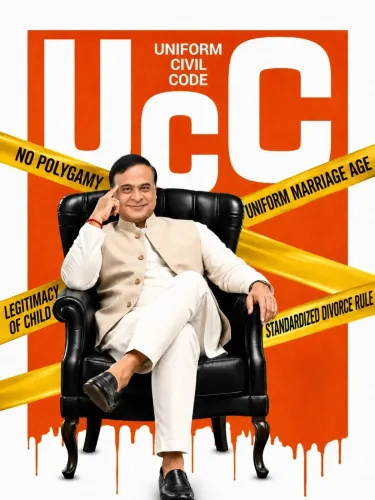
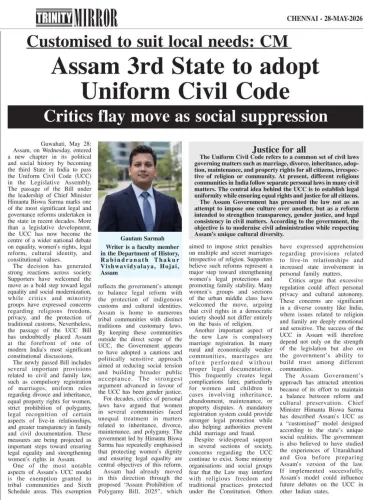
Assam Chief Minister Himanta Biswa Sarma on Saturday, 23 May 2026, signalled that the state's Uniform Civil Code is imminent, posting on X that there are 'just a few days to go for #UCCAssam.' The brief but pointed message marks a significant step in Assam's push to become the second Indian state, after Uttarakhand, to enact a common civil code governing personal laws for all residents regardless of religion.
Context
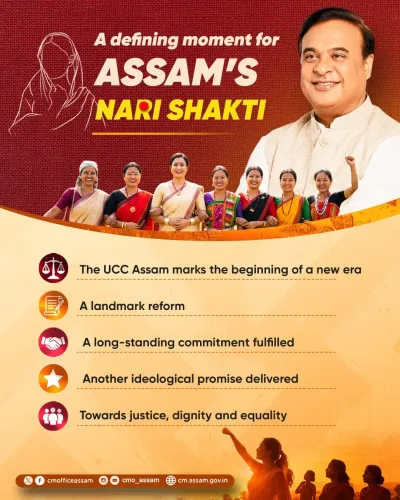
The Uniform Civil Code refers to a single, religion-neutral set of laws covering marriage, divorce, inheritance, and adoption — areas currently governed by separate personal law systems for different religious communities. Chief Minister Sarma has been the most vocal state-level champion of the measure, framing it as a matter of gender justice and constitutional equality. His post on 23 May is the clearest public signal yet that a formal rollout is close.
Uttarakhand broke ground in February 2024 when its assembly became the first in India to pass a state UCC law. Assam's move, if completed, would make it the second state to cross that threshold and would significantly expand the geographic and demographic scope of the reform.
Policy Backdrop
The Assam government constituted an expert committee in 2023 to draft a state-specific Uniform Civil Code, with Chief Minister Sarma announcing the initiative publicly. The BJP, which governs both Assam and the Centre, has carried the UCC as a manifesto commitment since the 1980s, consistently describing it as essential to national integration and equal rights for women. The party reiterated the pledge in successive general-election manifestos, most recently in 2024.
The Assam initiative is therefore not an isolated state experiment but part of a coordinated national programme. Sarma, who also serves as convenor of the North-East Democratic Alliance (NEDA), has positioned Assam as a legislative leader among BJP-ruled north-eastern states, and a successful UCC implementation could accelerate similar moves elsewhere in the region.
Stakeholders and Impact
The code, once notified, would apply to all residents of Assam — a state of roughly 3.5 crore people that includes substantial Muslim, Hindu, Christian, and tribal populations, each currently subject to distinct personal law regimes. Supporters argue a common code will end discriminatory practices and deliver uniform rights to women across communities. Critics, particularly from minority and tribal organisations, have raised concerns about cultural autonomy and the adequacy of consultation.
Tribal communities in Assam have historically sought exemptions from centralised personal law reform, citing constitutional protections under the Sixth Schedule. How the final legislation addresses those carve-outs will be closely watched by civil-society groups and legal scholars. Any enacted law is also likely to face immediate scrutiny before the Gauhati High Court or the Supreme Court of India.
What's Next
Chief Minister Sarma's post stops short of announcing a specific date, but the language — 'just a few days' — suggests a notification or formal launch is being prepared for the near term. Legal challenges are widely anticipated the moment the code is formally enacted, which could set the stage for a landmark constitutional ruling on states' competence to legislate a uniform civil code. The outcome in Assam will be watched closely by other BJP-governed states that have signalled interest in similar legislation.
Point of View
Designed to build anticipation and signal resolve ahead of what would be a landmark legislative moment for the BJP in the north-east. Positioning Assam as the second UCC state reinforces the party's national narrative that the reform is achievable at the sub-national level even without a central law. The timing — more than two years after Uttarakhand's passage — also suggests the Assam government has spent considerable time stress-testing the draft against anticipated legal challenges. How the state handles tribal exemptions and minority concerns in the final text will determine whether the law survives constitutional scrutiny and serves as a replicable template for other states.
NationPress
10 Oct 2026
Frequently Asked Questions
What is the Assam Uniform Civil Code?
The Assam Uniform Civil Code is a proposed state law that would replace religion-specific personal laws on marriage, divorce, inheritance and adoption with a single set of rules applicable to all residents of Assam, regardless of their religion.
When will the Assam UCC be implemented?
Chief Minister Himanta Biswa Sarma indicated on 23 May 2026 that the launch is 'just a few days' away, though an exact date has not been officially announced.
Which was the first state to pass a Uniform Civil Code in India?
Uttarakhand was the first Indian state to pass a Uniform Civil Code, with its assembly enacting the legislation in February 2024.
Will the Assam UCC apply to tribal communities?
Tribal communities in Assam hold constitutional protections under the Sixth Schedule, and whether they will be fully covered or granted exemptions under the Assam UCC is one of the key questions that the final legislation is expected to address.
Can the Assam UCC be challenged in court?
Yes. Legal experts widely anticipate that petitions will be filed before the Gauhati High Court or the Supreme Court of India challenging the law's constitutional validity once it is formally notified.