CM Himanta Declares UCC Assam Now a Reality
Synopsis
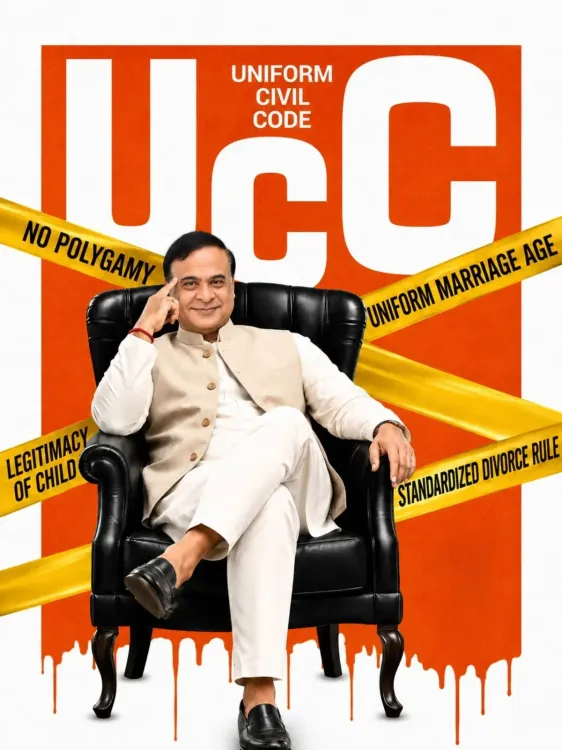
Assam Chief Minister Himanta Biswa Sarma declared the Uniform Civil Code a reality in the state on 6 June 2026, replacing religion-based personal laws with a single civil framework for all citizens — a long-standing BJP electoral commitment now operationalised at the state level.
Key Takeaways
Assam CM Himanta Biswa Sarma announced on 6 June 2026 that the Uniform Civil Code is now in force in Assam.
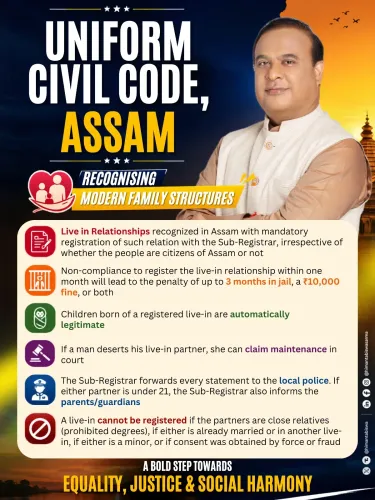
The UCC replaces separate religion-based personal laws on marriage, divorce, inheritance and adoption for all citizens of the state.
Article 44 of the Constitution has directed the state to pursue a UCC since 1950 ; the BJP included it in its 2014 and 2019 election manifestos.
Assam's large tribal belt governed under the Sixth Schedule raises unresolved questions about the code's applicability to customary tribal laws.
Legal challenges before the Gauhati High Court or Supreme Court are widely anticipated over the legislation's scope and constitutional validity.
The move positions Assam as a potential model for other BJP-ruled states considering similar legislation.
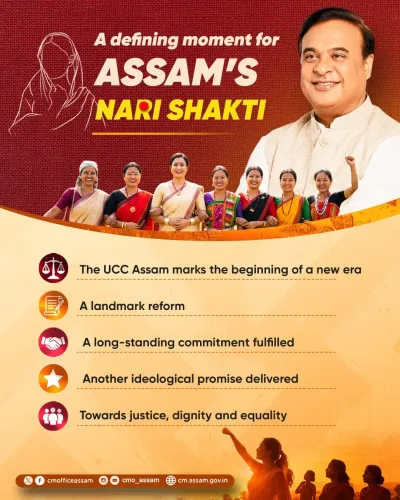
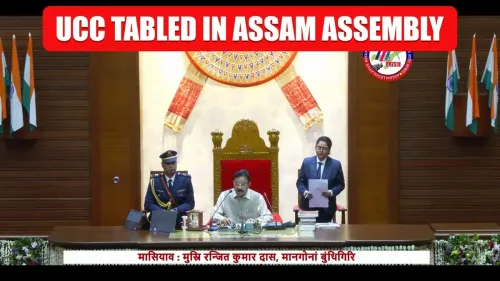
Assam Chief Minister Himanta Biswa Sarma on Saturday, 6 June 2026, declared the Uniform Civil Code (UCC) a reality in Assam, announcing that all citizens of the state will now be governed by a single set of personal laws regardless of religion. The announcement, made via a post on X, signals a landmark shift in the state's legal framework, eliminating religion-specific provisions on matters such as marriage, divorce, inheritance and adoption.
Context
Sarma's post declared: 'No more special provisions, everyone's equal before the law. #UCCAssam, now a reality.' The statement marks Assam as one of the first states in India to formally operationalise a Uniform Civil Code, a step that has been a centrepiece of the Bharatiya Janata Party (BJP)'s political programme for over a decade. The move effectively replaces religion-based personal laws — governing communities such as Hindus, Muslims, Christians and others — with a common statutory framework.
Policy Backdrop
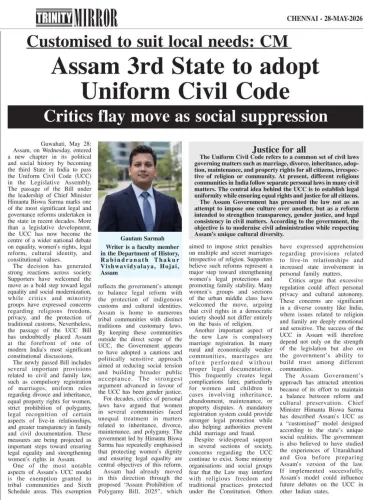
Article 44 of the Constitution of India (1950) lists a Uniform Civil Code among the Directive Principles of State Policy, directing the state to 'endeavour to secure' such a code for all citizens. The BJP explicitly promised enactment of a UCC in its 2014 and 2019 general election manifestos under the 'one nation, one law' plank. Assam, however, carries a particular constitutional complexity: large portions of the state fall under the Sixth Schedule of the Constitution, which grants autonomous governance rights to tribal communities — a dimension that legal experts say will be closely scrutinised in any challenge to the new law.
Sarma, who has served as Assam Chief Minister since 2021 and doubles as convenor of the North-East Democratic Alliance (NEDA), has consistently positioned the state as a testing ground for BJP's national governance agenda. The UCC announcement follows a pattern of assertive legislative action in the state on issues touching identity, demography and personal law.
Stakeholders and Impact
Religious communities across Assam — including its significant Muslim population — will see existing personal law arrangements superseded by the unified code. Women's rights groups have historically supported UCC proposals on the grounds that uniform laws would strengthen protections against practices such as instant triple talaq and unequal inheritance rules. At the same time, tribal organisations operating under the Sixth Schedule framework have expressed concern about whether customary laws governing land, succession and community governance will be preserved or overridden.
The announcement is expected to generate significant political mobilisation ahead of future state and national electoral cycles, with opposition parties likely to contest both the substance and the process of the legislation.
What's Next
The immediate focus will be on the precise text of the Assam UCC legislation — specifically its scope, effective date, and any carve-outs for Sixth Schedule tribal areas. Constitutional lawyers are expected to examine whether the state legislature had the competence to enact such a law and whether it conflicts with central personal law statutes. Petitions before the Gauhati High Court or the Supreme Court of India are widely anticipated. How the Sarma government navigates the intersection of civil equality and tribal autonomy will set a precedent for other BJP-governed states watching closely.
Point of View
Timed to reinforce the party's 'one nation, one law' narrative at both the state and national level. By acting at the state level rather than waiting for central legislation, Assam has effectively forced the pace of a debate that has long stalled in Parliament. The critical test will be the Sixth Schedule question: if tribal customary laws are exempted, critics will argue the code is not truly uniform; if they are not, a constitutional confrontation with tribal bodies becomes likely. Either way, Assam's UCC will serve as a live case study shaping how India's broader UCC debate unfolds.
NationPress
21 Oct 2026
Frequently Asked Questions
What is the Uniform Civil Code in Assam?
The Uniform Civil Code in Assam is a single set of laws governing personal matters such as marriage, divorce, inheritance and adoption for all citizens of the state, regardless of their religion, replacing earlier religion-specific personal law frameworks.
When did UCC come into effect in Assam?
Assam Chief Minister Himanta Biswa Sarma declared the UCC a reality on 6 June 2026 , though the precise effective date and full legislative text are subject to official notification.
Does the Assam UCC apply to tribal communities?
This is a key unresolved question. Large parts of Assam fall under the Sixth Schedule of the Constitution, which protects tribal customary laws. Whether the Assam UCC overrides or exempts these provisions is expected to be contested in court.
Which states have implemented UCC in India?
Assam is among the earliest states to declare a Uniform Civil Code operational. Uttarakhand had earlier enacted UCC legislation, making it a reference point; Assam's move adds momentum to similar discussions in other BJP-governed states.
Can the Assam UCC be challenged in court?
Yes. Constitutional lawyers anticipate petitions in the Gauhati High Court or the Supreme Court of India challenging the law on grounds of legislative competence, conflict with central personal law statutes, and the rights of Sixth Schedule tribal communities.