Assam becomes 3rd state to adopt UCC
Synopsis
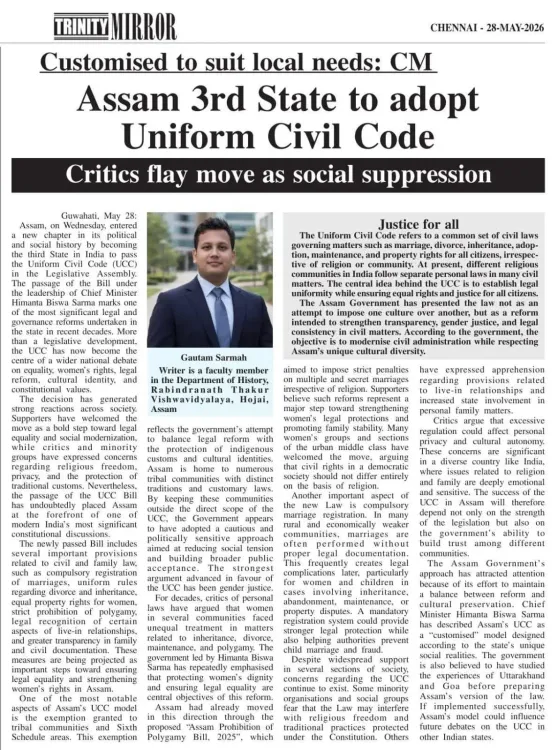
Assam has become the third Indian state to adopt the Uniform Civil Code, following Goa and Uttarakhand, as Chief Minister Himanta Biswa Sarma's government advances one of the BJP's core legislative commitments. The move has broad implications for the state's diverse religious and tribal communities.
Key Takeaways
Assam has become the third state in India to adopt the Uniform Civil Code , as announced by the Chief Minister's Office on 30 May 2026 .
Goa has held a uniform civil code since 1867 under a Portuguese-era statute; Uttarakhand became the first post-independence state to legislate a fresh UCC in February 2024 .
The UCC is rooted in Article 44 of the Indian Constitution, a Directive Principle directing the State to enact common personal laws.
Chief Minister Himanta Biswa Sarma has been a leading advocate of BJP legislative priorities in the Northeast since taking office in May 2021 .
Key areas of scrutiny include protections for tribal communities under the Sixth Schedule and potential legal challenges from minority groups.
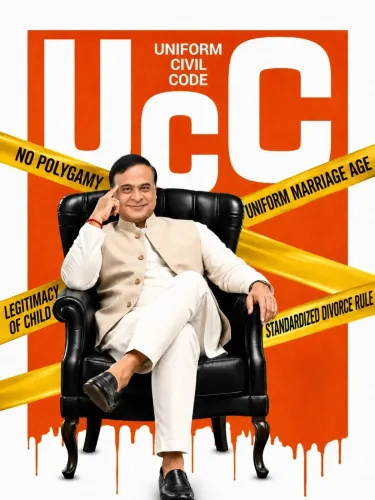
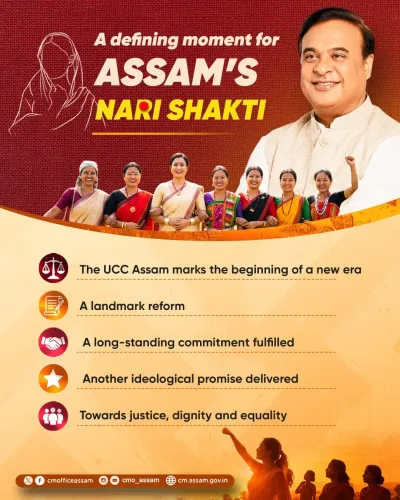
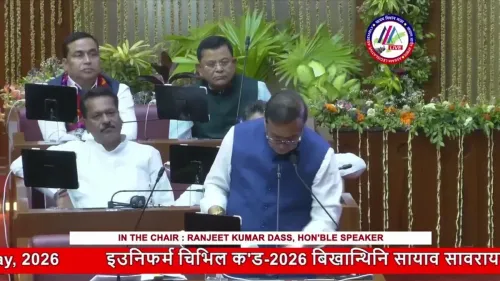
The Chief Minister's Office of Assam announced on Saturday, 30 May 2026 that Assam has become the third state in India to adopt the Uniform Civil Code (UCC), a landmark move to replace religion-based personal laws with a common legal framework for all citizens.
Context
The Uniform Civil Code derives its constitutional basis from Article 44 of the Indian Constitution, a Directive Principle of State Policy that has remained largely unimplemented at the national level since 1950. It calls on the State to secure uniform laws governing marriage, divorce, inheritance, and adoption for all citizens regardless of religious affiliation.
Goa has long been the only Indian state with a functioning uniform civil code, inherited from the Portuguese-era civil code of 1867. That changed in February 2024, when Uttarakhand became the first state after independence to legislate a fresh UCC, breaking new ground and setting a template for other BJP-ruled states.
Policy Backdrop
Assam's move follows a broader legislative push by BJP-governed states to enact uniform personal laws, fulfilling a long-standing party commitment. Chief Minister Himanta Biswa Sarma, who has led the Assam government since May 2021, has been a vocal advocate for the BJP's legislative priorities in the Northeast.
The UCC has been a politically significant agenda item for the Bharatiya Janata Party for decades, with proponents arguing it will advance gender justice and national integration by eliminating disparities in personal law across religious communities. Critics, particularly from minority religious groups, have raised concerns about cultural autonomy and the rights of tribal communities, many of whom are concentrated in states like Assam.
Stakeholders and Impact
The adoption of the UCC in Assam has wide-ranging implications for the state's diverse population, which includes Hindus, Muslims, Christians, and a significant number of tribal communities governed by customary laws. Women's rights advocates have broadly welcomed uniform inheritance and marriage laws, arguing they close legal gaps that disadvantage women under certain personal law regimes.
Tribal groups in Assam, however, have historically sought exemptions from UCC provisions, citing the primacy of customary practices protected under the Sixth Schedule of the Constitution. How the Assam legislation addresses these communities will be a critical point of scrutiny. Religious minority organisations are expected to closely examine the enacted provisions and may mount legal challenges.
What's Next
Attention will now turn to the drafting of implementation rules, the formation of any oversight bodies, and the timeline for the code coming into force across Assam. Legal experts anticipate that constitutional challenges before the Gauhati High Court or the Supreme Court of India are possible, particularly on questions of tribal customary law and minority rights.
With Assam now joining Goa and Uttarakhand as the only states with a UCC in effect, the development will intensify the national debate on whether the Centre should pursue a pan-India code — a question that is likely to remain at the heart of Indian political discourse in the months ahead.
Point of View
Effectively building political and legal precedent from the ground up. The move places Chief Minister Himanta Biswa Sarma at the forefront of the party's ideological agenda in the Northeast, a region where religious and tribal diversity makes implementation far more complex than in Uttarakhand. The critical test will be whether the Assam legislation carves out workable exemptions for Sixth Schedule tribal communities — a design choice that could either defuse opposition or invite prolonged judicial scrutiny. Nationally, three states now operating under a UCC framework substantially strengthens the political case for a pan-India code, raising the stakes for the debate in Parliament.
NationPress
14 Oct 2026
Frequently Asked Questions
Which states have adopted the Uniform Civil Code in India?
Goa , Uttarakhand , and now Assam are the three states in India with a Uniform Civil Code. Goa has had one since the Portuguese colonial era, Uttarakhand enacted fresh legislation in February 2024, and Assam adopted the UCC in May 2026.
What is the Uniform Civil Code and what does it cover?
The Uniform Civil Code (UCC) is a proposed common set of laws governing personal matters — marriage, divorce, inheritance, and adoption — applicable to all citizens regardless of religion. It is mandated as a goal under Article 44 of the Indian Constitution.
Will the UCC apply to tribal communities in Assam?
This is a key question under scrutiny. Many tribal communities in Assam are protected under the Sixth Schedule of the Constitution, which safeguards customary laws. How the Assam UCC legislation addresses tribal exemptions will be closely watched by legal experts and community groups.
Who is the Chief Minister of Assam pushing the UCC?
Himanta Biswa Sarma of the BJP is the Chief Minister of Assam. He has been in office since May 2021 and has been a prominent advocate of the party's legislative priorities, including the Uniform Civil Code.
Can the Assam UCC be challenged in court?
Yes, legal challenges are anticipated. Constitutional experts expect petitions may be filed before the Gauhati High Court or the Supreme Court of India , particularly on grounds related to minority religious rights and tribal customary law protections under the Sixth Schedule.