CM Himanta: Assam UCC Preserves Customs, Ensures Women's Rights

Synopsis
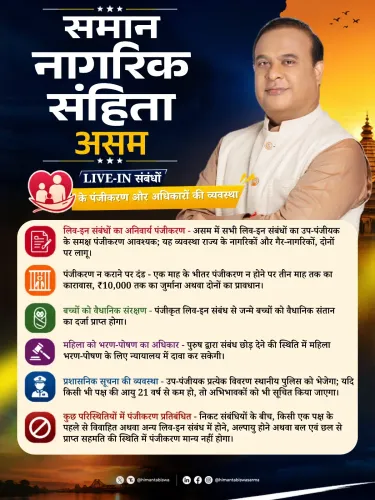
Chief Minister Himanta Biswa Sarma told the Assam Legislative Assembly on 27 May 2026 that the state's Uniform Civil Code will protect customs and traditions while enforcing strict provisions to uphold justice, equality and women's rights — signalling a dual-track approach to civil law reform.
Key Takeaways
CM Himanta Biswa Sarma stated in the Assam Legislative Assembly on 27 May 2026 that the state's UCC guarantees complete freedom in matters of customs, traditions and rituals.
The code will include strict provisions in specific areas to uphold justice, equality and the rights of women .
Assam formed an expert committee in 2024 to study the feasibility of a state-specific UCC, following Uttarakhand 's landmark UCC legislation.
The proposed code must navigate protections for tribal communities under the Sixth Schedule and the Assam Accord framework.
A formal draft UCC bill and consultations with tribal councils are the next anticipated steps in the legislative process.
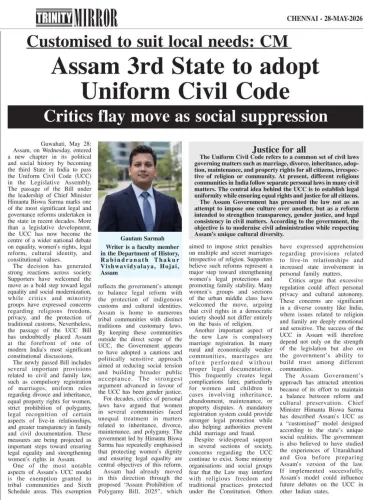
The Chief Minister's Office of Assam announced on Thursday, 28 May 2026 that Chief Minister Dr. Himanta Biswa Sarma stated in the Assam Legislative Assembly that the state's proposed Uniform Civil Code (UCC) will guarantee complete freedom in matters of customs, traditions and rituals, while incorporating strict provisions in specific areas to uphold justice, equality and the rights of women.
Context
Speaking on the floor of the Assam Legislative Assembly on Wednesday, 27 May 2026, CM Himanta Biswa Sarma sought to address concerns that a uniform civil code would override the distinct customs and traditions of Assam's diverse communities. He framed the proposed code as a dual-purpose instrument — one that protects cultural plurality while simultaneously enforcing non-negotiable standards of gender justice. The statement came as the Assembly engaged in what appears to be substantive debate on the contours of a state-specific UCC framework.
Policy Backdrop
The push for a state-level UCC in Assam has been building since 2024, when the state government constituted an expert committee to study the feasibility of such a code. Uttarakhand became the first Indian state to pass a UCC law in 2024, setting a legislative precedent that several BJP-governed states have since looked to as a model. The Uniform Civil Code is envisioned under Article 44 of the Indian Constitution as a directive principle, calling for uniform personal laws governing marriage, divorce, inheritance and adoption across communities.
Assam's situation carries additional complexity. The state has a large tribal population with protections enshrined under the Sixth Schedule of the Constitution and the Assam Accord framework. Any UCC formulation must navigate these pre-existing legal guarantees, which is likely why CM Sarma emphasised that the code will 'guarantee complete freedom in matters of customs, traditions and rituals.' The carve-outs signal an effort to distinguish Assam's model from a one-size-fits-all approach.
Stakeholders and Impact
Two constituencies stand at the centre of this debate: women and tribal communities. For women across communities, the 'strict provisions' referenced by CM Sarma are expected to address inequities in personal law — particularly around marriage age, divorce rights and inheritance — that currently vary by religion and custom. Tribal councils and community leaders, on the other hand, have historically been wary of any centralising legislation that could dilute customary law, and the Chief Minister's assurances appear directed squarely at these concerns.
The broader political dimension is equally significant. The UCC has been a long-standing commitment in the BJP's national manifesto, and state-level action in Assam reinforces that arc while allowing the party to demonstrate legislative delivery on a flagship social-reform agenda ahead of future electoral cycles.
What's Next
The immediate focus shifts to whether the Assam government will introduce a formal draft UCC bill in the ongoing or an upcoming Assembly session. Stakeholder consultations — particularly with tribal councils operating under the Sixth Schedule — will be a critical test of whether the balance CM Sarma described can be translated into enforceable legislative text. The outcome in Assam could shape the template for other states with comparably diverse customary-law landscapes, making its drafting process one of the more closely watched legislative exercises in the country.
Point of View
Distinguishing its model from Uttarakhand's more straightforward rollout. If Assam succeeds in drafting a code that holds up to both constitutional scrutiny and community acceptance, it could become the reference point for multi-community states considering similar legislation. The Assembly statement also signals that the government is moving toward a bill introduction, elevating this from policy discussion to active legislative business.
NationPress
19 Sept 2026
Frequently Asked Questions
What did CM Himanta Biswa Sarma say about the Assam UCC in the Assembly?
CM Sarma stated on 27 May 2026 that the Assam Uniform Civil Code guarantees complete freedom in matters of customs, traditions and rituals, while incorporating strict provisions in specific areas to uphold justice, equality and the rights of women.
Will the Assam UCC affect tribal customs and traditions?
According to CM Sarma's statement, the Assam UCC is designed to protect customs, traditions and rituals, with the government signalling sensitivity to tribal communities who hold protections under the Sixth Schedule of the Constitution and the Assam Accord.
Which was the first Indian state to pass a Uniform Civil Code?
Uttarakhand was the first Indian state to pass a Uniform Civil Code law, doing so in 2024, setting a legislative precedent that other BJP-governed states including Assam have since been studying.
What is the current status of the Assam UCC bill?
As of May 2026, CM Sarma has made a statement of intent in the Assam Legislative Assembly outlining the code's principles. A formal draft bill has not yet been publicly tabled, and stakeholder consultations — particularly with tribal councils — are expected to follow.
How does the Assam UCC relate to Article 44 of the Indian Constitution?
Article 44 of the Indian Constitution is a directive principle that calls on the state to secure a Uniform Civil Code for all citizens. Assam's proposed code draws on this constitutional vision while attempting to balance it with existing protections for tribal and minority communities within the state.