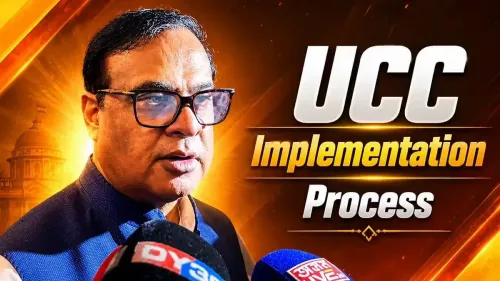
CM Himanta Hails Passage of UCC Assam Bill in Assembly

Synopsis
Assam Chief Minister Himanta Biswa Sarma on 27 May 2026 hailed the passage of the UCC Assam Bill, which imposes a single civil code across all religions in the state except Sixth Schedule tribal areas, following Uttarakhand's 2024 precedent and the BJP's long-standing manifesto commitment.
Key Takeaways
The UCC Assam Bill was passed on 27 May 2026 , making Assam one of the first Indian states to enact a state-level Uniform Civil Code.
CM Himanta Biswa Sarma stated the law ensures every person across all religions in Assam is 'equal before the law' in civil matters.
The law explicitly exempts Sixth Schedule tribal autonomous areas, preserving constitutional protections for tribal customary laws.
All NDA legislators in the Assam assembly supported the bill, according to CM Sarma.
Uttarakhand enacted India's first state-level UCC in February 2024 , serving as the legislative precedent for Assam.
The move aligns with Article 44 of the Indian Constitution and the BJP's manifesto commitments of 2014 and 2019 .
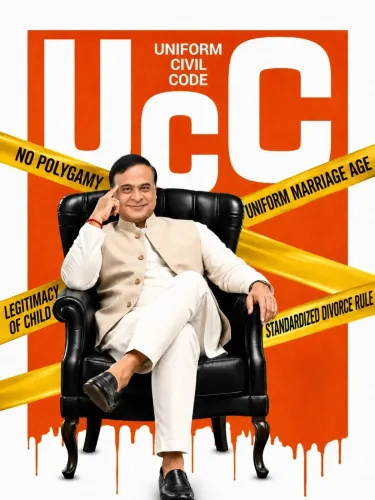
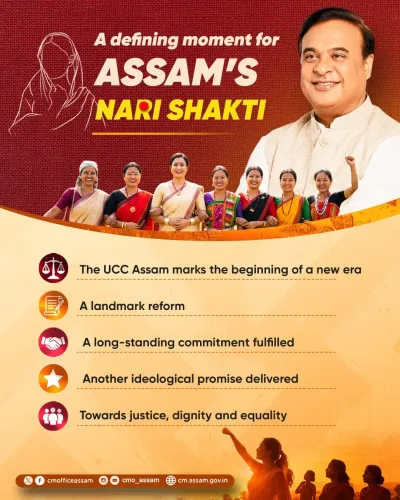
Assam Chief Minister Himanta Biswa Sarma on Wednesday, 27 May 2026 welcomed the passage of the Uniform Civil Code (UCC) Assam Bill in the state assembly, declaring that every person across all religions in Assam — barring Sixth Schedule tribal areas — will now be equal before the law in civil matters. The Chief Minister also thanked all NDA legislators for their support of the legislation.
Context
Posting on X, CM Sarma stated: 'Today, with the passage of the #UCCAssam bill, every person from every religion across any region of Assam (except 6th Schedule areas), will be equal before the law in terms of these civil matters.' He added that he thanked 'all NDA legislators for wholeheartedly supporting this crucial Bill.'
The passage marks a significant legislative moment for Assam, making it one of the early states to enact a state-level Uniform Civil Code following Uttarakhand, which became the first Indian state to do so in February 2024.
Policy Backdrop
Article 44 of the Indian Constitution (1950) places a Uniform Civil Code among the Directive Principles of State Policy, directing the State to secure a common code governing civil matters — including marriage, inheritance, and related personal law — for all citizens regardless of religion.
The BJP included UCC implementation in its national election manifestos of 2014 and 2019. Uttarakhand's UCC, enacted in early 2024, provided the first working state-level template and set a precedent that Assam has now followed. The Assam bill applies to residents across faiths but explicitly carves out Sixth Schedule autonomous tribal districts, consistent with long-standing constitutional protections for tribal customary laws in the North-East.
Stakeholders and Impact
The bill directly affects Assam's diverse population, which includes Hindu, Muslim, Christian and other religious communities governed by different personal law regimes for civil matters. Under the new law, a single civil code will apply uniformly across these communities in non-Sixth Schedule regions of the state.
The Sixth Schedule exemption preserves the autonomy of tribal communities in districts such as those under the Bodoland Territorial Council and other autonomous councils, whose customary practices remain protected under the Constitution. CM Sarma, who also serves as convenor of the North-East Democratic Alliance (NEDA), has consistently positioned the move as a step toward formal legal equality rather than cultural uniformity.
What's Next
Attention will now turn to the framing of rules and administrative mechanisms required to operationalise the UCC Assam law on the ground. Legal challenges before courts are a possibility, as has been the pattern with major personal-law reforms in India.
Observers will also watch whether other BJP-governed North-East states within the NEDA framework move toward similar legislation, and whether the central government uses Assam's experience to inform any future national-level UCC push.
Point of View
And it carries particular symbolic weight given Assam's religious and ethnic diversity. By carving out Sixth Schedule areas, CM Sarma has threaded a careful constitutional needle — advancing the party's ideological priority while pre-empting the sharpest objections from tribal communities in the North-East. As NEDA convenor, Sarma's move could create soft pressure on other BJP-aligned North-East governments to follow suit, effectively building a regional UCC bloc ahead of any central legislation. The unanimous NDA support underscores the ruling coalition's legislative cohesion, though the real test will come in implementation and any judicial scrutiny.
NationPress
10 Oct 2026
Frequently Asked Questions
What is the UCC Assam Bill passed in 2026?
The UCC Assam Bill is a state legislation passed on 27 May 2026 that establishes a Uniform Civil Code for Assam, replacing religion-specific personal laws with a single civil code governing matters such as marriage and inheritance for all residents except those in Sixth Schedule tribal areas.
Which areas are exempt from the Assam UCC?
Sixth Schedule areas — constitutionally protected tribal autonomous districts in Assam — are exempt from the UCC Assam Bill, preserving customary tribal laws in those regions.
Is Assam the first state to pass a Uniform Civil Code?
No. Uttarakhand became the first Indian state to enact a Uniform Civil Code in February 2024. Assam is among the early states to follow with its own state-level UCC legislation.
What does Article 44 of the Indian Constitution say about UCC?
Article 44 is a Directive Principle of State Policy that directs the State to endeavour to secure a Uniform Civil Code for all citizens across India, covering civil matters irrespective of religion.
What did CM Himanta Biswa Sarma say about the UCC Assam Bill?
CM Sarma said that with the passage of the bill, every person from every religion across Assam (except Sixth Schedule areas) will be equal before the law in civil matters, and thanked all NDA legislators for 'wholeheartedly supporting this crucial Bill.'