CM Himanta Unveils Key Features of Assam UCC
Synopsis
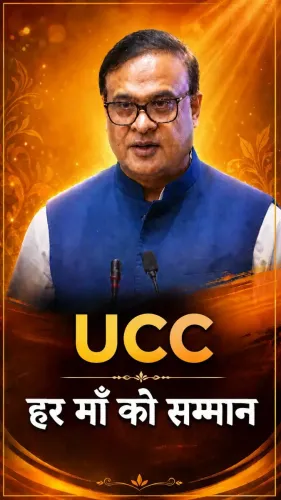
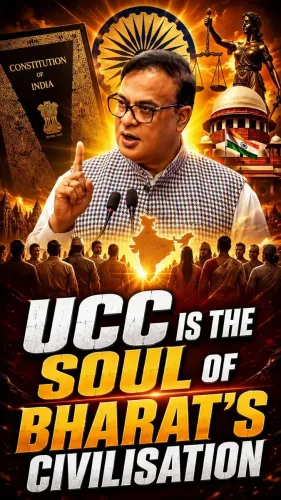
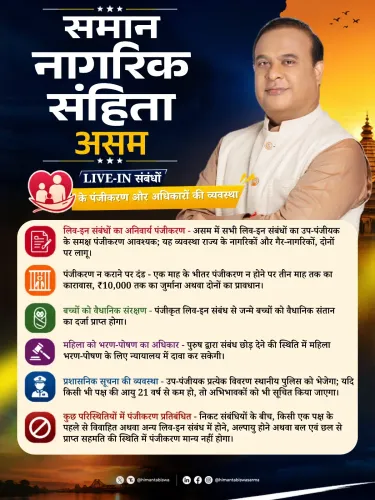
Assam Chief Minister Himanta Biswa Sarma on 28 May 2026 unveiled the salient features of UCCAssam, framing it as a fulfilment of BJP's core ideological promise. The code aims to standardise family law, protect women from exploitation, and carve out protections for indigenous communities under the Sixth Schedule.
Key Takeaways
CM Himanta Biswa Sarma publicly outlined the salient features of #UCCAssam on 28 May 2026 .
The code is designed to bring parity in family law across religious communities in Assam .
A central stated objective is protecting women from exploitation through standardised personal law.
The framework explicitly includes provisions to recognise modern family structures .
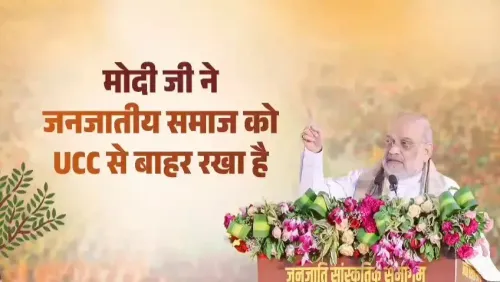
Rights of indigenous communities — protected under the Sixth Schedule — are to be safeguarded through targeted exemptions.
Uttarakhand 's February 2024 UCC law served as a legislative template for other BJP -governed states including Assam .
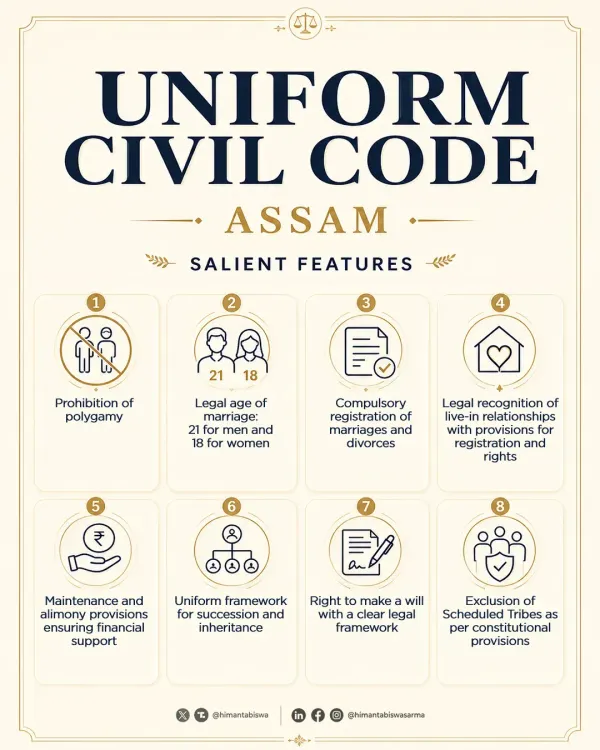
Assam Chief Minister Himanta Biswa Sarma on Thursday, 28 May 2026, outlined the salient features of the Uniform Civil Code for Assam (#UCCAssam), describing it as the fulfilment of a core ideological promise that will bring parity in family law, protect women from exploitation, recognise modern family structures, and safeguard the rights of indigenous communities.
Context
CM Sarma stated that #UCCAssam 'fulfils one of our foremost ideological promises and brings parity in family law and systems to fully protect our sisters from exploitation and recognise modern family structures whilst protecting rights of indigenous communities.' The announcement signals that the Assam government is moving decisively to codify a single set of personal laws governing marriage, divorce, inheritance, and adoption across religious communities in the state.
The framing of the UCC around gender justice — specifically the protection of women — and simultaneous assurances to tribal groups reflects the dual political imperatives the Bharatiya Janata Party (BJP) faces in the Northeast: advancing a majoritarian reform agenda while retaining the trust of numerically significant indigenous constituencies.
Policy Backdrop
The BJP has carried the Uniform Civil Code as a core plank in its national manifestos since 2014 and 2019, committing to replace religion-specific personal laws with a uniform framework. Uttarakhand became the first Indian state to enact a UCC law in February 2024, providing a legislative template that other BJP-governed states, including Assam, Gujarat, and Madhya Pradesh, have been studying.
In Assam, the code is being shaped to address practices such as polygamy while simultaneously carving out exemptions for tribal customs protected under the Sixth Schedule of the Constitution. This dual approach — reform for the general population, protection for scheduled tribes — is central to how CM Sarma has publicly positioned the legislation.
Stakeholders and Impact
Women in Assam are the primary stated beneficiaries of the code, with the government arguing that standardised family law will close loopholes that currently enable discriminatory practices in personal matters such as marriage and divorce. The emphasis on 'parity' suggests the code will seek to equalise rights regardless of the religious personal law a citizen would otherwise fall under.
Indigenous communities — a politically and constitutionally significant constituency in Assam — have been explicitly acknowledged in CM Sarma's announcement. The Sixth Schedule grants substantial autonomy to tribal councils in states including Assam, and any UCC framework will need to navigate the boundary between state-level standardisation and constitutionally protected tribal customary law. Tribal autonomous councils and civil society groups are expected to scrutinise the specific exemptions closely.
What's Next
The immediate next step is the tabling of the UCCAssam bill in the Assam Legislative Assembly, where the ruling BJP-led alliance holds a working majority. Following passage, the legislation is likely to face legal scrutiny, including potential challenges before the Gauhati High Court or the Supreme Court of India, particularly from tribal autonomous councils contesting the scope of exemptions.
The Assam move will also intensify pressure on other BJP-ruled states to accelerate their own UCC processes, reinforcing the party's national narrative ahead of future electoral cycles. How the state balances the competing demands of gender equality advocates and indigenous rights groups will set a precedent for the broader national UCC conversation.
Point of View
And CM Sarma's framing reveals a carefully calibrated political strategy. By anchoring the code in gender justice — specifically women's protection — rather than leading with religious uniformity, the BJP seeks to broaden the reform's appeal and pre-empt criticism from minority groups. The simultaneous assurance to indigenous communities signals that the government is acutely aware of the Northeast's distinct constitutional architecture and the electoral cost of alienating Sixth Schedule communities. If the Assam bill passes without significant legal setback, it will substantially accelerate UCC momentum in Gujarat and Madhya Pradesh and reframe the national debate ahead of the next general election cycle.
NationPress
10 Oct 2026
Frequently Asked Questions
How does Assam UCC protect indigenous communities?
The UCCAssam framework is being designed to carve out exemptions for tribal customary practices protected under the Sixth Schedule of the Indian Constitution, ensuring that autonomous tribal councils and their traditional laws are not overridden by the uniform code.
Which state was first to implement UCC in India?
Uttarakhand became the first Indian state to enact a Uniform Civil Code law in February 2024, providing a legislative model that BJP-governed states including Assam have studied while drafting their own versions.
What does Assam UCC mean for women?
According to CM Himanta Biswa Sarma, UCCAssam aims to bring parity in family law to fully protect women from exploitation by closing loopholes in current religion-specific personal laws that can enable discriminatory practices in marriage and divorce.
Is UCC a BJP policy promise?
Yes. The BJP included the implementation of a Uniform Civil Code as a core commitment in its national manifestos of 2014 and 2019, framing it as a measure to replace religion-specific personal laws with a single civil code applicable to all Indian citizens.