CM Himanta Highlights Welfare Gains Under Double Engine Govt in Assam

Synopsis
Assam CM Himanta Biswa Sarma on 4 July 2026 posted a video highlighting welfare results across the state — pucca housing under PMAY, PM-KISAN farmer support, Orunodoi cash transfers for women, and sanitation access — framing them as outcomes of the BJP's double engine government model.
Key Takeaways
CM Himanta Biswa Sarma posted a video on 4 July 2026 showcasing welfare scheme outcomes across Assam .
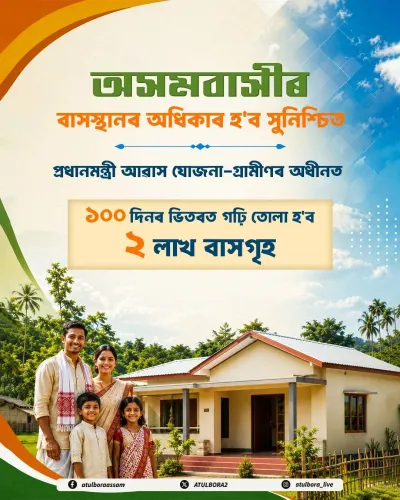
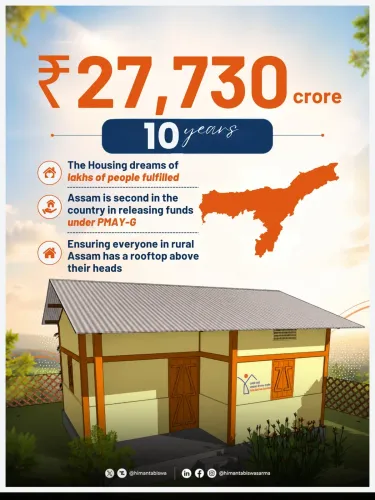
The post cites PMAY pucca housing , PM-KISAN Kisan Samman , and Orunodoi monthly cash transfers as key deliverables.
Sanitation facilities referred to as Ijjatghar were highlighted as a dignity-linked welfare outcome for women.
The 'double engine government' framing positions coordinated BJP rule at both the state and central level as the driver of these results.
Assam has been governed by the BJP since 2016 , with CM Sarma in office since May 2021 .
Updated beneficiary data for PMAY and Orunodoi is expected to be released during the next budget session or central ministry review.
Assam Chief Minister Himanta Biswa Sarma on Saturday, 4 July 2026, shared a video on X showcasing the on-ground impact of welfare schemes across Assam, pointing to housing, farmer support, sanitation, and women's financial empowerment as visible markers of progress under what he called the 'double engine government.'
Posting in Hindi, CM Sarma wrote: 'Aaj Assam mein charon or jankalyan ke parinaam dikhai de rahe hain' ('Today, the results of public welfare are visible all around in Assam'). He cited pucca houses for the homeless, Kisan Samman for farmers, sanitation facilities — referred to as Ijjatghar — for women, and the Arunodaya scheme's economic support as concrete deliverables of this dual-government model.
Context
The phrase 'double engine government' is a formulation used by the BJP to describe states where both the state government and the central government are led by the party, implying coordinated policy delivery. Assam has been governed by the BJP since 2016, with CM Sarma at the helm since May 2021. The post, accompanied by a video, appears designed to consolidate the narrative of welfare delivery ahead of administrative review cycles.
Policy Backdrop
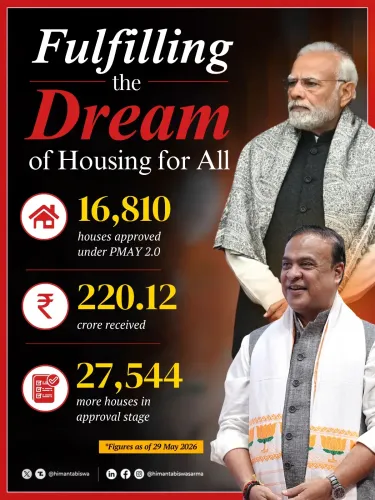
The welfare outcomes cited in the post draw from a stack of both central and state schemes. Pradhan Mantri Awas Yojana (PMAY) has been the primary vehicle for delivering pucca housing to rural and urban households in Assam under successive annual action plans since 2015. PM-KISAN, launched nationally in 2019, provides direct annual income-support instalments to landholding farmer families, including those in Assam.
The Orunodoi (Arunodaya) scheme, launched by the Assam government in 2020, provides monthly cash transfers to women from economically weaker sections, making it one of the state's flagship women-centric programmes. Together, these schemes represent the BJP's strategy of layering state initiatives on top of central direct benefit transfers to maximise household-level impact in the Northeast.
Stakeholders and Impact
The primary beneficiaries highlighted in the post are rural households that have received permanent housing, farming families receiving income support under PM-KISAN, and women beneficiaries of the Orunodoi scheme. Sanitation access — referenced through the term Ijjatghar, meaning a facility of dignity — has been a recurring element of welfare messaging in Assam, particularly for women in rural areas.
The broader political stakeholder is the BJP itself, which has used welfare delivery as an organisational tool to deepen its presence across Assam and the wider Northeast region. CM Sarma also serves as convener of the North-East Democratic Alliance (NEDA), giving him a regional platform beyond Assam to project this governance model.
What's Next
Attention will turn to the release of updated beneficiary lists and utilisation certificates for PMAY and Orunodoi during Assam's next budget session or central ministry reviews. The state government is expected to continue amplifying scheme outcomes through direct-to-citizen communication, with video-led social media posts forming a key part of that outreach strategy. Whether fresh tranches or expanded eligibility criteria are announced will be closely watched by rural households and women's groups across the state.
Point of View
Vernacular social media content to convert scheme data into political narrative ahead of review cycles. By bundling central schemes like PMAY and PM-KISAN with the state-originated Orunodoi programme, the messaging blurs the line between central and state credit, a deliberate strategy in a state the party has held since 2016. As NEDA convener, Sarma's welfare optics carry weight beyond Assam, serving as a template for BJP-governed northeastern states. The post signals that welfare delivery will remain the party's primary political currency in the region through the next electoral cycle.
NationPress
3 Oct 2026
Frequently Asked Questions
What is the Orunodoi scheme in Assam?
The Orunodoi (also spelled Arunodaya) scheme is an Assam government programme launched in 2020 that provides monthly cash transfers to women from economically weaker sections to support their livelihoods and financial independence.
What is the double engine government model CM Himanta refers to?
The 'double engine government' is a BJP formulation describing states where both the state and central governments are led by the BJP, implying coordinated and faster delivery of welfare schemes and development projects.
What welfare schemes are being highlighted in Assam in 2026?
CM Himanta Biswa Sarma's post highlights PMAY pucca housing, PM-KISAN farmer income support, the Orunodoi cash transfer scheme for women, and sanitation facilities as key welfare outcomes in Assam.
What is PM-KISAN and how does it benefit Assam farmers?
PM-KISAN is a central government scheme launched in 2019 that provides annual direct income support to landholding farmer families across India, including those in Assam, through direct benefit transfers.
Who is Himanta Biswa Sarma and what is his role in the Northeast?
Himanta Biswa Sarma is the Chief Minister of Assam since May 2021 and a senior BJP leader. He also serves as the convener of the North-East Democratic Alliance (NEDA), giving him a coordinating role across BJP and allied governments in the northeastern region.