CM Pema Khandu Backs Arunachal–Sikkim Farm Linkage
Synopsis
Arunachal Pradesh CM Pema Khandu has backed the Brother–Sister Constituency initiative, under which premium pineapples and lemons from Mebo are being sent to Sikkim for value addition, with support from Discover Temi, promoting agro-tourism and inter-state rural development.
Key Takeaways
CM Pema Khandu publicly endorsed the Brother–Sister Constituency initiative linking Arunachal Pradesh and Sikkim on 25 July 2026 .
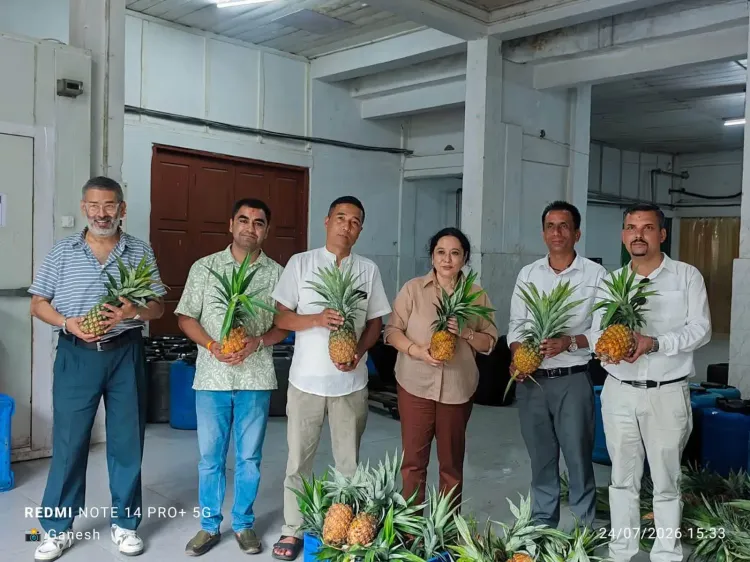
Premium pineapples and lemons from Mebo, Arunachal Pradesh , have been flagged off to Sikkim Supreme for value addition and market expansion.
The initiative is supported by Discover Temi , a Sikkim platform associated with the Temi tea garden belt and local tourism promotion.
MLA Oken Tayeng (Mebo, Arunachal Pradesh) and MLA Bedu Singh Panth (Sikkim) are the key legislators driving the partnership.
The model aims to benefit Mebo farmers, Sikkim's agro-processing sector, and rural tourism operators in both states.
The initiative is positioned as a replicable template for inter-state cooperation across the northeastern region.
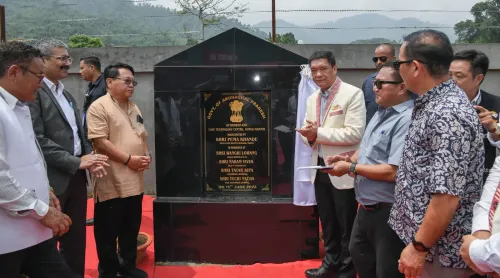
Arunachal Pradesh Chief Minister Pema Khandu on Friday, 25 July 2026, lauded a cross-border agricultural initiative that is sending premium pineapples and lemons from Mebo, Arunachal Pradesh, to Sikkim for value addition and market expansion under the Brother–Sister Constituency arrangement between the two northeastern states.
Context
The flagging-off of produce from Mebo — an assembly constituency in eastern Arunachal Pradesh known for its pineapple and lemon cultivation — to Sikkim Supreme marks a concrete step in the inter-state cooperation effort. CM Khandu described the initiative as 'a beautiful example of how collaboration can strengthen rural livelihoods,' extending congratulations to MLA Oken Tayeng of Mebo and MLA Bedu Singh Panth of Sikkim, the two legislators driving the partnership on either side.
The initiative is supported by Discover Temi, a Sikkim-based platform linked to the promotion of the Temi tea garden belt and local tourism. The involvement of Discover Temi points to an intent to weave agro-tourism and cultural exchange into the commercial arrangement, going beyond a simple commodity trade.
Policy Backdrop
Northeastern states have increasingly pursued bilateral economic linkages in agriculture and tourism to diversify rural incomes beyond centrally sponsored schemes. The shared Himalayan geography and cultural affinities between Arunachal Pradesh and Sikkim have historically made them natural partners, a relationship that the North Eastern Council — established in 1971 — has long sought to formalise through regional coordination frameworks.
The Brother–Sister Constituency model takes this a step further by pairing individual legislative constituencies rather than state governments, allowing elected representatives to drive ground-level collaboration on agriculture, market access, and tourism without waiting for large infrastructure projects. This constituency-level approach is part of a broader pattern across the Northeast of emphasising value addition and direct market linkages for smallholder farmers.
Stakeholders and Impact
The most immediate beneficiaries are Mebo's farming households, who gain access to Sikkim's processing and retail ecosystem through Sikkim Supreme, potentially commanding better prices than local or informal markets. Agro-processing operators in Sikkim stand to gain a reliable supply of fresh tropical fruit from across the state border.
Rural tourism operators in both states also stand to benefit as the initiative explicitly promotes sustainable agro-tourism and cultural exchange. CM Khandu framed the partnership as one that 'connects communities, preserves local heritage, and creates sustainable economic opportunities,' signalling that the political backing for the model extends to its cultural dimensions, not just its commercial ones.
What's Next
The Chief Minister expressed hope that the Arunachal–Sikkim partnership would 'continue to grow as a model of inter-state cooperation and inclusive development,' suggesting that the current produce shipment is intended as a replicable template rather than a one-off exercise. Observers will watch whether comparable constituency-pairing arrangements are extended to other northeastern states, and whether measurable gains in farm incomes and tourist footfall are tracked and published to validate the model. The success of this corridor could also inform how the North Eastern Council structures future sub-regional cooperation frameworks.
Point of View
Giving individual MLAs a direct stake in cross-border economic outcomes. For CM Pema Khandu, publicly championing the model reinforces his administration's narrative of grassroots-driven development in a state where central connectivity projects often dominate the headline agenda. The inclusion of Discover Temi and agro-tourism signals an attempt to build a multi-layered value chain rather than a simple commodity corridor, which, if it scales, could offer a template for other northeastern state pairs. The broader test will be whether the model generates documented income gains for farmers that can withstand political scrutiny beyond the initial flagging-off ceremony.
NationPress
23 Oct 2026
Frequently Asked Questions
What is the Brother–Sister Constituency initiative between Arunachal Pradesh and Sikkim?
It is an inter-state cooperation arrangement that pairs legislative constituencies in Arunachal Pradesh and Sikkim to promote agricultural trade, agro-tourism, and cultural exchange at the grassroots level, with Mebo and a Sikkim constituency currently linked under the scheme.
What produce is being sent from Mebo to Sikkim under this initiative?
Premium pineapples and lemons grown in Mebo, Arunachal Pradesh , are being sent to Sikkim Supreme for value addition and market expansion, benefiting local farmers with access to a wider commercial ecosystem.
Who are the MLAs behind the Arunachal–Sikkim Brother–Sister Constituency initiative?
Oken Tayeng , MLA from Mebo constituency in Arunachal Pradesh, and Bedu Singh Panth , MLA from Sikkim, are the two legislators spearheading the partnership on either side of the state border.
What is Discover Temi and how is it involved?
Discover Temi is a Sikkim-based initiative associated with the Temi tea garden belt and local tourism promotion; it is supporting the Arunachal–Sikkim cooperation by helping integrate agro-tourism and cultural exchange into the agricultural trade linkage.
What did CM Pema Khandu say about the initiative?
CM Pema Khandu called it 'a beautiful example of how collaboration can strengthen rural livelihoods' and expressed hope that the partnership would grow as 'a model of inter-state cooperation and inclusive development' across the northeastern region.