CM Majhi Chairs High-Level Cyclone Review at SRC Office

Synopsis
Chief Minister Mohan Charan Majhi held a high-level review at Odisha's SRC office after Cyclone Arnab, ordering war-footing rescue at the G. Udayagiri landslide site using Navy seismic detectors, directing rapid restoration of power and water, and pre-positioning relief supplies ahead of a fresh cyclone threat.
Key Takeaways
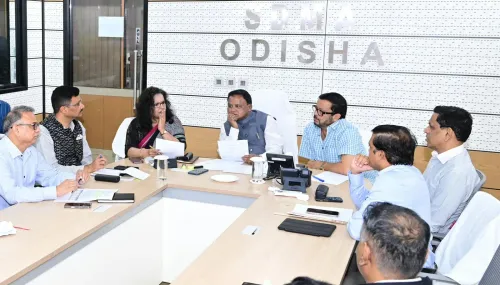
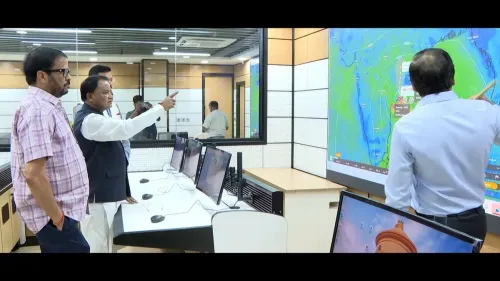
CM Mohan Charan Majhi chaired an emergency high-level review at the SRC office on October 31 to assess post-cyclone damage and plan response.
The Indian Navy airlifted a Seismic Life Detection Unit by helicopter to the G.
Udayagiri landslide site in Kandhamal district.
NDRF, Fire Services, SOG , and Indian Navy teams are conducting joint rescue operations on a war-footing basis in inaccessible areas.
A Chain Pulley System with East Coast Railway assistance is being used to evacuate people from terrain cut off by the cyclone.
Departments have been ordered to restore electricity, roads, and drinking water immediately in all affected areas.
Shelter readiness, pre-emptive evacuations, and stockpiling of dry food, water, and medicines are underway ahead of a fresh potential cyclone.
With a landslide burying communities in G. Udayagiri and another cyclone potentially bearing down on Odisha's coast, Chief Minister Mohan Charan Majhi convened an emergency high-level review at the Special Relief Commissioner (SRC) office on Saturday, October 31 — demanding war-footing rescue operations and zero tolerance for misinformation.
Seismic Detectors and Navy Helicopters at G. Udayagiri
The most urgent front is the landslide site at G. Udayagiri in Kandhamal district, where the Indian Navy has airlifted an advanced 'Seismic Life Detection Unit' by helicopter to locate survivors buried under debris. This technology — capable of detecting faint vibrations from trapped individuals — signals just how desperate the search has become in terrain that road vehicles cannot reach.
On the ground, a joint rescue column comprising NDRF teams, Fire Services, the Special Operations Group (SOG), and Indian Navy personnel is operating on what the Chief Minister's Office described as a 'war-footing basis' in the most inaccessible pockets of the affected zone. The multi-agency coordination mirrors the model Odisha has refined over decades — most visibly during Cyclone Fani in 2019, when more than 1.2 million people were evacuated with minimal casualties.
Chain Pulley System and East Coast Railway Join the Evacuation Push
For communities cut off by washed-out roads, the state has mobilised a Chain Pulley System with assistance from East Coast Railway to physically move people across flooded or collapsed terrain to safer ground. It is a rare deployment that underscores how severely the cyclone has disrupted normal movement in parts of the state.
CM Majhi has directed the Energy Department and other line departments to restore electricity, roads, and drinking water on priority in all cyclone-hit areas. These three utilities — power, connectivity, and clean water — are the first dominoes in any post-disaster recovery, and their absence compounds every other risk from disease to displacement.
Preparing for the Next Storm While Fighting the Last One
Even as rescue teams work through the wreckage of the current cyclone, the review meeting turned one eye toward a fresh cyclonic threat that meteorological agencies have flagged. Shelter facilities are being readied, pre-emptive evacuations from high-risk coastal and low-lying zones have been ordered, and stockpiles of dry rations, potable water, and medicines are being positioned at strategic points.
Odisha's vulnerability is structural: the state sits squarely on the northern Bay of Bengal cyclone track and has faced repeated severe storms. The 1999 Super Cyclone — which killed more than 10,000 people — drove the state to build one of India's most institutionalised disaster-response architectures, including the Odisha State Disaster Management Authority. That architecture is now being stress-tested simultaneously on two fronts: active rescue and pre-emptive preparation.
Cracking Down on Rumours Alongside the Cyclone
CM Majhi has also directed all administrative departments to supply complete, verified, and official information to the media in real time — and to fact-check and rebut rumours and misleading reports without delay. In a crisis where panic can cost lives, the order to control the information environment is as operationally significant as any rescue directive.
With seismic detectors scanning rubble, Navy helicopters threading through storm clouds, and shelter registers being filled ahead of a possible second cyclone, Odisha is running two disaster timelines at once — and the next 48 to 72 hours will determine how well that dual-track response holds.
Point of View
Not a policy one. The deployment of Navy seismic detection technology and the unusual use of East Coast Railway's chain pulley system both point to the severity of terrain disruption, which could become a political liability if restoration of power and water drags beyond the initial 72-hour window. The instruction to actively counter misinformation suggests the administration is also managing a parallel information crisis — a challenge that has grown significantly in the social-media era and one that, if mishandled, can amplify public panic and undermine coordinated relief.
NationPress
1 Nov 2026
Frequently Asked Questions
What is the Seismic Life Detection Unit deployed at G. Udayagiri?
A Seismic Life Detection Unit is advanced rescue equipment that detects faint vibrations or sounds made by people trapped under debris, allowing rescuers to locate survivors in collapsed structures or landslide rubble. The Indian Navy airlifted one to the G. Udayagiri landslide site in Kandhamal district by helicopter.
Which agencies are involved in the cyclone rescue operations in Odisha?
The rescue operations involve the National Disaster Response Force (NDRF), Odisha Fire Services, the Special Operations Group (SOG), and the Indian Navy, all working jointly on a war-footing basis in difficult terrain.
What is a Chain Pulley System and why is it being used in Odisha?
A Chain Pulley System uses mechanical pulleys and chains to move heavy loads or people across gaps, steep terrain, or flooded areas where vehicles cannot operate. It is being deployed with East Coast Railway assistance to evacuate residents from areas cut off by the cyclone.
What preparations is Odisha making for the next possible cyclone?
The state is readying cyclone shelters, ordering pre-emptive evacuations from high-risk zones, and stockpiling dry rations, potable water, and medicines at strategic locations ahead of a fresh cyclonic threat flagged by meteorological agencies.
What is the SRC office in Odisha?
SRC stands for Special Relief Commissioner, the nodal government office in Odisha responsible for coordinating disaster relief and response. CM Majhi chaired his high-level cyclone review meeting at this office on October 31.