CM Majhi Hails Cabinet Nod to BHAVYA-Rasayan Chemical Scheme
Synopsis
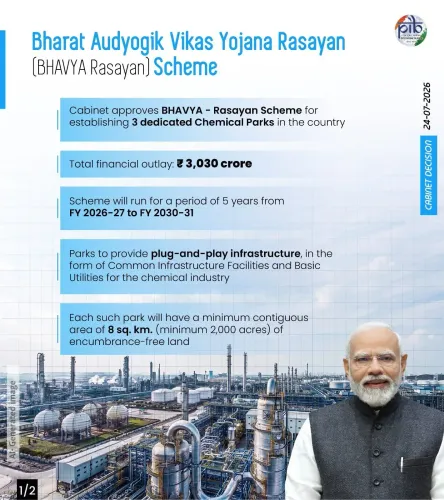
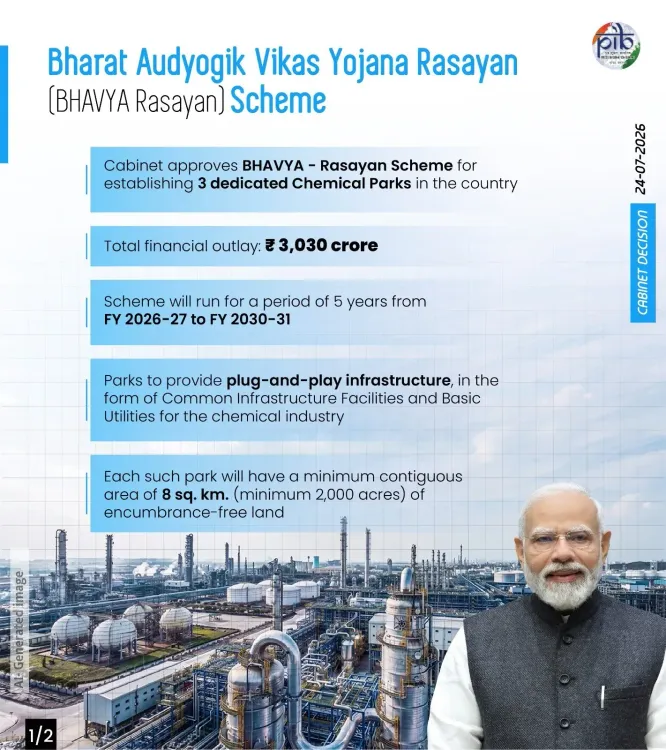
The Union Cabinet has approved the BHAVYA-Rasayan Scheme with a ₹3,030 crore outlay to establish three world-class chemical parks in India. Odisha Chief Minister Mohan Charan Majhi welcomed the move, saying it will attract global investment, create large-scale employment, and advance Atmanirbharta and Viksit Bharat goals.
Key Takeaways
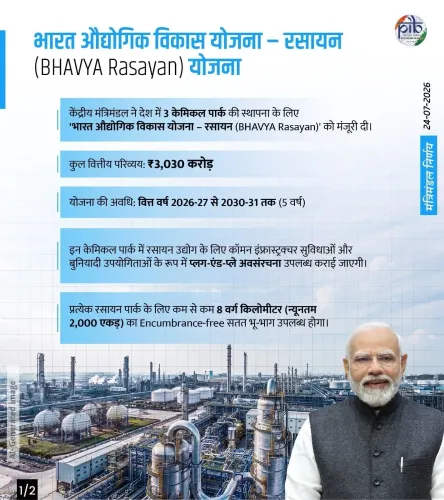
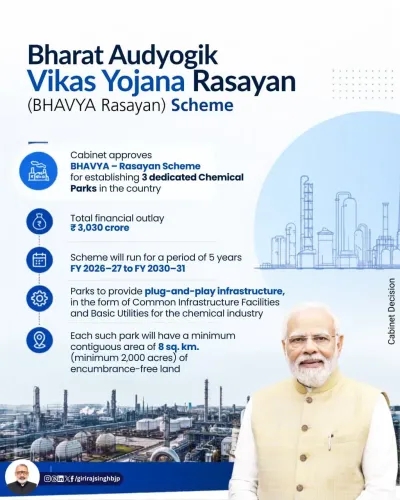
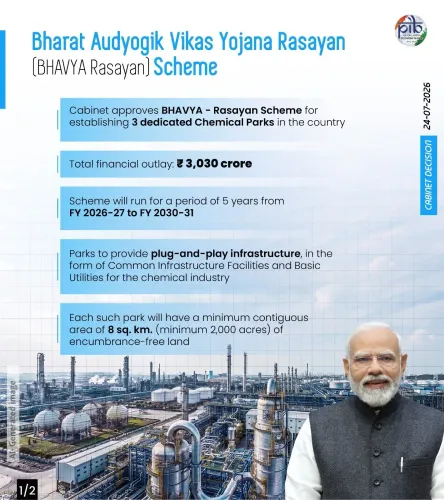
The Union Cabinet approved the BHAVYA-Rasayan Scheme with a total outlay of ₹3,030 crore .
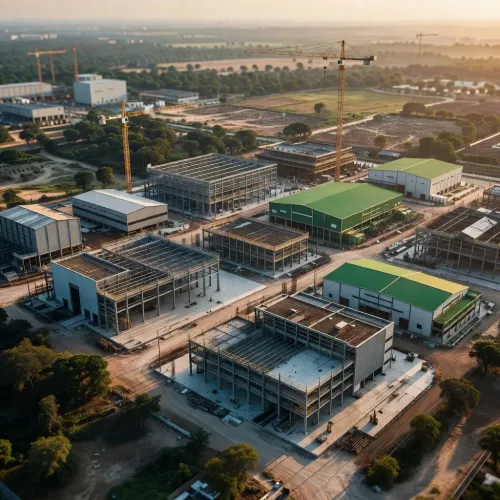
The scheme will fund the establishment of three world-class chemical parks with shared infrastructure.
Goals include attracting domestic and global investment, generating large-scale employment, and boosting exports.
Shared infrastructure is designed to lower production costs and promote sustainable waste management.
The scheme aligns with the Atmanirbhar Bharat and Viksit Bharat policy frameworks championed by PM Narendra Modi .
Odisha CM Mohan Charan Majhi publicly endorsed the scheme, signalling strong state-level support for the initiative.
Odisha Chief Minister Mohan Charan Majhi on Friday, 25 July 2026, welcomed the Union Cabinet's approval of the Bharat Audyogik Vikas Yojana Rasayan (BHAVYA-Rasayan) Scheme, calling it a landmark reform in India's path toward becoming a global chemical manufacturing powerhouse. The scheme carries an outlay of ₹3,030 crore and envisages the creation of three world-class chemical parks designed to attract both domestic and international investment.
Context
In his post on X, CM Majhi stated that the scheme 'will attract domestic and global investments, generate large-scale employment and strengthen upstream, downstream and ancillary industries.' He also expressed gratitude to Prime Minister Narendra Modi, describing the initiative as 'visionary' and crediting it with advancing the goals of Atmanirbharta and a Viksit Bharat. The Chief Minister's endorsement signals strong state-level support for the centrally driven industrial push.
The BHAVYA-Rasayan Scheme is structured around the concept of shared infrastructure within dedicated chemical parks. According to the post, this model is intended to lower production costs, promote sustainable waste management, reduce import dependence, and deepen India's integration with global value chains.
Policy Backdrop
The scheme builds on a multi-year policy lineage aimed at strengthening domestic manufacturing. The Make in India initiative, launched in 2014, first positioned India as a target destination for global manufacturing investment. The Atmanirbhar Bharat campaign, announced in 2020, sharpened the focus on self-reliance in critical sectors, including chemicals and petrochemicals.
An earlier framework, the Petroleum, Chemicals and Petrochemicals Investment Region (PCPIR) policy introduced in 2007, had sought to promote integrated chemical regions with shared utilities and logistics. BHAVYA-Rasayan represents a continuation and deepening of that approach, with an explicit emphasis on sustainable industrial practices and export competitiveness.
India's chemicals sector has long been flagged as strategically important given the country's high import bill for specialty and fine chemicals. Shared-infrastructure parks are seen as a way to bring down capital costs for smaller manufacturers and make Indian chemical exports more price-competitive globally.
Stakeholders and Impact
The primary beneficiaries identified in the post include chemical manufacturers, industrial investors, and the broader manufacturing workforce. By clustering producers within common-infrastructure parks, the scheme aims to create ancillary ecosystems — suppliers, logistics providers, and service firms — that multiply employment beyond the core chemical units.
Sustainable waste management built into the park design is expected to address one of the sector's persistent environmental concerns, potentially easing regulatory compliance for tenants. Boosting exports while reducing reliance on imported chemicals would also strengthen India's current-account position over the medium term.
Odisha, which has been actively positioning itself as an industrial investment destination, stands to benefit if one of the three parks is located in the state. The Chief Minister's prompt and prominent endorsement of the scheme underscores the state government's interest in being part of the rollout.
What's Next
The immediate focus will shift to the announcement of locations for the three chemical parks, which will determine which states attract the bulk of early investment flows. Domestic and global chemical firms are expected to begin preliminary engagement with the government once site details are confirmed.
Subsequent investment proposals, infrastructure tendering, and state-level land-allocation decisions will define the pace at which the scheme's ₹3,030 crore outlay translates into on-ground activity. The BHAVYA-Rasayan Scheme could become a key data point in India's pitch to global supply chains looking to diversify manufacturing bases away from single-country dependence.
Point of View
Moving beyond broad investment incentives toward purpose-built, shared-infrastructure ecosystems. CM Majhi's swift and emphatic endorsement is politically telling — Odisha has been aggressively courting industrial investment, and aligning visibly with a central scheme of this scale strengthens the state's pitch to potential park tenants. The scheme also reflects a broader government pattern of clustering-led industrialisation, echoing the logic of semiconductor and electronics parks announced in earlier policy cycles. Whether the initiative delivers on its export and employment promises will depend heavily on site selection, environmental clearances, and the speed of private-sector uptake once park locations are confirmed.
NationPress
24 Jul 2026
Frequently Asked Questions
What is the BHAVYA-Rasayan Scheme?
The BHAVYA-Rasayan (Bharat Audyogik Vikas Yojana Rasayan) Scheme is a central government initiative approved by the Union Cabinet to establish three world-class chemical parks in India, with a total outlay of ₹3,030 crore, aimed at attracting investment, generating employment, and boosting chemical exports.
What is the budget outlay for BHAVYA-Rasayan?
The Union Cabinet approved an outlay of ₹3,030 crore for the BHAVYA-Rasayan Scheme to fund the development of three chemical parks across India.
How many chemical parks will be built under BHAVYA-Rasayan?
Three world-class chemical parks are planned under the BHAVYA-Rasayan Scheme, with shared infrastructure designed to lower production costs and promote sustainable waste management.
Why did Odisha CM Mohan Charan Majhi welcome the BHAVYA-Rasayan Scheme?
CM Mohan Charan Majhi welcomed the scheme because it promises large-scale employment, domestic and global investment inflows, and stronger industrial ecosystems — goals that align with Odisha's ongoing push to attract industrial investment.
How does BHAVYA-Rasayan connect to Atmanirbhar Bharat?
The scheme directly advances the Atmanirbhar Bharat goal of reducing India's dependence on chemical imports by building domestic production capacity through shared-infrastructure chemical parks, thereby strengthening self-reliance in a strategically important sector.