CM Majhi sets up 6 exclusive SC/ST courts in Odisha
Synopsis
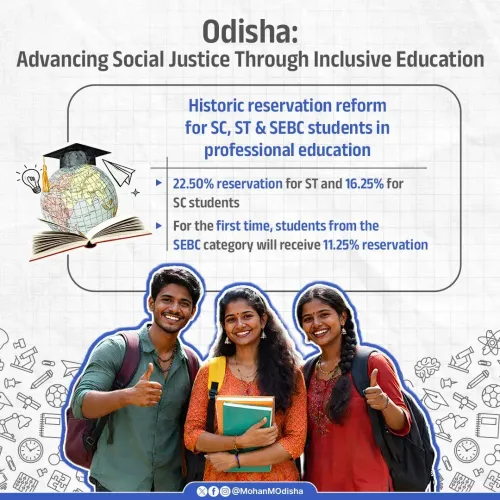
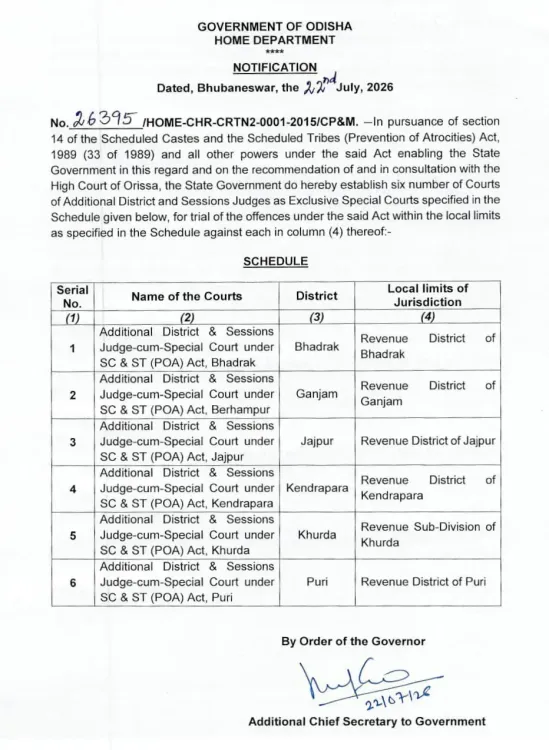
Odisha CM Mohan Charan Majhi has formally notified six Exclusive Special Courts in Bhadrak, Ganjam, Jajapur, Kendrapara, Puri, and Khordha to fast-track trials under the SC/ST (Prevention of Atrocities) Act, 1989, pledging to end years of case pendency that denied justice to tribal and Dalit communities.
Key Takeaways
Six Exclusive Special Courts have been formally notified by the Odisha government in Bhadrak, Ganjam, Jajapur, Kendrapara, Puri, and Khordha .
The courts will hear cases exclusively under the SC/ST (Prevention of Atrocities) Act, 1989 , aiming to cut trial timelines for atrocity victims.
CM Mohan Charan Majhi cited decades of case pendency and legal laxity under previous governments as the core problem being addressed.
The move is framed around the BJP's 'Antyodaya' and 'Sabka Saath, Sabka Vikas' philosophies, targeting the last-mile beneficiary.
The government has adopted a 'zero tolerance' policy on crime and exploitation, with the courts positioned as a structural pillar of that stance.
Operationalisation details — judicial appointments, case-transfer protocols, and disposal targets — are the next critical milestones to watch.
Odisha Chief Minister Mohan Charan Majhi on 22 July 2026 announced the formal notification of six Exclusive Special Courts across the state to fast-track trials under the Scheduled Castes and Scheduled Tribes (Prevention of Atrocities) Act, 1989, targeting years of case pendency that he said had denied justice to the most vulnerable communities.
Context
Posting in Odia on X, CM Majhi invoked the BJP's twin governance philosophies — 'Antyodaya' (upliftment of the last person in the queue) and 'Sabka Saath, Sabka Vikas, Sabka Vishwas, Sabka Prayas' (together with all, development for all, trust of all, effort of all) — to frame the move as a moral, not merely administrative, commitment. He declared that delivering 'appropriate social justice' to tribal, Dalit, and exploited communities is 'the core ethical promise of our government,' not simply a policy decision.
The six courts will be located in Bhadrak, Ganjam, Jajapur, Kendrapara, Puri, and Khordha — districts spread across coastal and southern Odisha. An official notification has already been published, making the announcement a formal legal step rather than a policy proposal.
Policy Backdrop
The SC/ST (Prevention of Atrocities) Act, 1989 — amended in 2015 and again in 2018 — mandates the establishment of special courts for the expeditious disposal of atrocity cases and strengthens victim rights. Despite the law's provisions, critics and legal observers have long noted that designated courts across several states, including Odisha, struggled with large dockets and delays stretching across multiple years.
Odisha's previous Biju Janata Dal (BJD) government, which held power for 24 consecutive years before the 2024 assembly elections, operated designated courts for such cases but faced persistent criticism over pendency. CM Majhi, whose BJP-led administration took charge in June 2024, has framed the new 'exclusive' courts as a structural break from that era — institutions dedicated solely to SC/ST atrocity cases rather than courts handling a mixed docket.
The Chief Minister stated that 'thousands of cases pending for years due to laxity in legal processes during previous regimes' had left innocent victims without recourse, and that his government was 'committed to ending that neglect.'
Stakeholders and Impact
Scheduled Caste and Scheduled Tribe communities in the six identified districts stand to be the most direct beneficiaries. These groups — constitutionally protected but historically vulnerable to atrocities and slow legal redressal — will now have access to courts whose sole mandate is their cases, which legal experts say can significantly reduce trial timelines.
The 'double engine government' framing used by Majhi signals that the state intends to leverage alignment between the BJP government in Bhubaneswar and the Union government in New Delhi to push through judicial infrastructure and resource allocation. The announcement also carries political weight: it positions the BJP as the credible custodian of Dalit and Adivasi rights in a state where those communities form a substantial share of the electorate.
Atrocity victims with cases already in the legal system in the six districts could see their hearings expedited once the courts are operationalised. The government has pledged 'dignified justice in the shortest possible time.'
What's Next
The immediate question is the operationalisation timeline — when the courts will begin hearing cases, how judges and support staff will be appointed, and what case-transfer protocols will apply to existing pending matters. CM Majhi has signalled a 'zero tolerance' policy on crime and exploitation, suggesting the government may announce complementary measures such as victim compensation mechanisms or expansion to additional districts. Monthly case-disposal data from these courts, once functional, will be the clearest measure of whether the institutional promise translates into on-the-ground impact for Odisha's most marginalised citizens.
Point of View
The BJP converts a campaign-style promise into a verifiable legal act — one that can be tracked by case-disposal metrics. The 'Antyodaya' framing also ties the state initiative directly to Prime Minister Modi's national vocabulary, reinforcing the 'double engine' narrative heading into future electoral cycles. Whether the courts are staffed and operationalised swiftly will determine if this becomes a governance benchmark or another pending promise.
NationPress
22 Jul 2026
Frequently Asked Questions
What are the six exclusive special courts announced by Odisha CM Majhi?
Odisha CM Mohan Charan Majhi has notified six Exclusive Special Courts — in Bhadrak, Ganjam, Jajapur, Kendrapara, Puri, and Khordha — dedicated solely to fast-tracking cases under the SC/ST (Prevention of Atrocities) Act, 1989.
What is the SC/ST Prevention of Atrocities Act 1989?
The Scheduled Castes and Scheduled Tribes (Prevention of Atrocities) Act, 1989, is a central law that criminalises atrocities against SC/ST communities and mandates special courts for speedy trials; it was strengthened by amendments in 2015 and 2018.
Why did Odisha set up exclusive special courts for SC/ST cases?
CM Majhi cited years of case pendency and laxity in legal processes under previous governments, which he said left innocent victims without justice; the exclusive courts are designed to resolve this backlog faster than mixed-docket courts.
Which districts in Odisha will get the new SC/ST special courts?
The six districts are Bhadrak, Ganjam, Jajapur, Kendrapara, Puri, and Khordha, covering coastal and southern Odisha.
What is the 'double engine government' referred to by CM Majhi?
'Double engine government' is BJP terminology for simultaneous BJP rule at the Centre and in a state, implying coordinated policy and resource delivery — Majhi used it to signal that both Bhubaneswar and New Delhi are aligned on this social-justice push.