CM Majhi Upgrades Odisha's Semiconductor Policy for Future Growth
Synopsis
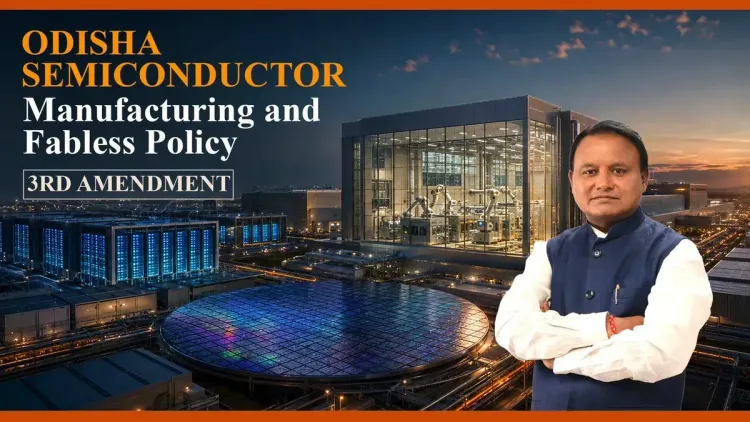
Odisha CM Mohan Charan Majhi has enacted the 3rd Amendment to the state's Semiconductor Manufacturing and Fabless Policy, aligning it with India Semiconductor Mission 2.0. The move targets high-value investment, value-chain deepening, and skilled job creation as part of the Samruddha Odisha 2036 vision.
Key Takeaways
CM Mohan Charan Majhi announced the 3rd Amendment to Odisha's Semiconductor Manufacturing and Fabless Policy on August 13, 2026 .
The amendment aligns the state policy with the central government's India Semiconductor Mission 2.0 (ISM 2.0) .
Goals include strengthening the semiconductor value chain, attracting high-value investments, and creating jobs and skills in the sector.
The initiative is positioned as a pillar of Samruddha Odisha 2036 , the state's long-term economic prosperity vision.
Several Indian states have introduced semiconductor-specific policies since 2021 to complement the central mission; Odisha's amendment deepens this state-centre alignment.
Specific investment proposals or MoUs under the revised policy are expected to emerge in the coming months.
Odisha is making a calculated bet on silicon. Chief Minister Mohan Charan Majhi announced on Thursday, August 13, 2026, that his government has enacted the 3rd Amendment to the Odisha Semiconductor Manufacturing and Fabless Policy, aligning it with the central government's India Semiconductor Mission 2.0 (ISM 2.0) — a move designed to pull high-value semiconductor investments into the state and build a pipeline of skilled tech jobs.
What the Amendment Targets
The revised policy zeroes in on three linked goals: deepening the semiconductor value chain within Odisha, attracting investment from chip manufacturers and fabless design firms, and generating employment and skills in a sector that demands highly trained workers. CM Majhi framed the effort squarely within his government's long-term blueprint, stating the state is 'building a future-ready Odisha that will contribute to India's semiconductor ambitions and advance our vision of Samruddha Odisha 2036.' Samruddha Odisha 2036 is the state's overarching economic prosperity vision, and semiconductors are now a named pillar of it — a signal that Bhubaneswar is treating chip-sector growth as a strategic priority, not an afterthought.Odisha Joins the State-Level Semiconductor Race
The timing is deliberate. The India Semiconductor Mission was first approved in 2021 as part of a Production Linked Incentive framework for electronics, and since then several Indian states have moved to write their own complementary policies — competing to host fabrication units, assembly and test facilities, and design centres that global supply chains are actively relocating out of concentrated East Asian hubs. Odisha's original Semiconductor Manufacturing and Fabless Policy was an early entry in that race. The 3rd Amendment represents an iterative tightening: aligning state incentive structures with ISM 2.0 so that investors navigating both central and state approval windows face a coherent, stacked-incentive environment rather than conflicting frameworks.What Investors and Job-Seekers Should Watch
The policy amendment itself is the legislative foundation; the real test comes in the months ahead, when specific investment proposals or Memoranda of Understanding under the revised framework are expected to surface. Semiconductor fabs and design centres require long lead times and significant capital — announcements of anchor investors would be the clearest indicator that the policy is converting intent into activity. For Odisha's workforce, the skills angle is equally consequential. Semiconductor manufacturing demands engineers, technicians, and process specialists — categories where demand consistently outpaces supply across India. A credible investment pipeline would put pressure on the state's technical education institutions to accelerate relevant programmes. Odisha has drawn the blueprint. The next chapter is written by the investors who sign on the dotted line.Point of View
The move serves a dual political-economic purpose: it positions Odisha as a serious industrial destination ahead of potential investor roadshows, while anchoring his government's identity to a high-visibility national technology agenda. The alignment with ISM 2.0 is significant because stacked central-state incentives are precisely what global chip firms evaluate when shortlisting greenfield sites. Whether Odisha can convert policy credibility into anchor investments will determine if this amendment becomes a genuine inflection point or another well-worded framework awaiting execution.
NationPress
13 Aug 2026
Frequently Asked Questions
What is the 3rd Amendment to Odisha's Semiconductor Policy?
It is the latest revision to the Odisha Semiconductor Manufacturing and Fabless Policy, aligning the state's incentive framework with the central government's India Semiconductor Mission 2.0 to attract chip manufacturers and fabless design firms.
What is India Semiconductor Mission 2.0?
India Semiconductor Mission (ISM) is a central government programme launched in 2021 to build a domestic semiconductor design, fabrication, and assembly ecosystem; ISM 2.0 refers to its updated iteration that states are now aligning their own policies with.
What is Samruddha Odisha 2036?
Samruddha Odisha 2036 is the Odisha government's long-term vision document targeting economic prosperity and industrial growth in the state by the year 2036, with semiconductors now a named strategic pillar.
Why are Indian states competing for semiconductor investments?
Since 2021, global supply chains have been actively diversifying away from concentrated East Asian manufacturing hubs, and the central government's PLI-backed India Semiconductor Mission created a financial incentive environment that states are amplifying with their own complementary policies.
What jobs will Odisha's semiconductor policy create?
The policy targets employment for engineers, technicians, and process specialists in semiconductor manufacturing and fabless chip design — high-skill categories where demand consistently outpaces supply across India.