CM Majhi calls for protecting Odisha's forests, rivers on World Environment Day
Synopsis
Odisha Chief Minister Mohan Charan Majhi on World Environment Day 2026 called on citizens to protect the state's forests, rivers, wildlife and coastline, framing conservation as an extension of Odisha's cultural heritage and reinforcing commitments under existing national and international environmental frameworks.
Key Takeaways
CM Mohan Charan Majhi posted a World Environment Day message on 5 June 2026 urging protection of Odisha's forests, rivers, wildlife and coastline.
Odisha has a 480-kilometre coastline and hosts the Simlipal biosphere reserve and Chilika Lake , India's first Ramsar wetland site designated in 1981 .
The appeal drew on Odisha's cultural traditions to frame conservation as a shared societal commitment, not merely a legal obligation.
Tribal communities and coastal fishing groups are the primary stakeholders in the health of the state's natural ecosystems.
Odisha has been under BJP governance since June 2024 , continuing earlier focus on forest rights and coastal zone regulation.
The next Forest Survey of India report on Odisha's forest cover will serve as a key benchmark for assessing conservation outcomes.
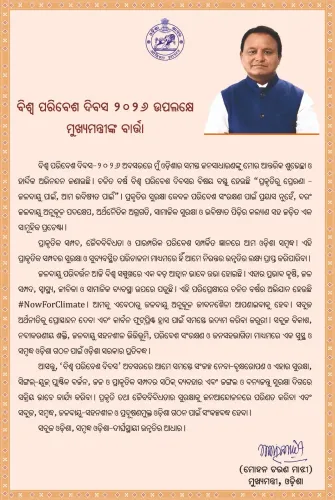
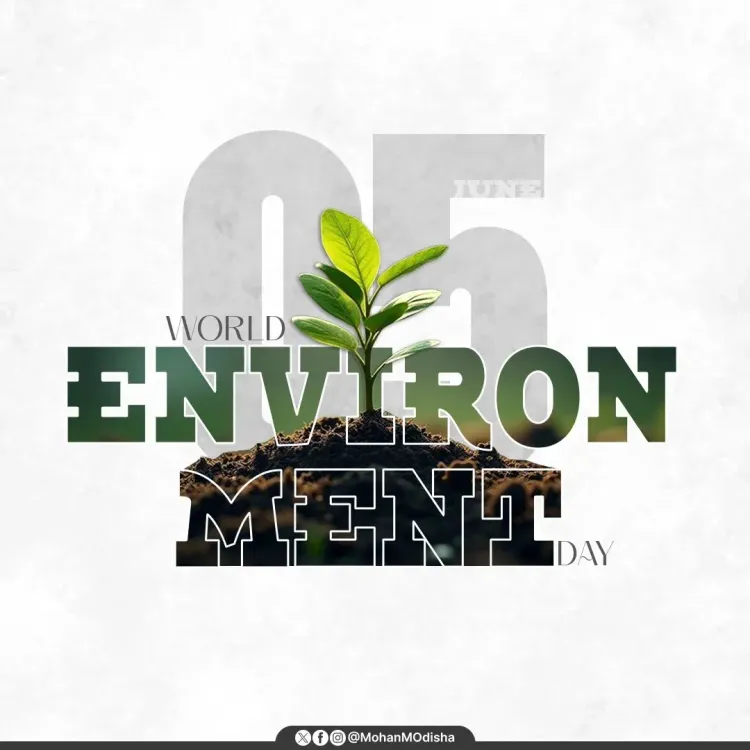
Odisha Chief Minister Mohan Charan Majhi on 5 June 2026 marked World Environment Day by calling on citizens to honour the state's cultural bond with nature and collectively protect its forests, rivers, wildlife and coastline. The message, posted on his official X account, drew on Odisha's deep-rooted traditions to reinforce conservation commitments at a time of mounting ecological pressures across the eastern state.
Context
World Environment Day, observed every year on 5 June, was established by the United Nations in 1973 to promote global environmental awareness and drive action at national and sub-national levels. CM Majhi used the occasion to frame conservation not merely as a statutory obligation but as an extension of Odisha's living cultural identity, stating: 'Odisha's culture and traditions have long celebrated a deep bond between people and nature.'
The appeal targeted four specific ecological domains — forests, rivers, wildlife and the coastline — each of which carries distinct legal and ecological significance for the state. The framing reflects a wider pattern among Indian state governments of anchoring environmental messaging in heritage narratives to build broader public support for conservation mandates.
Policy Backdrop
Odisha's conservation architecture rests on several foundational instruments. The Wildlife Protection Act of 1972 established the legal framework under which the state manages its protected forest areas, including the Simlipal biosphere reserve in Mayurbhanj district. Chilika Lake, the largest coastal lagoon in Asia, was designated India's first Ramsar wetland site in 1981, committing successive state governments to long-term biodiversity and coastal protection obligations.
The state's 480-kilometre coastline remains acutely vulnerable to cyclonic events, while the Mahanadi river system — a lifeline for agriculture and drinking water — faces pressures from sedimentation and upstream water-use disputes. Odisha under BJP governance since June 2024 has continued the previous administration's emphasis on forest rights and coastal zone regulation, aligning state priorities with national afforestation and river conservation programmes.
Stakeholders and Impact
The communities most directly affected by the health of Odisha's natural ecosystems include tribal groups whose livelihoods and cultural practices are intertwined with forest land, and coastal fishing communities dependent on the integrity of the lagoon and shoreline ecosystems. Both groups have historically been at the centre of debates over balancing development pressures — particularly from mining and port expansion — against ecological preservation.
CM Majhi's invocation of cultural tradition alongside conservation signals an effort to build consensus across these constituencies. It also aligns with central government priorities around green cover expansion and coastal zone management, reinforcing Odisha's position within national environmental governance frameworks.
What's Next
Observers will watch for concrete follow-through in the form of updated state forest and coastal management plans. The release of the next Forest Survey of India report on Odisha's forest cover will provide a measurable benchmark against which the state's conservation rhetoric can be assessed. Any revisions to the state's coastal zone management plan will similarly indicate the degree to which World Environment Day messaging translates into policy action.
For a state that sits at the intersection of biodiversity richness and industrial development demand, the Chief Minister's call to 'work together' points toward a governance approach that must reconcile competing pressures — making the months ahead a critical test of intent.
Point of View
The message attempts to build cross-community ownership over ecological protection at a moment when Odisha faces real tensions between industrial expansion and biodiversity preservation. The specific enumeration of forests, rivers, wildlife and coastline maps precisely onto the state's four most contested ecological frontiers, suggesting the framing is deliberate rather than incidental. Whether this rhetorical investment translates into measurable policy action will define its significance beyond the occasion.
NationPress
20 Sept 2026
Frequently Asked Questions
Why did Odisha CM Mohan Charan Majhi post about World Environment Day?
CM Mohan Charan Majhi posted on World Environment Day, 5 June 2026 , to call on citizens to protect Odisha's forests, rivers, wildlife and coastline, framing conservation as part of the state's cultural heritage.
What are the key environmental assets of Odisha that CM Majhi referenced?
Odisha's key environmental assets include the Simlipal biosphere reserve, the Mahanadi river system, Chilika Lake — India's first Ramsar wetland site — and a 480-kilometre coastline vulnerable to cyclones.
When was World Environment Day established and why is it observed?
World Environment Day was established by the United Nations in 1973 and is observed every year on 5 June to promote global environmental awareness and encourage action at national and sub-national levels.
What is Chilika Lake and why is it significant for Odisha?
Chilika Lake is the largest coastal lagoon in Asia and was designated India's first Ramsar wetland site in 1981 , making it a cornerstone of Odisha's biodiversity and coastal conservation commitments.
How long has the BJP been governing Odisha and what is its environmental focus?
The BJP has governed Odisha since June 2024 , when Mohan Charan Majhi became the state's first BJP Chief Minister. The government has continued the previous administration's emphasis on forest rights and coastal zone regulation.