CM Majhi's Odisha Crosses Bridge Target, One-Third Road Goal Done
Synopsis
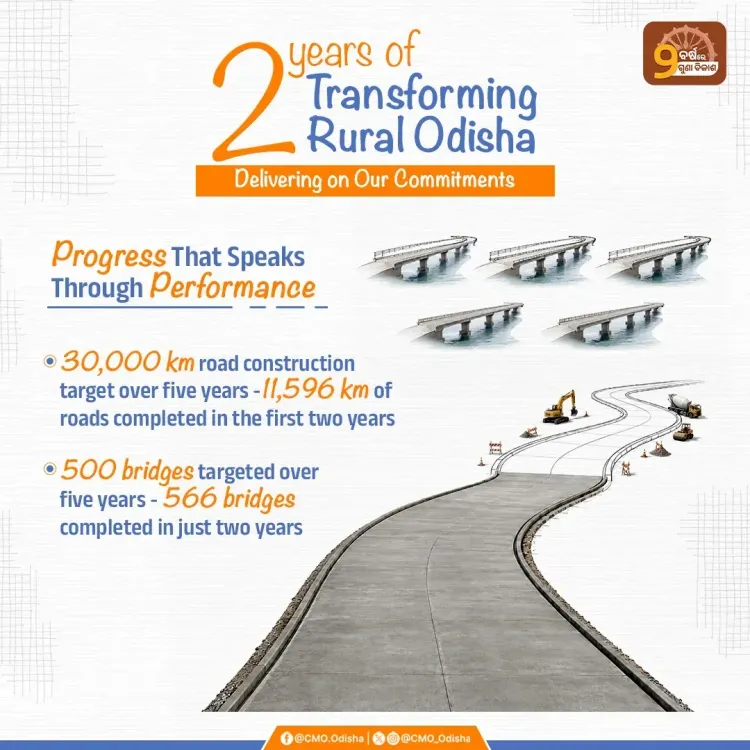
Two years into its tenure, the BJP government in Odisha under CM Mohan Charan Majhi has completed over one-third of its five-year road construction target and surpassed its bridge construction goal, according to the Chief Minister's Office, marking a claimed milestone in rural connectivity.
Key Takeaways
The Chief Minister's Office of Odisha announced the milestone on June 26, 2026 , marking two years of the BJP government's rule.
The state claims to have delivered over one-third of its five-year road construction target within the first two years.
Odisha has reportedly surpassed its bridge construction target for the same period.
The stated goal is to strengthen rural connectivity and improve access to essential services across Odisha's villages .
CM Mohan Charan Majhi has been credited with the push, with the announcement also tagging the PMO India .
The remaining three years of the five-year road target will be a key benchmark for the administration's overall delivery record.
The Chief Minister's Office of Odisha announced on Friday, June 26, 2026 that the state government, under Chief Minister Mohan Charan Majhi, has completed more than one-third of its five-year road construction target and surpassed its bridge construction target within just two years of taking office, marking a significant milestone in Odisha's rural infrastructure push.
Context
The CMO's post, shared with the hashtags #2YearsofLokankaSarakar and #BikasharaDharaOdishaSara, states that Odisha's 'rural transformation is moving from commitment to concrete results.' The announcement coincides with the two-year anniversary of the BJP government's formation in Odisha following its landmark assembly election victory in June 2024, which ended nearly two-and-a-half decades of Biju Janata Dal rule in the state.
The government claims it has 'delivered over one-third of its five-year road construction target and surpassed its bridge construction target,' with the stated aim of 'strengthening connectivity, improving access to essential services, and bringing development closer to every village.'
Policy Backdrop
Rural road and bridge construction featured prominently in the BJP's 2024 Odisha election manifesto, with the party pledging to accelerate connectivity as a core development priority. The emphasis on measurable yearly targets — road kilometres laid, bridges completed — reflects a broader pattern in BJP-governed states where infrastructure metrics serve as primary indicators of governance delivery.
Odisha's approach also aligns with national rural connectivity programmes that link state spending to central frameworks designed to connect remote villages to markets, schools, and health facilities. The state's eastern geography, with its mix of tribal hinterlands and coastal districts, has historically made last-mile connectivity a persistent challenge.
Stakeholders and Impact
The primary beneficiaries of the programme are rural villagers across Odisha's panchayats, particularly those in interior and tribal regions where road access directly determines reach to agricultural markets, government services, and emergency healthcare. Improved bridge connectivity is especially critical during the monsoon season, when many villages in Odisha face isolation due to flooding of rivers and streams.
Local contractors, construction workers, and panchayat administrations are also central stakeholders in the delivery of these targets. The pace of execution over the next three years will determine whether the full five-year road target is met before the next state assembly election cycle.
What's Next
With over one-third of the road target reportedly cleared in two years, the government will need to sustain — or accelerate — construction activity to complete the remaining work within the five-year window. Progress reports, mid-term audits, and independent assessments of project quality and rural reach will be closely watched by opposition parties, civil society groups, and the PMO, which was tagged in the original post.
If the stated targets are validated by third-party reviews, they could become a centrepiece of the BJP's governance narrative heading into future electoral cycles in Odisha — with rural connectivity serving as a tangible, visible proof point of the administration's delivery record.
Point of View
Bridges) rather than softer outcomes, the Majhi government is adopting a deliverables-first messaging strategy that BJP administrations have used effectively in other states. The tag to PMO India signals an attempt to frame Odisha's rural push as part of the broader national development story, potentially unlocking political capital at the Centre. The real test, however, will come when independent audits assess not just kilometres built, but the quality and last-mile reach of the infrastructure delivered.
NationPress
26 Jun 2026
Frequently Asked Questions
What has the Odisha government achieved in road construction in two years?
The Chief Minister's Office of Odisha announced that the state has completed over one-third of its five-year road construction target within the first two years of the BJP government under CM Mohan Charan Majhi.
Has Odisha met its bridge construction target?
According to the CMO's announcement on June 26, 2026, Odisha has surpassed its bridge construction target set for the two-year period, ahead of the five-year schedule.
When did Mohan Majhi become Chief Minister of Odisha?
Mohan Charan Majhi became Chief Minister of Odisha in June 2024, after the BJP won the state assembly elections, ending the long-running BJD government.
What is the significance of rural road construction in Odisha?
Odisha's interior and tribal regions have historically faced poor connectivity, making road and bridge construction critical for access to markets, healthcare, and government services, particularly during the monsoon season when flooding can isolate villages.
What are the hashtags used by the CMO Odisha post about rural development?
The CMO Odisha post used the hashtags #2YearsofLokankaSarakar, #BikasharaDharaOdishaSara, and #2YearsofRuralDevelopment to mark the two-year governance anniversary and infrastructure achievements.