CM Mann caps Punjab private school fee hike at 5%
Synopsis
Punjab Governor has approved an ordinance capping annual fee hikes by private unaided schools at 5 per cent. CM Bhagwant Mann announced the move on 13 July 2026, saying it will ease the financial burden on thousands of parents across the state.
Key Takeaways
The Punjab Governor has approved The Punjab Regulation of Fee of Unaided Education Institutions (Amendment) Ordinance, 2026 .
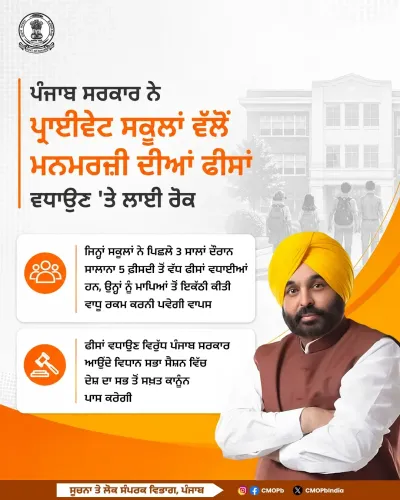
Private unaided schools in Punjab are now barred from raising fees by more than 5 per cent annually at their own discretion.
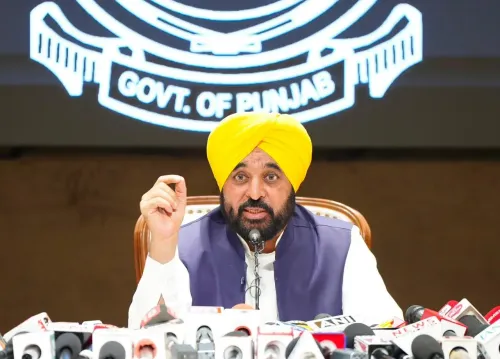
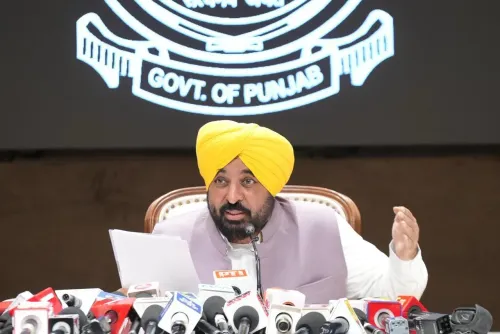
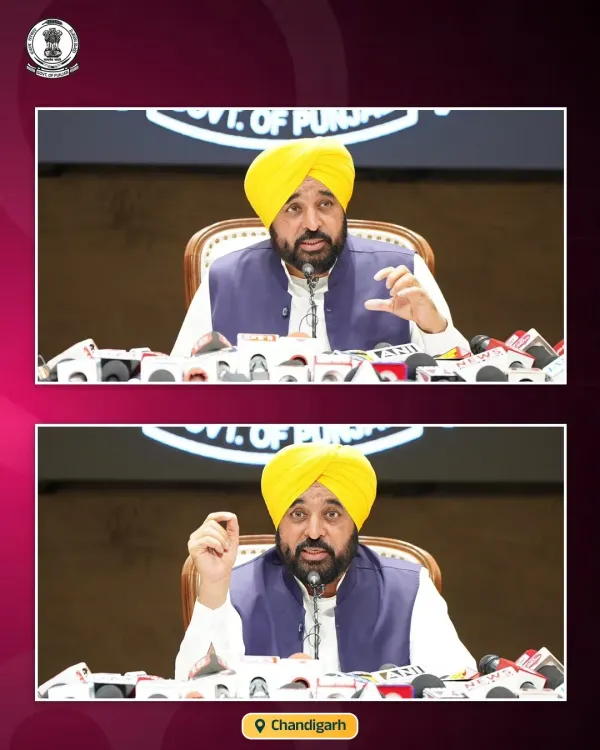
CM Bhagwant Singh Mann made the announcement at a press conference on 13 July 2026 .
The ordinance amends the Punjab Regulation of Fee of Unaided Educational Institutions Act, 2016 .
The measure is expected to benefit thousands of parents across the state by limiting unpredictable school fee increases.
The ordinance must be converted into a statute by the Punjab legislature within six weeks of the assembly reconvening.
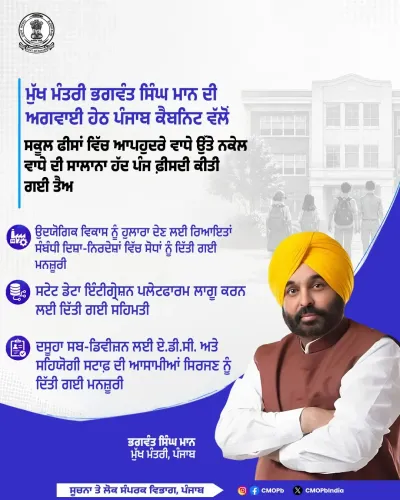
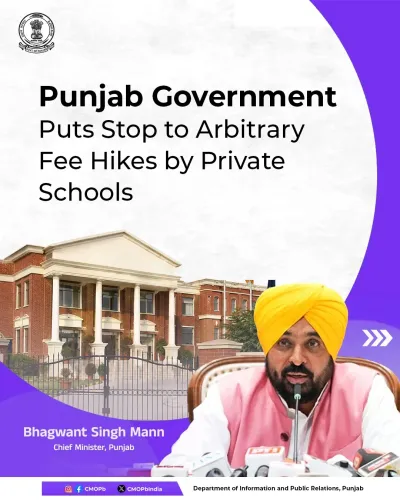
Chief Minister Bhagwant Singh Mann announced on Monday, 13 July 2026 that the Governor of Punjab has approved The Punjab Regulation of Fee of Unaided Education Institutions (Amendment) Ordinance, 2026, placing a hard ceiling of 5 per cent on annual fee increases by private unaided schools across the state. The announcement was made by the Chief Minister's Office of Punjab through a press conference addressed by CM Mann himself.
Addressing the press conference, Mann stated that private schools will no longer be able to raise fees 'at their own discretion' beyond the 5 per cent annual limit, a move the government says will 'reduce the financial burden on thousands of parents across the state.' The ordinance, promulgated through the constitutional authority of the Punjab Governor, takes immediate effect as an executive measure.
Context
Punjab has long grappled with complaints from parents over steep, arbitrary fee hikes by private unaided schools — institutions that receive no government grants and have historically set their own fee structures. The issue has been a persistent source of middle-class grievance, particularly in urban centres such as Ludhiana, Amritsar, and Mohali. The new ordinance amends the foundational Punjab Regulation of Fee of Unaided Educational Institutions Act, 2016, which first introduced a regulatory framework to curb such practices but left room for discretionary increases that schools exploited.
Policy Backdrop
The Aam Aadmi Party administration, which has governed Punjab since March 2022, has made education reform and middle-class welfare central planks of its governance agenda. Fee regulation for private schools fits within that broader pattern of state intervention in the education sector. Ordinances of this nature serve as interim legislative instruments when the assembly is not in session, and must be converted into a full statute by the legislature within six weeks of the assembly reconvening to remain in force.
State governments across India have periodically introduced similar fee-cap mechanisms in response to the commercialisation of schooling. Punjab's 2016 Act was itself part of this national trend, and the 2026 amendment ordinance represents a tightening of that earlier framework by introducing a specific numerical ceiling where previously the law's enforcement had been contested.
Stakeholders and Impact
The ordinance directly affects thousands of families whose children attend private unaided schools in Punjab. For parents, the 5 per cent cap provides a predictable upper limit on year-on-year cost increases, shielding household budgets from sudden large hikes. Private school managements, however, are likely to scrutinise the measure closely, and legal challenges before the Punjab and Haryana High Court are a foreseeable outcome, consistent with the pattern seen in other states where similar caps have been contested on grounds of institutional autonomy.
What's Next
The immediate step is the formal gazette notification of the ordinance to give it legal effect across the state. The Punjab government will subsequently need to introduce a corresponding amendment bill in the state assembly to convert the ordinance into a permanent statute. Observers will also watch for any interim stay applications filed by private school associations challenging the 5 per cent cap, as well as the government's enforcement mechanism for monitoring compliance among the state's large and diverse private school sector.
Point of View
Directly addressing a long-standing grievance over the unchecked commercialisation of private schooling. By using the ordinance route, CM Mann signals urgency and executive decisiveness, bypassing the slower legislative calendar. The 5 per cent cap is a concrete, communicable number that is easy for parents to understand and hold the government accountable on. However, the real test lies in enforcement infrastructure and the government's ability to defend the cap in court against challenges from well-resourced private school management bodies.
NationPress
13 Jul 2026
Frequently Asked Questions
What is the Punjab private school fee cap ordinance 2026?
The Punjab Regulation of Fee of Unaided Education Institutions (Amendment) Ordinance, 2026 is an executive measure approved by the Punjab Governor that restricts private unaided schools from increasing annual fees by more than 5 per cent at their own discretion.
How much can private schools in Punjab increase fees now?
Private unaided schools in Punjab can now increase fees by a maximum of 5 per cent per year under the new ordinance announced on 13 July 2026.
Who announced the Punjab school fee ordinance?
Chief Minister Bhagwant Singh Mann announced the ordinance at a press conference on 13 July 2026, stating that the Punjab Governor had granted approval.
Does the Punjab fee cap apply to all private schools?
The ordinance applies to unaided private schools — institutions that do not receive government grants. Schools that receive state aid may fall under different regulatory frameworks.
Can Punjab's private school fee ordinance be challenged in court?
Yes. Ordinances capping school fees have historically been challenged by private school associations in high courts on grounds of institutional autonomy, and similar litigation before the Punjab and Haryana High Court is a foreseeable outcome.