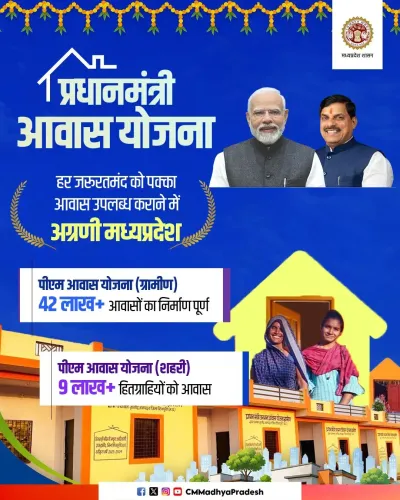
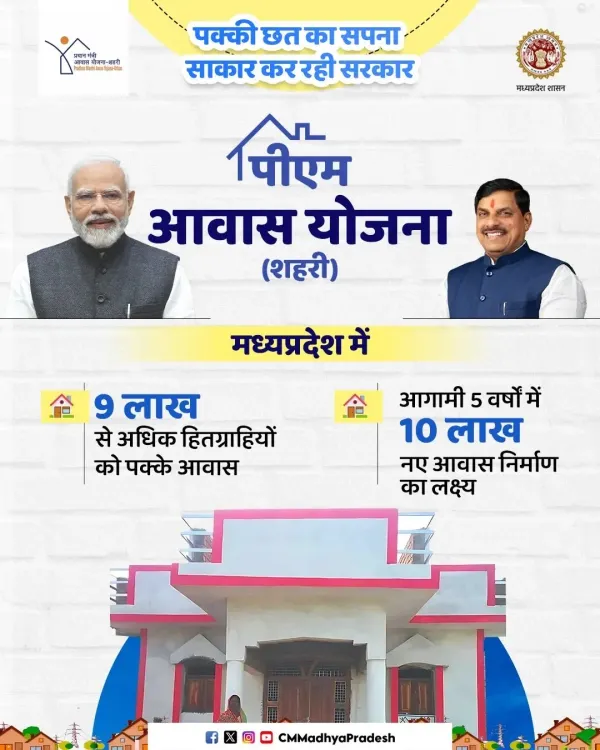
CM Mohan Yadav: MP gives pucca homes to 9 lakh+ under PMAY-Urban
Synopsis
The Chief Minister's Office of Madhya Pradesh says more than 9 lakh urban beneficiaries have received permanent homes under PMAY-Urban, with CM Dr. Mohan Yadav's administration claiming significant delivery under the centrally sponsored housing mission.
Key Takeaways
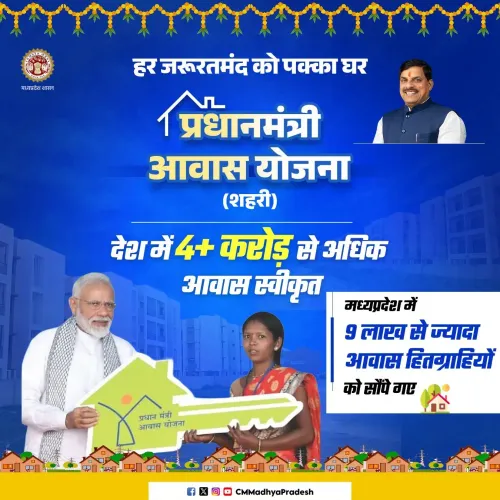
The Chief Minister's Office of Madhya Pradesh announced on 25 July 2026 that more than 9 lakh beneficiaries have received permanent housing under PMAY-Urban in the state.
Pradhan Mantri Awas Yojana (Urban) was launched in June 2015 with a 'Housing for All' mandate, targeting urban poor, slum dwellers, and economically weaker sections.
The scheme operates through four verticals including in-situ slum redevelopment and credit-linked subsidy, funded by the Ministry of Housing and Urban Affairs .
Mohan Yadav has been in office since December 2023 and has made welfare delivery visibility a feature of state communications.
Women beneficiaries are a key focus, with ownership or co-ownership mandated in several categories under the scheme.
Independent verification of completion versus sanctioned figures from the central ministry remains the next critical milestone.
The Chief Minister's Office of Madhya Pradesh announced on Saturday, 25 July 2026, that more than 9 lakh beneficiaries in the state have received permanent housing under the Pradhan Mantri Awas Yojana (Urban), highlighting the scheme's reach across urban households in the state.
The post, shared by the official handle of the Chief Minister's Office and tagging Chief Minister Dr. Mohan Yadav and the Madhya Pradesh Urban Development Department, declared: 'Pakke ghar ka sapna ho raha sakar' ('The dream of a permanent home is being realised'), underscoring the state government's claim of significant on-ground delivery under the centrally sponsored mission.
Context
Pradhan Mantri Awas Yojana (Urban), commonly known as PMAY-Urban, was launched by the Central government in June 2015 with the overarching goal of 'Housing for All' for eligible urban households. The scheme targets urban poor, slum dwellers, and economically weaker sections through four verticals: in-situ slum redevelopment, credit-linked subsidy, affordable housing in partnership, and beneficiary-led construction. The mission was subsequently extended beyond its original 2022 deadline with fresh phases and additional funding allocations to address residual demand. Madhya Pradesh has been among the states with significant urban housing demand, and the state government has periodically reported progress on houses sanctioned and completed under the scheme.Policy Backdrop
The Ministry of Housing and Urban Affairs designs and funds PMAY-Urban, coordinating with state urban development departments on targets, fund releases, and completion milestones. Under the federal structure of welfare delivery, state governments are responsible for identifying beneficiaries, coordinating with urban local bodies, and overseeing construction quality and timelines. Chief Minister Dr. Mohan Yadav, who has held the top post in Madhya Pradesh since December 2023, has made urban housing and welfare delivery a visible priority in state communications. The announcement fits a broader pattern in which state CM offices highlight local outcomes of national programmes, reinforcing both the Centre's policy credentials and the state administration's implementation record.Stakeholders and Impact
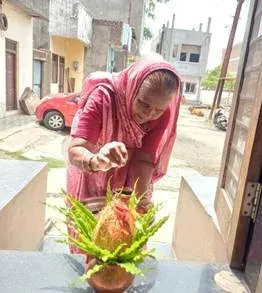
The primary beneficiaries of PMAY-Urban in Madhya Pradesh are urban poor families and slum households who previously lacked access to permanent, weatherproof housing with basic amenities such as water supply, sanitation, and electricity. A pucca house — a permanent structure built with durable materials — represents a significant asset and quality-of-life improvement for low-income urban families. With more than 9 lakh beneficiaries covered, the scale of delivery claimed by the state government represents a substantial share of the state's eligible urban population. Women beneficiaries are also a key focus of the scheme, with ownership or co-ownership mandated in many categories to strengthen women's property rights.What's Next
The next indicator to watch will be the quarterly progress report from the Ministry of Housing and Urban Affairs on house completion rates and fund utilisation specifically for Madhya Pradesh. Independent verification of completion figures — distinguishing between houses sanctioned, under construction, and fully handed over — will be critical to assessing the full impact of the scheme on the ground. As PMAY-Urban continues its expanded phases, the state's ability to maintain construction quality and timely delivery will determine whether the promise of a permanent home translates into lasting socio-economic gains for urban households across Madhya Pradesh.Point of View
The communication blurs the distinction between houses sanctioned and houses actually completed and occupied, a gap that has historically been significant in PMAY-Urban data. For CM Dr. Mohan Yadav, who is still consolidating his administrative identity after taking charge in late 2023, welfare delivery optics serve a dual purpose: reinforcing the BJP's national housing narrative while establishing state-level governance credentials. The real test will come when the central ministry's next progress report either validates or qualifies the state's claimed delivery numbers.
NationPress
25 Jul 2026
Frequently Asked Questions
What is Pradhan Mantri Awas Yojana Urban and who benefits from it?
Pradhan Mantri Awas Yojana (Urban), or PMAY-Urban, is a Central government scheme launched in June 2015 to provide permanent, pucca houses with basic amenities to urban poor, slum dwellers, and economically weaker sections. Beneficiaries receive support through credit-linked subsidies, in-situ slum redevelopment, or direct construction assistance.
How many beneficiaries has Madhya Pradesh covered under PMAY-Urban?
According to the Chief Minister's Office of Madhya Pradesh, more than 9 lakh beneficiaries in the state have received permanent housing under PMAY-Urban as of July 2026.
Who is the Chief Minister of Madhya Pradesh overseeing PMAY-Urban implementation?
Dr. Mohan Yadav has been the Chief Minister of Madhya Pradesh since December 2023 and is responsible for state-level oversight of PMAY-Urban and other urban development programmes.
What is the difference between a pucca house and a kutcha house in India?
A pucca house is a permanent structure built with durable materials such as brick, cement, and stone, offering protection from weather and structural stability. A kutcha house is a temporary or semi-permanent structure made from materials like mud, thatch, or bamboo, which is more vulnerable to damage.
When was PMAY-Urban launched and what is its current status?
PMAY-Urban was launched in June 2015 with an original target of Housing for All by 2022. The mission has since been extended with additional phases and funding to address residual demand across Indian cities and towns.