CM Mohan Yadav: MP to specially incentivise natural farming
Synopsis
Chief Minister Dr. Mohan Yadav has announced that Madhya Pradesh will specially encourage farmers practising natural farming, directing the state agriculture ministry to act on the commitment. The move aligns with India's national push to reduce chemical inputs, cut farmer costs, and build soil health.
Key Takeaways
The Chief Minister's Office of Madhya Pradesh announced on 9 July 2026 that natural farming practitioners will receive special encouragement from the state government.
Mohan Yadav was directly quoted in the post, with the directive addressed to the Madhya Pradesh Agriculture Ministry .
Madhya Pradesh has been an active participant in the central government's Paramparagat Krishi Vikas Yojana since 2015 .
Small and marginal farmers are the primary intended beneficiaries of the proposed incentive framework.
Specific incentive structures and budget allocations are yet to be publicly announced and are expected in upcoming policy rollouts.
The announcement fits a broader national pattern of states rolling out dedicated support for chemical-free farming to address soil degradation and input cost pressures.
The Chief Minister's Office of Madhya Pradesh announced on Thursday, 9 July 2026 that farmers practising natural farming in the state will receive special encouragement, quoting Chief Minister Dr. Mohan Yadav in a post on X directed to the state's agriculture ministry.
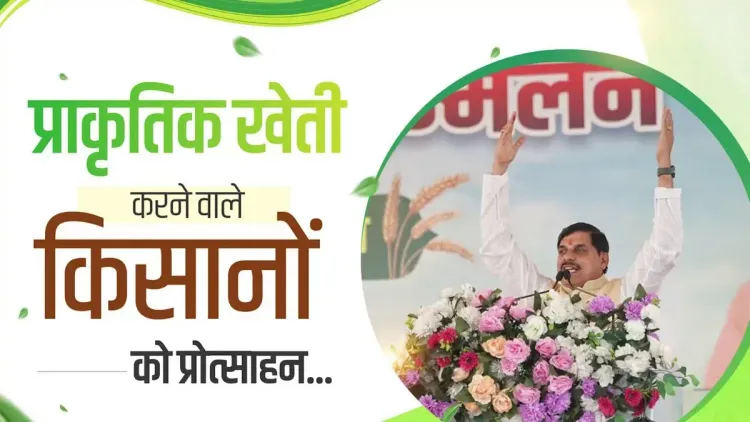
The post, in Hindi, stated: 'Madhya Pradesh mein prakritik kheti karne wale kisanon ko vishesh roop se protsahit kiya jaega' — ('Farmers engaged in natural farming in Madhya Pradesh will be specially encouraged') — a direct commitment attributed to CM Dr. Mohan Yadav.
Context
Natural farming, distinct from certified organic farming, relies on zero external chemical inputs, drawing on indigenous practices and biological cycles. The announcement signals a policy intent by the Madhya Pradesh government to create dedicated support pathways for farmers who have already transitioned or are transitioning to chemical-free cultivation methods.
The post was addressed to both CM Dr. Mohan Yadav's personal handle and the Madhya Pradesh Agriculture Ministry, indicating the directive flows from the Chief Minister's Office directly to the implementing department.
Policy Backdrop
Madhya Pradesh has been an active participant in the Paramparagat Krishi Vikas Yojana (PKVY), the central government's flagship scheme launched in 2015 to promote organic and natural farming through a cluster-based approach. The state also ran its own chemical-free farming missions and farmer training programmes between 2018 and 2023.
Dr. Mohan Yadav, who assumed office as Chief Minister in December 2023, has consistently highlighted agricultural development and farmer welfare as priorities of his administration. This announcement extends that policy thread by placing natural farming at the centre of the state's agrarian agenda.
India's broader national push toward natural farming is driven by concerns over soil degradation from decades of chemical-intensive agriculture, rising input costs that squeeze farmer margins, and the need to build climate resilience in food production systems.
Stakeholders and Impact
Small and marginal farmers stand to benefit most from targeted incentives, as they often lack the financial buffer to absorb the transition period — typically one to three seasons — during which yields may dip before soil health recovers. Special encouragement mechanisms could include input subsidies, premium market linkages, or direct income support.
The Department of Agriculture, Madhya Pradesh, which oversees extension services and scheme implementation, will be the primary executing body. The announcement's direct tag to the ministry suggests operational planning may already be under way.
Madhya Pradesh is one of India's largest agricultural states, with a significant share of its population dependent on farming. A state-backed push toward natural farming could influence cropping patterns, input markets, and rural livelihoods across multiple districts.
What's Next
The specific incentive structures, training modules, and budget allocations have not yet been publicly detailed. Observers will watch the next state agriculture budget and forthcoming departmental circulars for concrete programme outlines.
If the initiative follows the cluster model used under PKVY, villages or blocks may be designated as natural farming zones with dedicated extension support. The policy's scale and reach will ultimately determine whether it marks a structural shift or remains a targeted pilot within the state's broader farm economy.
Point of View
The Chief Minister's Office is signalling intent without yet committing to a defined programme — a common political sequencing that allows the government to gauge stakeholder response before locking in fiscal commitments. The direct tagging of the agriculture ministry in the post is notable: it publicly binds the department to follow through, creating a degree of accountability rarely present in aspirational announcements. If backed by substantive budget lines in the next state agriculture cycle, this could position Madhya Pradesh as a benchmark state for natural farming transitions in central India.
NationPress
9 Jul 2026
Frequently Asked Questions
What did CM Mohan Yadav announce about natural farming in Madhya Pradesh?
CM Dr. Mohan Yadav announced that farmers practising natural farming in Madhya Pradesh will be specially encouraged by the state government, with the directive addressed to the state agriculture ministry on 9 July 2026.
What is natural farming and how is it different from organic farming?
Natural farming relies entirely on zero external chemical inputs and indigenous biological cycles, going beyond certified organic farming by rejecting even approved organic inputs in favour of on-farm biological resources.
What is Paramparagat Krishi Vikas Yojana and does Madhya Pradesh participate?
Paramparagat Krishi Vikas Yojana is a central government scheme launched in 2015 to promote organic and natural farming through a cluster-based approach. Madhya Pradesh has been an active participant since the scheme's inception.
Which farmers in Madhya Pradesh will benefit from the natural farming incentive?
Small and marginal farmers who have transitioned or are transitioning to chemical-free cultivation are the primary intended beneficiaries, though specific eligibility criteria have not yet been announced.
When will the details of Madhya Pradesh's natural farming incentive scheme be released?
Specific incentive structures, training modules, and budget allocations are expected to be detailed in the next state agriculture budget or a forthcoming departmental policy rollout.