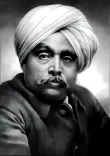
CM Nayab Saini Pays Tribute to Lala Lajpat Rai on Martyrdom Day
Synopsis
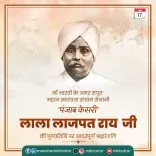
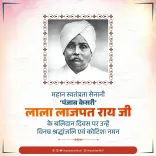
Haryana Chief Minister Nayab Singh Saini on 17 November 2026 paid tribute to Lala Lajpat Rai, the 'Punjab Kesari', on his martyrdom anniversary, honouring the freedom fighter who died in 1928 after a British lathi charge during protests against the Simon Commission.
Key Takeaways
Lala Lajpat Rai is commemorated on 17 November , the date of his death in 1928 .
He was fatally injured in a British lathi charge during protests against the Simon Commission in Lahore .
He is remembered as Punjab Kesari (Lion of Punjab) and was a key leader of the Lal-Bal-Pal triumvirate.
Haryana CM Nayab Singh Saini paid tribute on X, calling his sacrifice an eternal source of national inspiration.
His death is widely credited with galvanising revolutionary nationalism, including that of Bhagat Singh .
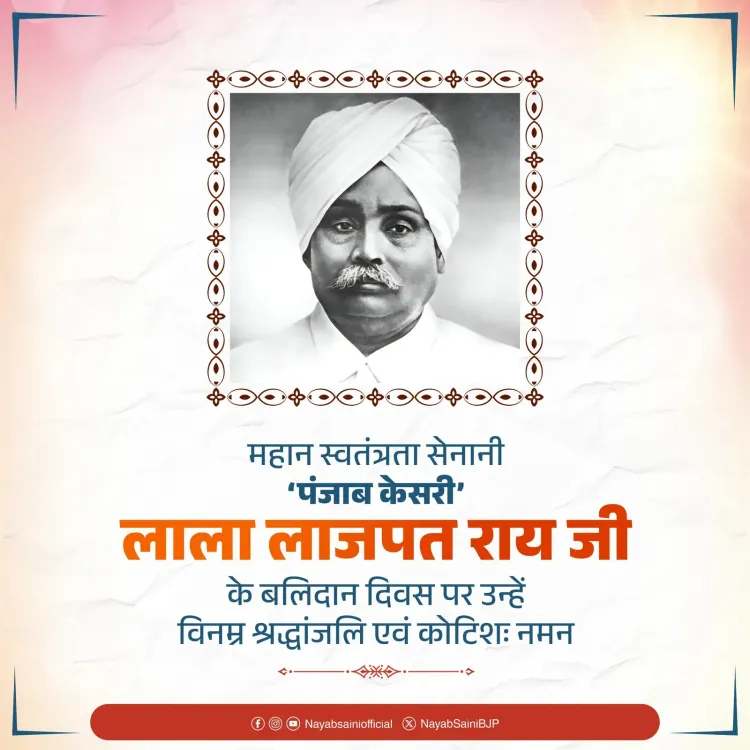
Nearly a century after a British lathi charge silenced one of India's fiercest freedom fighters, Haryana Chief Minister Nayab Singh Saini paused on 17 November 2026 to honour Lala Lajpat Rai — the leader history remembers as Punjab Kesari (the Lion of Punjab) — on his martyrdom anniversary.
In a tribute posted on X, CM Saini wrote that Lala Lajpat Rai 'awakened public consciousness against British rule through his revolutionary ideas and unbreakable patriotism,' adding that 'his supreme sacrifice for the freedom of the motherland will always inspire the people of this nation.' The post carries a tone of solemn reverence, closing with the words vinamra shraddhanjali evam koti-koti naman — a humble salute and countless bows of respect.
Who Was Lala Lajpat Rai and Why November 17 Matters
Lala Lajpat Rai, born in 1865 in present-day Punjab, rose to become one of the most commanding voices of the Indian independence movement — a co-leader of the celebrated Lal-Bal-Pal triumvirate alongside Bal Gangadhar Tilak and Bipin Chandra Pal. His pen, his speeches, and his street presence made him equally dangerous to colonial administrators.
On 30 October 1928, he led a protest march in Lahore against the all-British Simon Commission, which had been appointed to review India's constitutional future without a single Indian member. British police responded with a brutal lathi charge. Rai was severely beaten. He died on 17 November 1928 — a date that passed into the nationalist calendar as his martyrdom day.
His death did not dampen resistance; it detonated it. Revolutionary Bhagat Singh, who had witnessed the assault, vowed vengeance — a vow that set off one of the most storied chapters of militant nationalism in Indian history.
A Tribute Pattern That Crosses Party Lines
Paying homage to independence-era figures on their birth and death anniversaries is a consistent strand of Indian political messaging across the spectrum, and BJP leaders at the state and national level have made such commemorations a regular fixture. For a Haryana chief minister specifically, the tribute to Lala Lajpat Rai carries a regional resonance: Rai's legacy is deeply woven into the cultural and historical identity of Punjab and Haryana.
CM Saini's post on this martyrdom day is a reminder that the story of 17 November 1928 — a man beaten for demanding his country's freedom — still commands the attention of the highest offices nearly a hundred years on.
Point of View
Reinforcing a nationalist narrative that positions the BJP as the natural custodian of India's freedom movement legacy. For a Haryana chief minister, invoking the 'Punjab Kesari' also carries regional symbolism, connecting present-day governance to the soil these leaders fought for. Across Indian politics, the martyrdom anniversaries of towering independence figures function as shared civic moments — but the regularity and visibility of such posts by BJP leaders signal a deliberate effort to anchor the party's brand in freedom-struggle iconography. What endures beyond the politics, however, is the story itself: a man beaten on a street in Lahore for demanding dignity, whose death lit a fuse that history has never quite extinguished.
NationPress
17 Nov 2026
Frequently Asked Questions
When did Lala Lajpat Rai die and why?
Lala Lajpat Rai died on 17 November 1928 after sustaining severe injuries in a British police lathi charge during a protest in Lahore against the Simon Commission on 30 October 1928.
Why is Lala Lajpat Rai called Punjab Kesari?
He is called 'Punjab Kesari' — meaning the Lion of Punjab — in recognition of his fierce leadership of the independence movement in the Punjab region and his fearless opposition to British colonial rule.
What was the Simon Commission?
The Simon Commission was a 1927 British committee tasked with reviewing India's constitutional framework. It was boycotted across India because it included no Indian members, sparking widespread protests including the Lahore march led by Lala Lajpat Rai.
What is the Lal-Bal-Pal triumvirate?
Lal-Bal-Pal refers to Lala Lajpat Rai, Bal Gangadhar Tilak, and Bipin Chandra Pal — three nationalist leaders who collectively advocated assertive resistance to British rule in the early 20th century.
Why did Nayab Singh Saini post a tribute to Lala Lajpat Rai today?
17 November is observed as the martyrdom day of Lala Lajpat Rai, and Haryana Chief Minister Nayab Singh Saini posted a tribute on X to honour the freedom fighter's legacy and sacrifice on this anniversary.