CM Nayab Saini Transfers Welfare Funds via DBT in Haryana
Synopsis
Chief Minister Nayab Singh Saini of Haryana transferred welfare benefits directly into beneficiaries' bank accounts via the Direct Benefit Transfer platform on 10 July 2026, citing transparent governance as the administration's guiding principle.
Key Takeaways
CM Nayab Singh Saini personally oversaw a Direct Benefit Transfer (DBT) exercise for Haryana welfare beneficiaries on 10 July 2026 .
Funds were routed electronically straight into beneficiaries' bank accounts, bypassing intermediaries.
The state government framed the exercise as evidence of 'transparent governance' ( paaradarshai shaasan ).
India's DBT framework was launched in 2013 and expanded significantly from 2014 with Aadhaar and Jan Dhan integration.
Haryana's move follows a national pattern of states using DBT to publicise leakage-free welfare delivery.
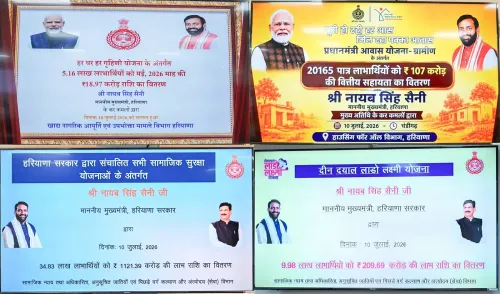
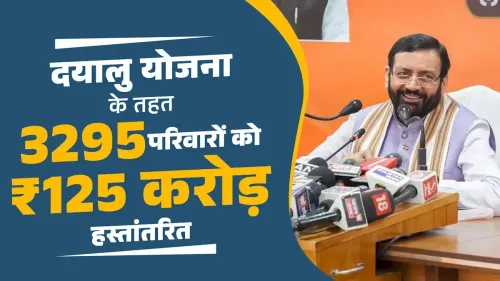
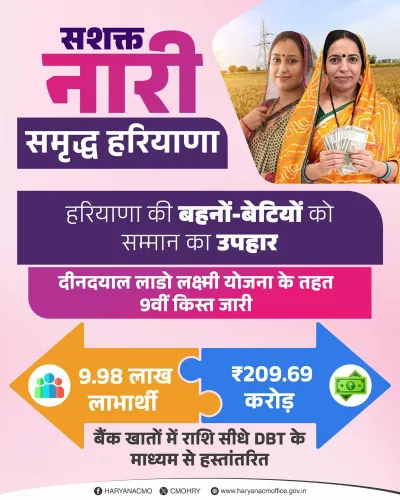
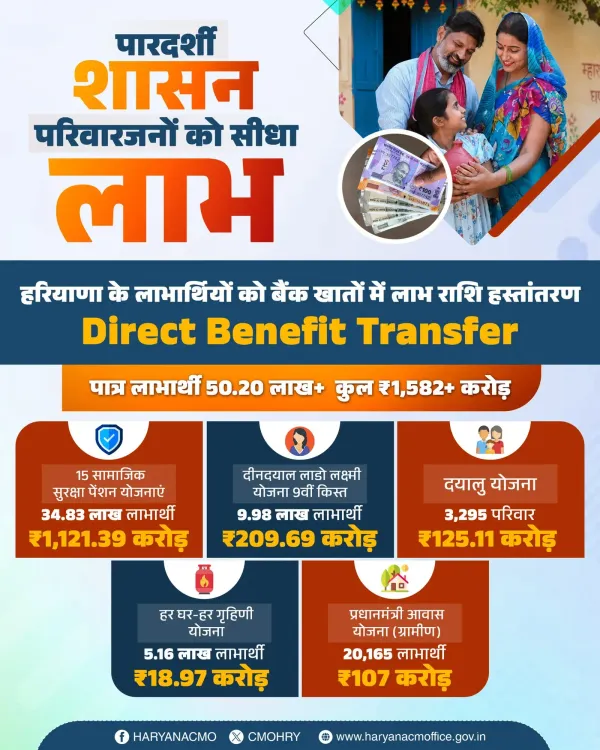
Scheme-wise beneficiary counts and cumulative transfer amounts have not yet been officially disclosed.
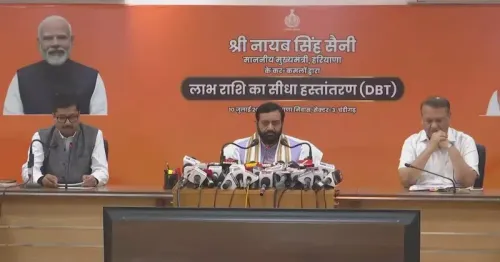
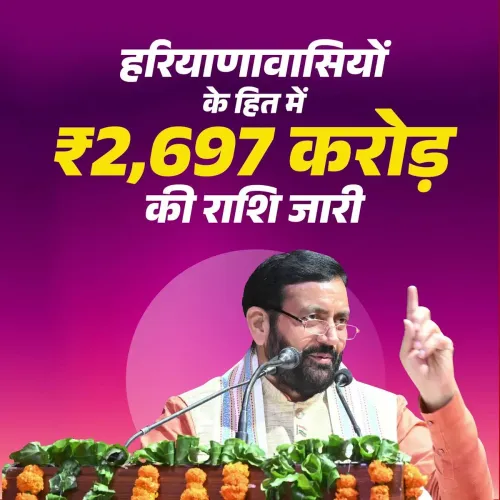
The Chief Minister's Office of Haryana announced on Friday, 10 July 2026, that Chief Minister Nayab Singh Saini has directly transferred welfare benefit amounts into the bank accounts of scheme beneficiaries across Haryana through the Direct Benefit Transfer (DBT) mechanism, underscoring the state government's stated commitment to transparent governance.
The official post declared: 'पारदर्शी शासन से हरियाणा के परिवारजनों को हो रहा अपार लाभ' ('Transparent governance is bringing immense benefit to the families of Haryana'), adding that the Chief Minister personally oversaw the direct transfer of benefit amounts into beneficiaries' bank accounts via DBT.
Context
The DBT exercise signals the Saini government's intent to position transparent, leakage-free welfare delivery as a political and administrative priority. By routing funds electronically and directly to bank accounts, the administration aims to eliminate intermediaries who have historically siphoned subsidies before they reach intended recipients. The announcement was accompanied by an image, reinforcing the visual communication of the event.Policy Backdrop
The Direct Benefit Transfer programme was formally launched by the Government of India in 2013 under the National e-Governance Plan. From 2014 onward, the integration of Aadhaar and Jan Dhan bank accounts dramatically expanded DBT's reach, bringing pensions, scholarships, cooking-gas subsidies, and agricultural support payments under its ambit. Haryana has progressively onboarded state-level schemes onto the DBT platform, aligning with the national framework that now covers hundreds of central and state programmes. The platform's core design principle is to reduce 'leakages' — funds lost to ghost beneficiaries, duplicate entries, or corrupt middlemen — and to ensure that the entitled amount reaches the right person in full and on time.Stakeholders and Impact
The primary beneficiaries are Haryana's welfare-dependent families — recipients of old-age pensions, disability allowances, agricultural input subsidies, and other state-run schemes. For these households, DBT transfers mean faster access to funds without the need to visit government offices or deal with third-party agents. Civil-society researchers and policy analysts have broadly acknowledged that DBT, when implemented with updated beneficiary databases, reduces transaction costs for the poor. At the same time, exclusion errors — where genuine beneficiaries lack Aadhaar linkage or active bank accounts — remain a concern flagged by welfare economists studying similar programmes across Indian states.What's Next
Attention will now turn to the Haryana finance department and any state-level DBT dashboard that may publish cumulative transfer figures, the number of beneficiaries covered in this round, and which schemes were included. Analysts will also watch whether the government tables a detailed account in the state legislature or releases scheme-wise breakdowns. Sustained, auditable disclosure of DBT data would be the clearest test of the 'transparent governance' promise that CM Nayab Singh Saini has placed at the centre of this announcement.Point of View
However, leaves the claim of 'immense benefit' unquantified and difficult to independently assess. Until granular data is published, the exercise reads as much as a communications strategy as a governance milestone.
NationPress
10 Jul 2026
Frequently Asked Questions
What is Direct Benefit Transfer (DBT) in India?
Direct Benefit Transfer is a Government of India platform, launched in 2013, that routes subsidies, pensions and scheme benefits electronically straight into beneficiaries' Aadhaar-linked bank accounts, cutting out middlemen and reducing fund leakages.
What did CM Nayab Saini do regarding DBT in Haryana?
On 10 July 2026, Chief Minister Nayab Singh Saini of Haryana transferred welfare benefit amounts directly into the bank accounts of scheme beneficiaries across the state via the DBT mechanism.
Which Haryana welfare schemes use the DBT platform?
Haryana has onboarded multiple state-level schemes onto DBT, including old-age pensions, disability allowances and agricultural subsidies, in line with the national framework that covers hundreds of central and state programmes.
How does DBT benefit poor families in Haryana?
DBT ensures that entitled welfare amounts reach beneficiaries in full and on time without requiring them to visit government offices or pay intermediaries, reducing both transaction costs and leakages.
What are the concerns with DBT implementation in India?
Welfare economists have highlighted exclusion errors — genuine beneficiaries who lack Aadhaar linkage or active bank accounts may be left out — as a persistent challenge in DBT rollouts across Indian states.