Giriraj Singh Hails Solapur Innovator's Bamboo Terry Towel
Synopsis
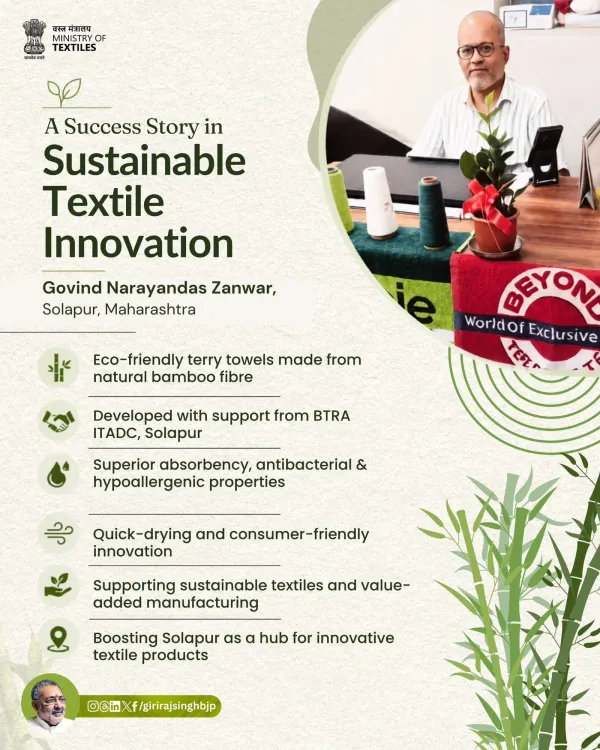
Union Textiles Minister Giriraj Singh on 10 July 2026 highlighted Solapur-based innovator Govind Narayandas Zanwar, who has developed eco-friendly terry towels from natural bamboo fibre, calling the work a demonstration that innovation and sustainability can advance together under India's Make in India and Atmanirbhar Bharat frameworks.
Key Takeaways
Giriraj Singh , Union Textiles Minister, publicly praised Govind Narayandas Zanwar of Solapur on 10 July 2026 for developing bamboo-fibre terry towels.
Solapur is a major national textile cluster known for terry towel and home textile production, now showing movement toward sustainable raw materials.
The innovation aligns with three government schemes: Make in India (2014), Atmanirbhar Bharat (2020), and the PLI scheme for textiles (2021).
Bamboo fibre is biodegradable and less water-intensive than cotton, making it relevant to India's green manufacturing push under Viksit Bharat 2047 .
Ministerial recognition can open doors for MSMEs to access export promotion bodies, institutional buyers, and government procurement linkages.
Policy watchers are tracking whether revised PLI sustainability standards or natural-fibre grants will follow in the next Union Budget.
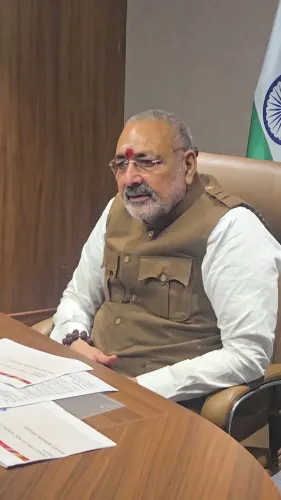
Union Textiles Minister Giriraj Singh on Friday, 10 July 2026 spotlighted a grassroots textile innovator from Solapur, Maharashtra, praising the development of eco-friendly terry towels made from natural bamboo fibre as a model of sustainable manufacturing aligned with national development goals.
In his post, the Minister highlighted the work of Shri Govind Narayandas Zanwar of Solapur, writing that he has demonstrated 'navachaar aur sustainability saath-saath aage badh sakte hain' — that 'innovation and sustainability can advance together' — by crafting environmentally friendly terry towels from natural bamboo fibre.
Context
Solapur is one of India's most established textile clusters, historically renowned for its terry towel and home textile production. The city's weaving ecosystem, built largely around small and medium enterprises, has long supplied domestic and export markets. The emergence of bamboo-fibre-based products from this cluster signals a shift toward green value addition within an already mature manufacturing base.
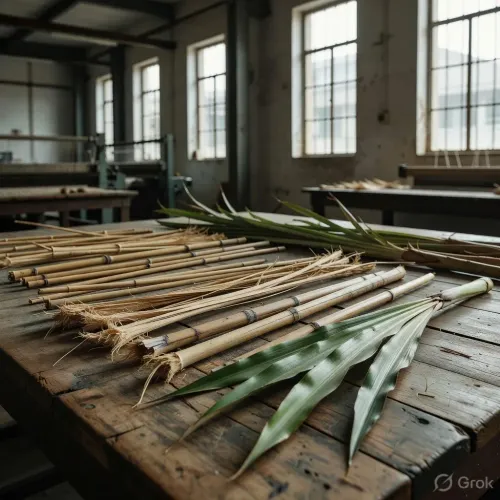
Bamboo fibre is biodegradable, requires significantly less water than cotton, and is increasingly sought after in global sustainable textile markets. Its adoption by artisans and small manufacturers in traditional clusters like Solapur reflects a broader industry realignment toward natural and eco-friendly raw materials.
Policy Backdrop
Minister Singh's endorsement connects the innovation directly to three flagship government programmes. The Make in India campaign, launched in September 2014, identified textiles as a priority sector for domestic manufacturing and export competitiveness. The Atmanirbhar Bharat initiative, announced in May 2020, reinforced the push for local supply chains and sustainable production methods to reduce import dependence.
The Production Linked Incentive (PLI) scheme for textiles, approved in September 2021, further extended policy support to man-made fibres and technical textiles, creating an enabling environment for innovators working with alternative raw materials. Bamboo-based textiles sit at the intersection of technical innovation and natural fibre development — precisely the space these schemes aim to incentivise.
The post also invokes Viksit Bharat 2047, the government's long-term roadmap targeting developed-economy status by India's independence centenary. Eco-friendly industrial growth and domestic R&D are treated as central pillars of that vision, and the Minister's framing positions Zanwar's work as a micro-level embodiment of that macro goal.
Stakeholders and Impact
Textile MSMEs and sustainable innovators stand to benefit most directly from this kind of ministerial visibility. Public recognition from a Union Minister can attract institutional buyers, export promotion support, and potential linkages with government procurement channels. For the broader Solapur cluster, it reinforces the region's identity as a site of textile innovation rather than just conventional production.
Consumers and environmental advocates also have a stake: bamboo terry towels offer a credible alternative to conventional cotton towels in terms of softness, absorbency, and ecological footprint. Growing domestic awareness of sustainable products means demand-side conditions are increasingly favourable for such innovations to scale.
What's Next
Policy watchers will look for whether the Ministry of Textiles moves to formalise support mechanisms — such as revised sustainability standards under the PLI scheme or dedicated natural-fibre innovation grants — that could help scale up innovations like Zanwar's beyond individual enterprise. The next Union Budget and any forthcoming textile sector review will be key moments to watch for such announcements. The Minister's consistent use of hashtags like #VocalForLocal, #MakeInIndia, and #ViksitBharat2047 suggests the government intends to keep sustainable textile innovation at the centre of its sectoral messaging in the months ahead.
Point of View
Self-reliant manufacturing. By tying a single artisan's bamboo-fibre product to Make in India, Atmanirbhar Bharat, and Viksit Bharat 2047 simultaneously, the Minister is doing political and policy work in one move — humanising large schemes through individual stories. The choice of Solapur, a cluster with strong MSME roots and export history, is unlikely to be incidental; it signals that the government sees established clusters as the proving ground for green transition, not just new industrial zones. Whether this soft signalling translates into hard policy support — revised standards, dedicated funding, procurement mandates — will determine whether moments like this are inflection points or simply good optics.
NationPress
10 Oct 2026
Frequently Asked Questions
Who is Govind Narayandas Zanwar and what did he make?
Govind Narayandas Zanwar is a Solapur-based textile innovator who developed eco-friendly terry towels using natural bamboo fibre, combining sustainability with traditional textile craftsmanship.
Why is Solapur significant for the Indian textile industry?
Solapur is one of India's most established textile clusters, particularly known for terry towel and home textile production driven largely by small and medium enterprises.
What is bamboo fibre and why is it considered eco-friendly?
Bamboo fibre is derived from bamboo plants and is considered eco-friendly because it is biodegradable and requires significantly less water to produce compared to conventional cotton.
How does this innovation connect to Make in India and Atmanirbhar Bharat?
Both schemes promote domestic manufacturing and local supply chains; bamboo-fibre terry towels represent exactly the kind of home-grown, value-added innovation these programmes aim to incentivise in the textile sector.
What is Viksit Bharat 2047?
Viksit Bharat 2047 is the Indian government's national vision to achieve developed-economy status by 2047, the centenary of India's independence, with eco-friendly industrial growth identified as a central pillar of that roadmap.