Giriraj Singh bets on New Age Fibres to boost India's textile exports
Synopsis
Union Textiles Minister Giriraj Singh has championed New Age Fibres as transformative enablers of India's textile sector, linking natural fibre innovation with sustainability, rural livelihoods, and global value-chain ambitions under PM Modi's leadership.
Key Takeaways
Giriraj Singh on 29 May 2026 publicly positioned New Age Fibres as 'critical enablers' of India's textile sector growth.
The minister linked New Age Fibres to three goals: driving innovation, improving sustainability standards, and strengthening rural livelihoods.
The push builds on existing policy pillars — Make in India (2014), the PLI Scheme for Textiles (2021), and Atmanirbhar Bharat (2020).
Key beneficiaries include textile MSMEs , natural fibre farmers, and rural artisans across states like Bihar , West Bengal , and Kerala .
Global demand for sustainably sourced textiles — especially in Europe and North America — creates an export opportunity India is seeking to capture.
Policy watchers are looking for a dedicated New Age Fibres scheme or PLI expansion as the next concrete step.
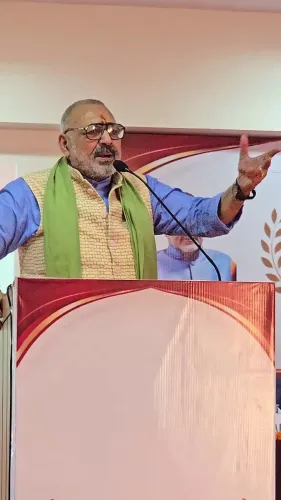
Union Textiles Minister Giriraj Singh on Friday, 29 May 2026 called New Age Fibres 'critical enablers' of India's textile sector growth, arguing that a structured approach to the country's natural fibre potential could propel the nation to the forefront of the global value chain.
Context
In his post on X, Giriraj Singh wrote that New Age Fibres are 'rapidly emerging as critical enablers of the growth of India's textile sector, driving innovation, improving sustainability standards, and strengthening rural livelihoods.' He added that 'by tapping into the hidden potential of our natural fibre sector, we can scale globally through a structured approach, with New Age Fibres leading the charge.'
The minister credited Prime Minister Narendra Modi's leadership, pointing to India's 'strong traditional knowledge and skilled workforce, combined with the blend of innovation and sustainability' as the foundation for this global ambition. The post was tagged with #NewAgeFibres, #TextileInnovation, #MakeInIndia, and #AtmanirbharBharat.
Policy Backdrop
The Ministry of Textiles has, since 2014, aligned textile manufacturing with the Make in India programme, which seeks to expand India's role in global value chains. The Production Linked Incentive (PLI) Scheme for Textiles, notified in 2021, extended incentives to man-made fibre and technical textile segments, signalling a deliberate push beyond conventional cotton and jute.
Policy discussions during 2020-21 under the National Textile Policy framework specifically emphasised sustainability and value addition in natural fibres. The Atmanirbhar Bharat initiative, launched in 2020, further reinforced the logic of combining traditional strengths with modern processing to reduce import dependence. Singh's post situates New Age Fibres squarely within this continuing policy arc.
India's push in this space also reflects a broader global trend: supply-chain diversification away from single-country dominance has opened new export windows for labour-intensive sectors. India's large rural artisan base and its deep history in natural fibre processing — from jute in West Bengal to coir in Kerala — give it a structural advantage that policymakers have sought to monetise through innovation layering.
Stakeholders and Impact
The constituencies most directly affected by a New Age Fibres push are textile MSMEs, natural fibre farmers, and rural artisans — groups that form a significant share of employment in states such as Bihar, West Bengal, Odisha, and Kerala. A structured policy that links innovation with rural livelihoods could translate into higher farm-gate prices for fibre crops and more stable incomes for weavers.
On the export side, global buyers — particularly in Europe and North America — are increasingly demanding green and sustainably sourced textiles. India's ability to certify and scale New Age Fibres under recognised sustainability standards would directly determine its competitiveness in these premium markets. The minister's emphasis on 'sustainability standards' suggests the ministry is aware of this demand signal.
What's Next
Observers will watch for concrete follow-through: whether the Ministry of Textiles announces a dedicated New Age Fibres policy, an extension of PLI benefits to this segment, or a focused presence at major international textile trade events. India's ongoing free trade agreement negotiations with key markets also provide a potential vehicle for securing preferential access for value-added natural fibre products.
Singh's framing — linking traditional knowledge, a skilled workforce, innovation, and sustainability into a single export proposition — sets the rhetorical terms for what could become a significant policy announcement in the months ahead. How quickly the ministry translates this vision into budgetary allocations and institutional support will determine whether New Age Fibres move from ministerial priority to measurable export growth.
Point of View
Not merely a social-media statement — it frames New Age Fibres within the same 'innovation plus tradition' narrative that has underpinned every major textile policy since 2014, suggesting the ministry is preparing the ground for a formal announcement. The explicit invocation of PM Modi's leadership and the Atmanirbhar Bharat hashtag indicates this is being positioned as part of the government's broader self-reliance branding. By highlighting rural livelihoods alongside global value chains, Singh is simultaneously addressing domestic political constituencies — fibre farmers and artisans — and international buyers demanding green supply chains. The mention of a 'structured approach' is the most policy-loaded phrase: it implies institutional mechanisms are being designed, and the industry will be watching for budgetary or PLI-linked follow-through.
NationPress
13 Oct 2026
Frequently Asked Questions
What are New Age Fibres in India's textile sector?
New Age Fibres refer to next-generation natural and innovative fibre materials being promoted by India's Ministry of Textiles to drive sustainability, export competitiveness, and rural income growth, though a formal government definition of the category is still awaited.
What did Giriraj Singh say about New Age Fibres?
Union Textiles Minister Giriraj Singh said on 29 May 2026 that New Age Fibres are 'rapidly emerging as critical enablers' of India's textile sector, and that tapping the natural fibre sector's 'hidden potential' through a structured approach can help India scale globally.
How does the New Age Fibres push connect to Make in India?
Make in India, launched in 2014, aims to expand domestic manufacturing and global value-chain participation; the New Age Fibres initiative is being positioned as an extension of this programme, combining traditional fibre knowledge with modern innovation and sustainability standards.
Which states benefit most from a natural fibre textile policy in India?
States with strong natural fibre traditions — including Bihar, West Bengal, Odisha, and Kerala — stand to benefit most, as the policy targets natural fibre farmers, rural artisans, and textile MSMEs concentrated in these regions.
What is the Production Linked Incentive scheme for textiles?
The PLI Scheme for Textiles, notified in 2021, provides financial incentives to boost domestic manufacturing in man-made fibre and technical textile segments; an extension to New Age Fibres is among the policy moves being watched by industry observers.