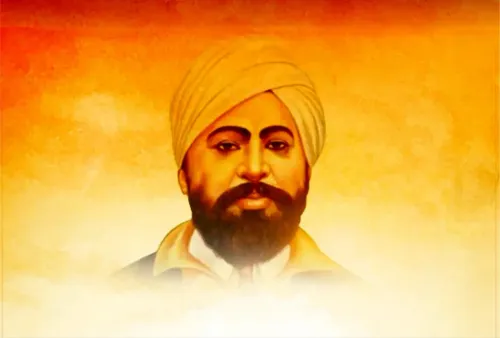
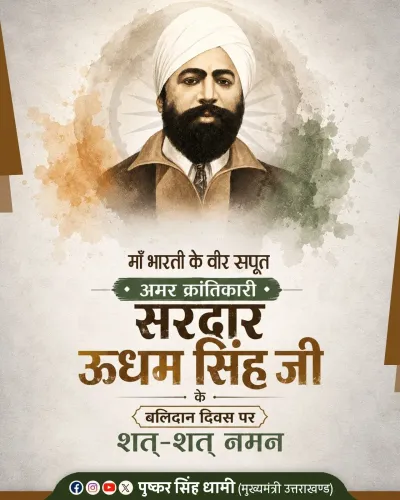
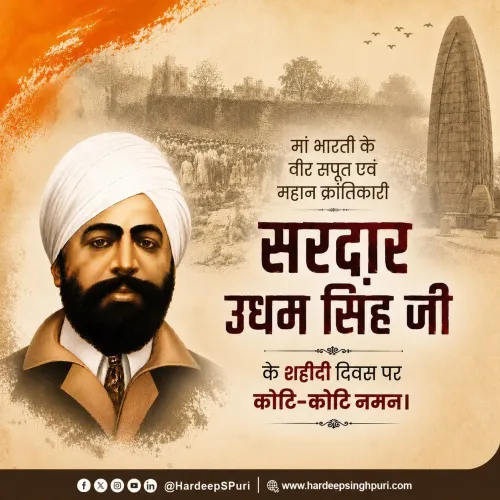
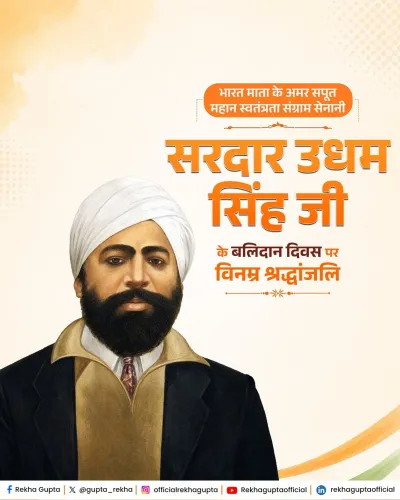
CM Bhupendra Patel pays tribute to Shaheed Udham Singh on martyrdom anniversary
Synopsis
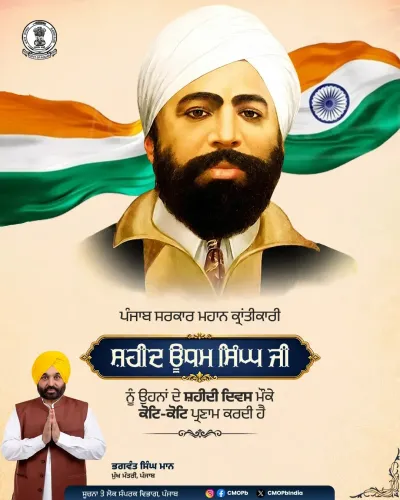
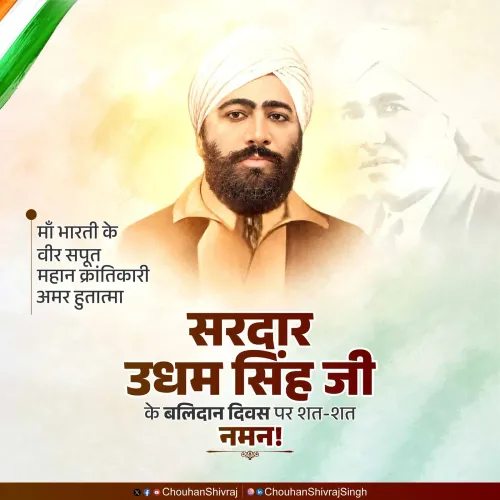
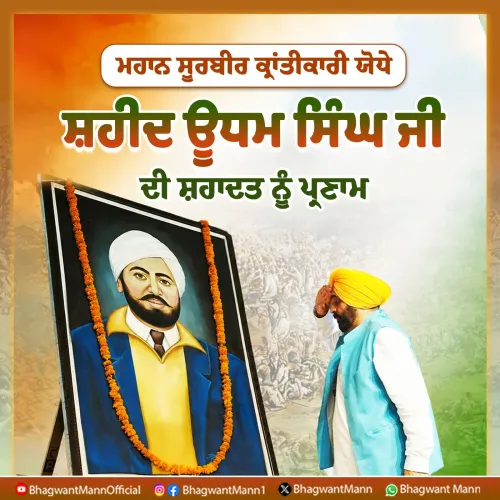
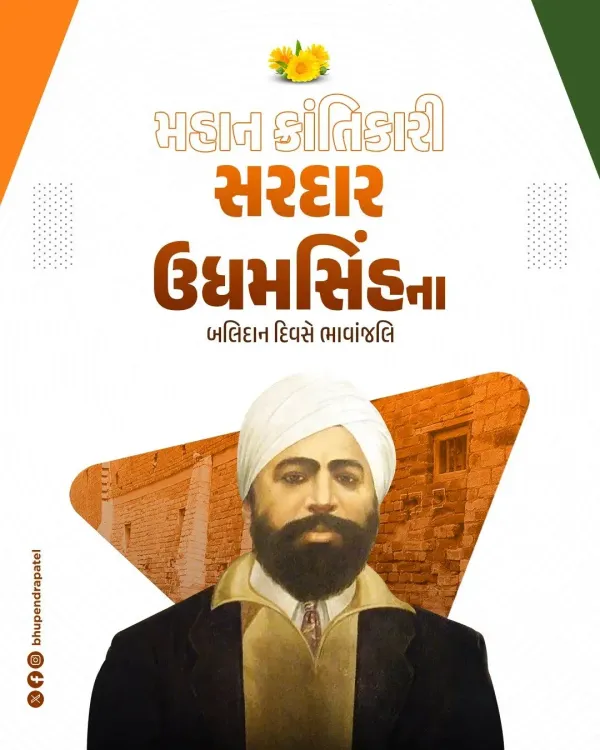
On 31 July 2026, Gujarat Chief Minister Bhupendra Patel paid homage to Sardar Udham Singh on his 86th martyrdom anniversary, calling him a symbol of indomitable courage who avenged the 1919 Jallianwala Bagh massacre by killing Michael O'Dwyer in London in 1940.
Key Takeaways
Sardar Udham Singh was hanged on 31 July 1940 at Pentonville Prison, London, after assassinating former Punjab Lieutenant Governor Michael O'Dwyer in March 1940.
Udham Singh's act was a direct response to the Jallianwala Bagh massacre of 13 April 1919 , in which British troops fired on an unarmed crowd in Amritsar .
Gujarat CM Bhupendra Patel paid tribute in Gujarati, calling Udham Singh's sacrifice 'a guiding light for all.' Udham Singh's remains were repatriated to India in 1974 ; a district in Uttarakhand — Udham Singh Nagar — is named in his honour.
BJP leaders routinely mark the death anniversaries of independence-era revolutionaries on social media, connecting themes of sacrifice and national pride to the party's public identity.
Eighty-six years after Sardar Udham Singh walked to the gallows in a London prison — calm, unbroken, his mission complete — Gujarat Chief Minister Bhupendra Patel paused on 31 July 2026 to honour the revolutionary whose single act of vengeance shook the British Empire to its core.
In a tribute posted in Gujarati, CM Patel wrote: 'જલિયાંવાલા બાગના નરસંહારનો બદલો લઈને માતૃભૂમિના સ્વાભિમાનની રક્ષા કરનાર...' — honouring Udham Singh as 'a symbol of indomitable courage and patriotism' who 'protected the self-respect of the motherland by avenging the Jallianwala Bagh massacre.' He added that Udham Singh's sacrifice, patience, and dedication to the motherland 'serve as a guiding light for all.'
The act that history never forgot
On 13 April 1919, British troops under the command of Brigadier-General Reginald Dyer opened fire on an unarmed crowd gathered at Jallianwala Bagh, Amritsar, killing hundreds in one of the most brutal episodes of colonial rule. Among those present that day was a young Udham Singh, who reportedly witnessed the carnage first-hand.
Twenty-one years later, on 13 March 1940, Udham Singh walked into Caxton Hall in London and shot Michael O'Dwyer — the former Lieutenant Governor of Punjab who had approved Dyer's order — fatally wounding him. He made no attempt to flee. Tried and convicted, Sardar Udham Singh was hanged on 31 July 1940 at Pentonville Prison. He was 37.
A revolutionary reclaimed by memory
Udham Singh's place in India's freedom movement was long debated — a revolutionary who used violence abroad, outside the mainstream of the non-cooperation movement. But over decades, particularly in Punjab and across North India, he has been elevated to the rank of a national martyr, his story inseparable from the wound of Jallianwala Bagh itself.
His remains were repatriated to India in 1974, and he is today commemorated with memorials, institutions, and a district in Uttarakhand — Udham Singh Nagar — named in his honour.
BJP leaders across the country regularly mark the anniversaries of independence-era revolutionaries on social media, weaving themes of sacrifice and national pride into the party's political identity. CM Patel's tribute follows that pattern — but the weight of the date it marks is anything but routine.
Eighty-six years on, the man who refused to run still commands the room.
Point of View
' the framing ties colonial-era grievance to contemporary identity politics. The choice of Gujarati — the language of the CM's own state — signals that this is as much local political communication as it is national commemoration. As martyr anniversaries become a regular fixture in the BJP's social media calendar, they serve a dual function: historical remembrance and ongoing brand-building around sacrifice and sovereignty.
NationPress
14 Sept 2026
Frequently Asked Questions
Who was Sardar Udham Singh and why is he remembered?
Sardar Udham Singh was an Indian revolutionary who assassinated Michael O'Dwyer — the former British Lieutenant Governor of Punjab — in London on 13 March 1940, to avenge the Jallianwala Bagh massacre of 1919. He was hanged on 31 July 1940 and is commemorated as a national martyr in India.
What was the Jallianwala Bagh massacre?
The Jallianwala Bagh massacre took place on 13 April 1919 in Amritsar, Punjab, when British troops commanded by Brigadier-General Reginald Dyer opened fire on an unarmed crowd, killing hundreds of people. It became a defining moment in India's independence movement.
When is Udham Singh's martyrdom anniversary?
Sardar Udham Singh's martyrdom anniversary falls on 31 July, the date he was executed by hanging at Pentonville Prison in London in 1940.
Why did Gujarat CM Bhupendra Patel pay tribute to Udham Singh?
Gujarat Chief Minister Bhupendra Patel posted a tribute in Gujarati on 31 July 2026 — Udham Singh's martyrdom anniversary — honouring him as a symbol of courage and patriotism whose sacrifice serves as a guiding light for the nation.
Is there a place named after Udham Singh in India?
Yes. Udham Singh Nagar, a district in the state of Uttarakhand, is named in honour of Sardar Udham Singh. His remains were also repatriated from the United Kingdom to India in 1974.