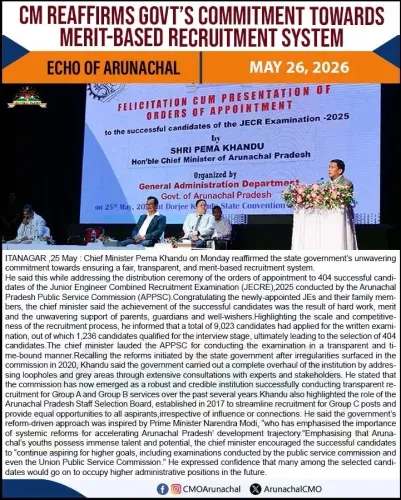
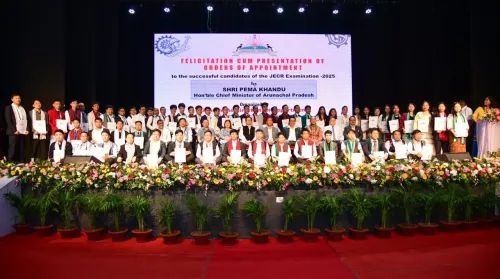
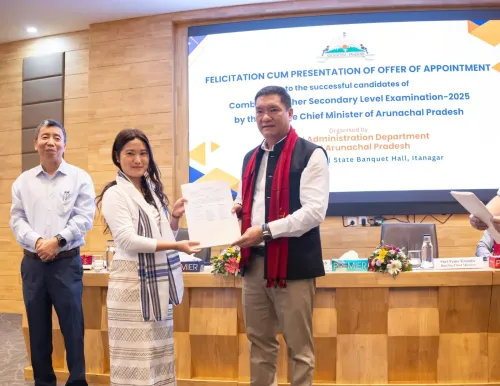
CM Pema Khandu: Arunachal Cabinet clears uniform teaching recruitment rules

Synopsis
The Arunachal Pradesh Cabinet has approved Uniform Recruitment Rules for 12 categories of teaching and technical posts in government engineering and polytechnic colleges, aiming to standardise hiring and strengthen merit-based technical education across the state.
Key Takeaways
The Arunachal Pradesh Cabinet approved Uniform Recruitment Rules on October 11, 2026 .
The rules cover 12 categories of teaching and technical posts in government institutions.
Both engineering colleges and polytechnic colleges are covered under the new framework.
The move is aimed at ensuring transparent, merit-based recruitment across state technical institutions.
Chief Minister Pema Khandu described it as a step toward stronger technical education in Arunachal Pradesh.
Arunachal Pradesh's technical education system got a structural overhaul on Sunday, October 11, 2026, as the state Cabinet approved Uniform Recruitment Rules covering 12 categories of teaching and technical posts across government engineering and polytechnic colleges — a move Chief Minister Pema Khandu says will make hiring in the sector transparent and merit-driven.
What the Cabinet cleared — and why it matters
The new rules create a single, standardised framework for recruiting across all 12 post categories in government-run engineering and polytechnic institutions in the state. Before such uniform rules, individual institutions could follow differing or ad-hoc norms, opening the door to inconsistencies in eligibility criteria, selection procedures, and seniority calculations. A consolidated rulebook shuts that door.
For a frontier state like Arunachal Pradesh — where quality technical education infrastructure is still being built out — predictable, rule-bound recruitment is foundational. It signals to qualified faculty that positions are filled on merit, not discretion, making the state more competitive in attracting talent to colleges that often struggle against better-resourced institutions in larger states.
Merit-based hiring as a governance signal
Chief Minister Khandu framed the decision explicitly as 'a step towards transparent, merit-based recruitment and stronger technical education in the State.' The language is deliberate: by anchoring the announcement to merit, the Cabinet is staking a governance position — that technical education expansion must be matched by institutional integrity in staffing.
Uniform recruitment rules are also a precondition for accountability. When roles, qualifications, and selection processes are codified identically across institutions, audits and grievance redressal become far simpler. Faculty, applicants, and oversight bodies all work from the same rulebook.
Engineering and polytechnic colleges at the centre
The decision targets government engineering colleges and polytechnic colleges — institutions that feed directly into the skilled technical workforce of the state. Polytechnic education, in particular, is a pipeline for diploma-level technicians who are critical to infrastructure projects, a sector that defines Arunachal Pradesh's development landscape given its strategic border geography and ongoing road, bridge, and power-sector buildout.
Standardising faculty recruitment across these institutions ensures that the quality of instruction keeps pace with the physical expansion of technical education capacity.
With the rulebook now approved, the next test is implementation — whether recruitment cycles under the new framework begin promptly and whether vacant faculty positions, a chronic challenge in remote-state colleges, start getting filled with the speed and fairness the Cabinet has now promised in writing.
Point of View
Where faculty shortages and inconsistent appointments have long undermined outcomes. For Chief Minister Khandu, the decision reinforces a governance-first narrative ahead of any future electoral cycle, positioning the BJP-led administration as reformist on institutional process rather than just on infrastructure spending. The focus on engineering and polytechnic colleges is also strategically pointed: as Arunachal Pradesh absorbs large-scale border infrastructure investment, the demand for locally trained technical workers will grow, making faculty quality a genuine economic variable. Whether the rules translate into faster, cleaner recruitment cycles — or remain a policy document — will determine the actual impact.
NationPress
11 Oct 2026
Frequently Asked Questions
What did the Arunachal Pradesh Cabinet approve on October 11 2026?
The Cabinet approved Uniform Recruitment Rules for 12 categories of teaching and technical posts in government engineering and polytechnic colleges in Arunachal Pradesh.
What are Uniform Recruitment Rules for colleges?
Uniform Recruitment Rules are standardised guidelines that define eligibility criteria, qualifications, and selection procedures for specific post categories identically across all covered institutions, replacing ad-hoc or institution-specific norms.
Which institutions are covered by the new Arunachal recruitment rules?
The rules cover government engineering colleges and polytechnic colleges in Arunachal Pradesh, targeting 12 categories of teaching and technical posts.
Why does Arunachal Pradesh need uniform recruitment rules for technical education?
Standardised rules prevent inconsistencies in hiring across institutions, support merit-based selection, make the state more attractive to qualified faculty, and simplify oversight and grievance redressal.
Who announced the Arunachal Cabinet decision on recruitment rules?
Chief Minister Pema Khandu announced the Cabinet decision on his official X account, calling it a step toward transparent, merit-based recruitment and stronger technical education in the state.