CM Pema Khandu Exempts 56 Activities from Trade Licence
Synopsis
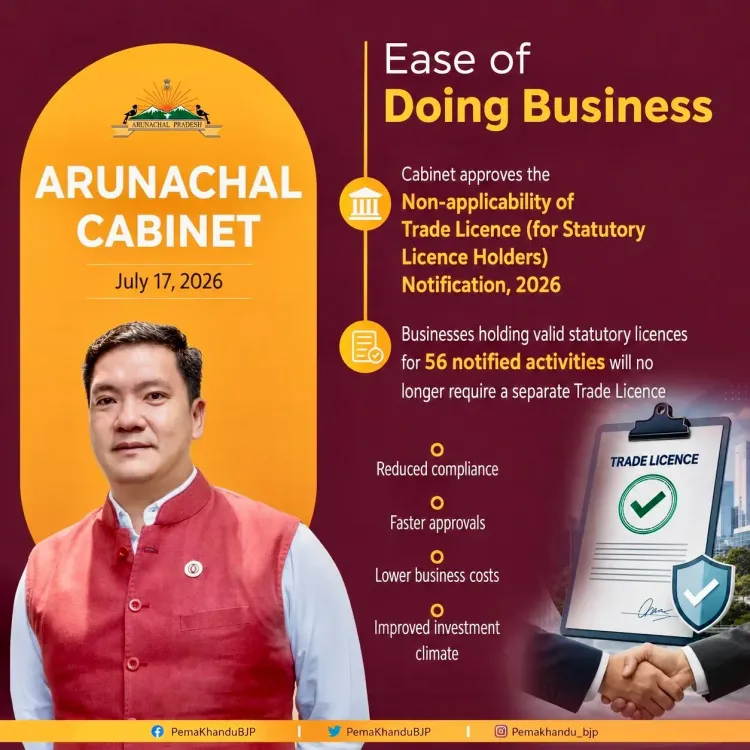
The Arunachal Pradesh cabinet under CM Pema Khandu has approved a notification exempting businesses with valid statutory licences from obtaining a separate trade licence for 56 notified activities, aiming to reduce red tape and improve the state's business climate.
Key Takeaways
The Arunachal Pradesh Cabinet approved the Non-applicability of Trade Licence (for Statutory Licence Holders) Notification, 2026 on 17 July 2026 .
Businesses holding valid statutory licences will no longer need a separate trade licence for 56 notified business activities .
The reform is aimed at reducing compliance burdens for entrepreneurs, local businesses, and investors in the state.
The move aligns with the central government's Ease of Doing Business initiative, which has pushed states to eliminate redundant licensing since 2014 .
Arunachal Pradesh had previously introduced a single-window clearance portal around 2017–2018 as part of the same reform trajectory.
Implementation timelines and the official gazette notification of the 56 exempted activities are the immediate next steps to watch.
Arunachal Pradesh Chief Minister Pema Khandu announced on Friday, 17 July 2026 that the state cabinet has approved the Non-applicability of Trade Licence (for Statutory Licence Holders) Notification, 2026, exempting businesses holding valid statutory licences from obtaining a separate trade licence for 56 notified business activities.
Context
The cabinet decision means that any entrepreneur or business entity already operating under a valid statutory licence — issued by a central or state regulatory authority — will no longer be required to obtain an additional trade licence for activities covered under the new notification. CM Khandu described the move as 'cutting red tape, speeding up approvals, and making Arunachal one of the best places to do business.'
The announcement was made under the hashtag #10yearsofteamarunachal, signalling that the ruling BJP-led state government is framing the reform as part of a decade-long governance record ahead of potential electoral messaging.
Policy Backdrop
The reform fits squarely within the central government's Ease of Doing Business initiative launched in 2014, which has consistently pushed states to eliminate redundant licence requirements and reduce compliance burdens on businesses. Arunachal Pradesh had earlier introduced a single-window clearance portal around 2017–2018 as part of the same broader push to attract investment into the state.
Indian states have progressively moved to resolve overlaps between trade licences and statutory licences, a friction point that has long drawn criticism from small and medium enterprises. The Northeast, in particular, has been a focus of regulatory simplification under schemes designed to promote industrial development and private investment in the region.
Stakeholders and Impact
The exemption is expected to benefit entrepreneurs, local businesses, and prospective investors across Arunachal Pradesh who currently navigate dual-licensing requirements. By collapsing the trade licence requirement for holders of statutory licences, the state reduces both the time and cost of compliance for businesses operating in the 56 exempted activity categories.
For a state like Arunachal Pradesh — which borders China and Myanmar and has historically faced infrastructure and investment challenges — reducing procedural friction is considered a key lever for economic growth. Smaller traders and service providers who hold licences from sector-specific regulators stand to benefit most immediately.
What's Next
Attention will now turn to the implementation timeline for the notification and whether the state government publishes the full list of 56 exempted activities in the official gazette. Business registration data and new enterprise formation numbers in the coming quarters will serve as early indicators of the reform's on-ground impact.
Observers will also watch for follow-up notifications that could expand the list of exempted activities further, as well as any corresponding digital integration with the state's single-window clearance system to make the exemption process seamless for applicants.
Point of View
Making it credible and implementable in the short term. By framing it under the #10yearsofteamarunachal banner, the BJP-led government is clearly positioning incremental governance wins as part of a cumulative political narrative. For a frontier state like Arunachal Pradesh, where investor hesitancy has historically been tied to procedural complexity alongside infrastructure gaps, even modest licence rationalisation carries disproportionate signalling value. The real test will be whether the exemption is backed by a publicly accessible, gazette-notified list of activities and integrated into the state's digital clearance infrastructure.
NationPress
17 Jul 2026
Frequently Asked Questions
What is the Non-applicability of Trade Licence Notification 2026 in Arunachal Pradesh?
It is a cabinet-approved notification that exempts businesses holding valid statutory licences from obtaining a separate trade licence for 56 notified business activities in Arunachal Pradesh, effective from 2026.
Which businesses benefit from Arunachal Pradesh's trade licence exemption?
Businesses and entrepreneurs that already hold a valid statutory licence issued by a central or state regulatory authority are exempted from needing an additional trade licence for activities covered under the 56 notified categories.
How many business activities are exempted from trade licence in Arunachal Pradesh?
The Arunachal Pradesh Cabinet has exempted 56 business activities from the trade licence requirement under the new 2026 notification.
What is CM Pema Khandu's role in Arunachal Pradesh's ease of doing business reforms?
As Chief Minister since 2016, Pema Khandu has overseen a series of regulatory reforms including a single-window clearance portal and now the trade licence exemption notification aimed at improving Arunachal Pradesh's business climate.
How does Arunachal Pradesh's trade licence reform relate to the central government's ease of doing business push?
The reform aligns with the central government's Ease of Doing Business initiative launched in 2014, which encourages states to eliminate redundant licence requirements and reduce compliance burdens on businesses.