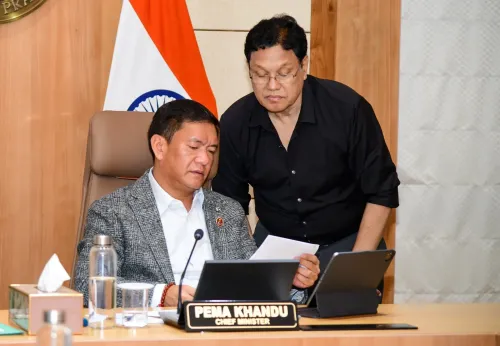
CM Pema Khandu: India's FTAs open global doors for Arunachal
Synopsis
Arunachal Pradesh CM Pema Khandu invoked India's expanding FTA network on August 7, 2026, arguing that bilateral trade deals under PM Modi are creating concrete export pathways for the frontier state's farmers, artisans, and small manufacturers.
Key Takeaways
CM Pema Khandu on August 7, 2026 linked India's FTA expansion directly to economic opportunity for Arunachal Pradesh's farmers, artisans, and MSMEs.
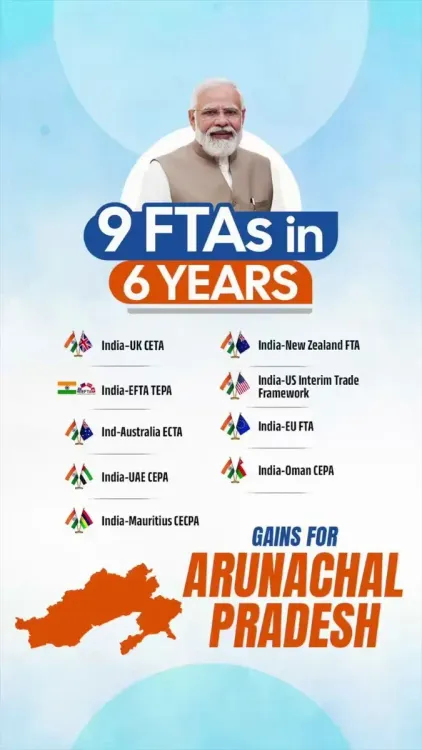
India has signed the India-UAE CEPA (February 2022) and the India-Australia ECTA (December 2022) , both expanding market access for Indian goods.
The Act East Policy , active since 2014 , has strategically positioned northeastern states as trade gateways to ASEAN and the Indo-Pacific.
Arunachal Pradesh's key exportable sectors include horticulture, handicrafts, and forest produce — products with strong niche international appeal.
Ongoing FTA negotiations with the United Kingdom and the European Union could open significant premium markets for the state's produce.
Realising FTA benefits on the ground will require closing logistics gaps and building export-ready processing capacity within the state.
India's northeastern frontier is no longer just a geographic edge — it is becoming a launchpad. Arunachal Pradesh Chief Minister Pema Khandu on Friday, August 7, 2026, declared that India's growing web of Free Trade Agreements is creating real, tangible opportunities for the state's farmers, artisans, and small businesses to reach global markets.
Khandu credited Prime Minister Narendra Modi directly, writing that under his leadership, 'India's expanding network of Free Trade Agreements is opening new doors to global markets for our farmers, artisans, MSMEs and manufacturers.' For Arunachal, he said, this translates to 'greater opportunities to take our products from the frontier to the world.'
From Act East to actual exports
The policy architecture behind this moment stretches back to 2014, when the Modi government launched the Act East Policy — a strategic pivot that repositioned India's northeastern states not as remote peripheries but as gateways to ASEAN and broader Indo-Pacific trade networks. Arunachal Pradesh, sharing borders with China, Bhutan, and Myanmar, sits at the heart of that vision.
India has since signed the India-UAE Comprehensive Economic Partnership Agreement (CEPA) in February 2022 and brought the India-Australia Economic Cooperation and Trade Agreement (ECTA) into force in December 2022. Both deals expanded market access for Indian goods — and in principle, for the agricultural produce, forest products, and handicrafts that define Arunachal's export potential.
What the frontier state actually produces
Arunachal Pradesh's economy rests on agriculture, horticulture, handicrafts, and forest produce — sectors that have historically struggled to find buyers beyond local and regional markets due to poor connectivity and thin value chains. The state's kiwi, ginger, large cardamom, and handwoven textiles carry strong niche appeal but have lacked the trade infrastructure to compete internationally.
Improved road and rail connectivity under central schemes, combined with FTA-driven tariff reductions in partner countries, could begin to change that calculus — provided logistics gaps are closed and export-ready processing capacity is built on the ground.
Ongoing negotiations and what to watch
India's trade negotiators are currently in advanced discussions with the United Kingdom and the European Union — two markets that would represent a significant step up in scale and sophistication for Indian exporters. A concluded UK FTA in particular could open premium consumer markets for high-value agricultural and artisanal goods of the kind Arunachal produces.
The real test will be in the export data: whether the state's MSMEs and farming communities can translate policy-level market access into actual shipments, contracts, and income gains.
The frontier is ready to move. Whether the supply chain can keep pace is the next question.
Frequently Asked Questions
What did Arunachal Pradesh CM Pema Khandu say about India's Free Trade Agreements?
CM Pema Khandu said that under PM Narendra Modi's leadership, India's expanding network of Free Trade Agreements is opening new global market opportunities for Arunachal Pradesh's farmers, artisans, MSMEs, and manufacturers.
Which Free Trade Agreements has India signed under PM Modi?
India signed the India-UAE Comprehensive Economic Partnership Agreement (CEPA) in February 2022 and the India-Australia Economic Cooperation and Trade Agreement (ECTA), which came into force in December 2022. Negotiations with the UK and EU are ongoing.
How does India's Act East Policy benefit Arunachal Pradesh?
The Act East Policy, launched in 2014, repositions India's northeastern states as gateways to ASEAN and Indo-Pacific trade networks. For Arunachal Pradesh, it means improved connectivity and a framework to integrate local produce and handicrafts into global value chains.
What products from Arunachal Pradesh could benefit from India's FTAs?
Arunachal Pradesh produces kiwi, ginger, large cardamom, handwoven textiles, and forest produce — niche, high-value goods that could find premium buyers in FTA partner countries if logistics and processing infrastructure are strengthened.
What is the next step for Arunachal Pradesh's global trade ambitions?
The immediate test is whether state MSMEs and farmers can convert FTA-driven tariff reductions into actual export volumes. Analysts will watch Arunachal's export data under existing agreements and the potential impact of a concluded India-UK FTA.