CM Pema Khandu Launches Arunachal Honey Policy 2026

Synopsis
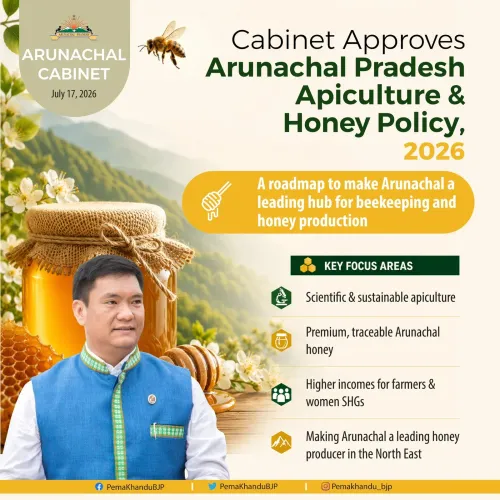
Arunachal Pradesh CM Pema Khandu unveiled the Apiculture & Honey Policy 2026 on November 11, aiming to harness the state's exceptional biodiversity to create sustainable beekeeping-based livelihoods for rural and tribal communities.
Key Takeaways
Arunachal Pradesh Chief Minister Pema Khandu announced the Apiculture & Honey Policy, 2026 on November 11, 2026 .
The policy aims to convert the state's rich biodiversity and diverse flowering-plant cover into organised honey production and rural income.
Primary beneficiaries are rural beekeepers and tribal farmers currently operating outside formal markets.
The state policy aligns with the National Beekeeping and Honey Mission launched by the Government of India in 2020 .
Detailed budget allocations, training modules, and central-state funding linkages are yet to be announced.
The announcement was part of Khandu's #10YearsOfSeva milestone communications marking a decade of his administration.
A land where flowering plants carpet valleys from sea level to alpine meadows is now betting on its bees. Arunachal Pradesh Chief Minister Pema Khandu announced the Apiculture & Honey Policy, 2026 on Wednesday, November 11, 2026, framing it as the state's formal move to convert its extraordinary biodiversity into bankable rural income.
What the policy signals for Arunachal's farming communities
Khandu described the initiative as 'an important step towards harnessing this potential and creating sustainable livelihood opportunities for our people.' The logic is straightforward: Arunachal Pradesh sits at one of the most species-rich intersections on earth — the Eastern Himalaya biodiversity hotspot — where diverse flowering plants bloom across altitudinal zones virtually year-round. That botanical richness makes the state a near-ideal habitat for apiculture, yet large-scale organised honey production has historically remained out of reach for most rural and tribal families.
The policy directly targets rural beekeepers and tribal farmers who currently operate in the informal economy with little access to training, quality inputs, or formal markets. A formalised state policy creates the institutional scaffolding — standards, support, market linkages — that subsistence beekeepers cannot build alone.
From national mission to state action: the policy chain
The move does not emerge in a vacuum. The Government of India launched the National Beekeeping and Honey Mission in 2020 under the Ministry of Agriculture to promote scientific beekeeping and push toward doubling farmers' income. Arunachal Pradesh's 2026 policy is a state-level answer to that central push — translating a national mandate into terrain-specific action across a state whose geography, culture, and climate demand bespoke solutions rather than generic templates.
Across the Northeast, this pattern has been building steadily. States in the region have increasingly anchored sector-specific economic policies in biodiversity — silk, bamboo, medicinal plants, and now honey — recognising that the region's ecological endowments are, themselves, an underused economic asset.
Khandu's decade in office — and what comes next
The announcement was tagged with the hashtags #10YearsOfSeva and #10YearsOfTeamArunachal, situating the honey policy within a broader narrative of a decade of governance Khandu's administration is now cataloguing. The apiculture push becomes one policy data point in that stocktaking exercise.
The critical test will come in the rollout. Exact budget allocations, training programme design, and any central-state funding tie-ups under the National Beekeeping and Honey Mission remain to be detailed — likely in forthcoming state budget sessions or dedicated policy documents. For the tribal farmers at the end of this policy chain, those specifics will matter far more than the announcement itself.
Arunachal has the flowers, the forest, and now the policy. Whether it also delivers the market is the question every beekeeper in the state will be watching.
Point of View
2026 is best read as Arunachal Pradesh's attempt to plug into an existing national value-chain push — the 2020 National Beekeeping and Honey Mission — with a state-specific framework suited to its unique ecological profile. For CM Pema Khandu, it also serves a political purpose: anchoring his decade in office to tangible, sector-specific economic deliverables rather than generic development rhetoric. The Northeast's broader pivot toward biodiversity-based livelihoods — silk, bamboo, medicinal herbs, and now honey — reflects a maturing recognition that the region's ecological capital is its strongest comparative advantage. The real measure of this policy's ambition will be its implementation architecture: without market linkages and training infrastructure, apiculture policies in similar states have historically stalled at the announcement stage.
NationPress
11 Nov 2026
Frequently Asked Questions
What is the Arunachal Pradesh Apiculture & Honey Policy 2026?
It is a state government policy announced by Chief Minister Pema Khandu on November 11, 2026, designed to develop organised beekeeping and honey production in Arunachal Pradesh, leveraging the state's biodiversity to create sustainable livelihoods for rural and tribal communities.
Who will benefit from Arunachal Pradesh's new honey policy?
The primary beneficiaries are rural beekeepers and tribal farmers in Arunachal Pradesh, who currently lack access to formal training, quality inputs, and organised markets for honey production.
Is Arunachal's honey policy linked to any central government scheme?
Yes. It aligns with the Government of India's National Beekeeping and Honey Mission launched in 2020 under the Ministry of Agriculture, which promotes scientific beekeeping and aims to boost farmers' incomes through the honey value chain.
Why is Arunachal Pradesh suited for apiculture?
Arunachal Pradesh lies within the Eastern Himalaya biodiversity hotspot and has diverse flowering plants across multiple altitudinal zones, providing near-ideal natural conditions for honeybees and high-quality honey production virtually year-round.
What are the next steps after the Apiculture & Honey Policy 2026 announcement?
Detailed budget allocations, training programme designs, and central-state funding tie-ups are expected to be outlined in upcoming state budget sessions or dedicated policy rollout documents.